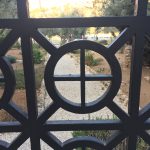
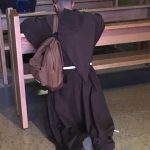
Where have you found God in the forests? Or the “forest” times of your life?

St. Andrew’s Episcopal Church

The Rev. Barbara Hutchinson

Seasons of Creation Year A: Forest

October 8, 2017

There are moments in our lives, sometimes fleeting or seemingly nearly beyond our grasp, when we catch a glimpse of something beyond the ordinary, when everything lines up and everything seems right. We may describe these moments as “being in the flow”, or of a sense of wholeness or peace that overcomes us, or experiencing a surge of newness, or a spark of creativity, or a place of deep and holy nourishment, or stumbling into a thin place. These come to us by grace, for we can never orchestrate them, but only enter into them when they are revealed to us. While in these states, we are experiencing what this Forest Season of Creation is all about – that living place where nourishment abounds, where both birth and death happen, where the life-force is strong, where there is a sense of being held as part of a greater whole.

Last week at our spiritual retreat at Holy Cross Monastery, I invited us to identify these moments of “forest creation” in our lives, for you see, each Season of Creation, in my understanding, aligns with a Season of Spirituality. This season of creation, the forest, echoes the Garden of Eden, that descriptive metaphor which speaks of a time when all of creation, including humankind, was in balance and in right relationship with the will of God. I took my journal, found a quiet spot, surrounded by the trees, and began my own spiritual reflection. It was not difficult for me to identify many “forest” moments of my life. In fact, that part flowed so easily that my mind naturally began to gather those moments into spiritual categories, such as moments of healing, giving or receiving hospitality, my soul being captured through the beauty of music, shared love, or handing you the bread, the Body of Christ, and knowing deep within, that I was handing the Body of Christ to the Body of Christ, an incredibly transcendent moment.

But then something interesting happened. I began to associate the word atonement, which we understand as having something to do with Jesus’ death on the cross and our salvation, with a feeling of alignment and wholeness, at-one-ment, at-one-with-God-ment, as Richard Rohr, a contemporary theologian, would explain. And I realized that some of my most painful moments were also at-one-with-God-moments. That gave me a lot to think about as I recalled a close friend of mine, who held her daughter as she died, feeling that completeness of being close to Danielle and to God, in a profound and life-giving way. In the worst possible moment of her life, there was something being offered to her by God that didn’t make everything okay, but somehow made everything holy. This is how creation and the cross fit together today. Because of Jesus’ death and resurrection, all that we might understand as separate or broken or lost or tragic, is that, but not only that. For Jesus’ resurrection means that everything that ends has a new beginning built into it. Because Jesus experienced the full joy and pain of humankind, God sanctified both, and our salvation is our journey. This is God’s invitation to a place of “forest” creation, that alive place that holds both birth and death, joy and pain, and where there is a mutuality of shared love, hospitality, and a surge toward newness. It is this paradox of Christian faith that allows us to place within our liturgy the Prayers of People we will read at the 10 a.m. service, which are full of lightness and happiness and celebration of the birds of the sky and the fish of the sea, with the Act of Remembrance after the violent act of the shooting in Las Vegas.

Our “forest” or creation experiences often do happen in the forests. One of my earliest childhood memories of sense the presence of God (although I didn’t talk about it that way then) was sitting in the tree in my backyard, for hours on end. I was a child who often sought solitude. The tree’s trunk had split, so there was a convenient, natural seat formed where the two trunks split from the main one, which seemed to be God’s invitation to sit awhile, be still and be aware of the presence of God. Maybe your “forest” experiences happen when you take walks in the woods, or as you drive Rt. 15 along the Susquehanna River and you see the brilliant yellow, gold, and red leaves shimmering against the river, and your breath is taken away. I think our forests can be a place for us to be inspired by God, to be invited by God deeper into God’s presence, to be healed by God as the wind through the branches seems to lift the heaviness in our hearts, all of which reconnects us to the metaphoric original state of wholeness, the Garden of Eden.

We can understand the relationship between our actual forests or our forest experiences elsewhere to our redemption through Jesus’ death and resurrection, because through them we are always invited back into the ongoing creative force of God, but our texts today draw us into a much broader context, where we can begin to see the relationship between our redemption and that of God’s created world.

In our text from Genesis we hear the account of creation which is chronologically after the one in which God created the world in seven days, but this one was written first. This was the original way the ancient Israelites reflected upon the world and imagined its beginning, told in a way that held their deepest values about the created world and our relationship with it. There are a few things that stand out in this passage: Humankind was made from the dust of the earth, out of which God created every other living thing. We are made from the same substance as the plants and the trees, and the animals who inhabit them. Humankind was not set above the rest of the created order, nor was humankind created in isolation from the rest of the created order, nor was earth a mere stage for human drama. Humankind was set in intimate relationship with its environment. The first “job” or vocation given to humankind was to care for God’s creation, even before humankind was instructed to “love God and love our neighbor”. Each time we work at restoring or caring for the earth, we are doing what God asks of us. Each time we pick up debris from the stream, each time we harvest the forests in sustainable ways, each time we raise organic crops, each time we attend to the amount of fertilizer we place upon our lawns, each time we plant native plants in our gardens, each time we find ways to bring back plant or animal diversity in our local area, we are doing what God asks of us, has asked of humankind from the beginning of time.

There are a lot of sad facts about our forests. There have been more forests cleared from 1850 to the present, nearly 170 years, than in all of previous history. Due to population growth and deforestation, the amount of forest cover available to each person has declined globally by 50% since 1960. One quarter of all the total animals will be lost in the next 40 years. I thought about this last year when they built that huge P&G Warehouse – where did all the animals who were living in those fields go? There are some very sad and scary facts about our changing earth, and they are important to us if we understand that God gave us the job to care for it.

And we can take inspiration from and hear an invitation to participate in the restoration of all of the created world, humankind and all else, all formed from the same matter, the dust of the earth, from our gospel today. It’s the familiar story of Nicodemus, a rabbi, who feels a draw toward Jesus, without understanding why. He senses truth within Jesus and begs to understand, and Jesus seems to speak in riddles. What does “born again” mean? In John’s gospel, this term does not refer to a “spiritual or individual” rebirth, but rather to a new way of living in the world here and now. This isn’t eternal life that Jesus is referring to, as we might interpret it, meaning immortality in heaven, but rather as experiencing God’s presence here and now—and then living into it. This is describing our atonement moments – our ‘at-one-with-God-moments’ which draw us back into the original creativity of God, our original vocation or job given to us by God of caring for the Earth, that life-force of God which continues to unfold in our lives and in the lives of all created beings. The job God gave us was to care for creation, so that means we need to work to be open to these at-one-ment moments, to move into the creative life-force of God, so that we can be active agents to support God’s plan of salvation, for us and for all creation.

There’s one story I’d like to tell you, that I believe puts this all together for us – the fact that we’re made of the same matter as the rest of our created world, the fact that our first job is to care for our world (the plants, the animals, the forests, and the sea), the fact that because of the cross, Jesus sanctified us and all creation to be active participants of God’s salvation plan for the world, which doesn’t just include us, and the fact that our redemption means that new life can always come from what we believe to be endings.

Last month, Bill and I travelled to the Adirondacks, where I had the honor marrying two amazing people, Daniel and Kristin, whom I knew from a different part of my life. That invitation alone was pure joy, joining in a celebration where God is making something brand new, something whole and complete, out of what is already wonderful. A week or so before the wedding, Daniel reached out to me and asked if I would do “double duty”. His cousin, aged 54, had died that past year, sadly carrying on the legacy of premature heart problems. Daniel asked if I would be there when they buried his ashes and say a prayer. Of course I would. That’s a true and deep honor to meet people in their moments of deepest need. I arrived at the set time in the morning, travelling down a dirt road to reach the final destination, a family cabin on the lake, which had witnessed love born again and again, lives changed and shared, hopes grown, life experienced in its fullness. I wore my clergy collar, a pair of black jeans, and a warm sweater as cool air drifted off the lake. I met the mother of the son who died, as she held in her hands a seedling of a tree. My heart melted. We hugged, we shared, we know we could get through this together. We walked to the front of the cabin, looking at the water, encompassed by the living world around us – the trees of all shapes and sizes. The mother was carrying what appeared to me to be a seedling to plant on top of the ashes we would bury. This was not true. The container was one which held the ashes of her deceased son, settled in the bottom, so the seedling’s roots could be settled around them and planted together. Ashes to ashes, dust to dust. Lots to think about. The whole family gathered to choose the right spot for the burial and the planting of this tree. They settled on a spot, which they had cleared so there would be enough light for the seedling to grow. When one of the men took the strong shovel, and pierced the earth, what appeared was a fibrous network of roots, strong and true, roots that were supporting the large giant trees nearby. All of the soil was rich compost, of an earthy color, not like the dark brown seemingly manufactured compost we buy at Lowes. It was full of life’s energy, yearning to create new life, full of priceless nourishment. The mother planted the seedling, tapped the soil around it so it would stay in place. Someone else had fashioned a cross out of splintered  wood found nearby, and placed it purposefully and with reverence near the seedling. We held hands, said the Lord’s Prayer, and felt renewed. I will never look at Ash Wednesday the same way again. Ashes to ashes, dust to dust has a new meaning to me, now having a visual to attach to what the redemption of us as people and the redemption of the created world looks like. God did not create us in isolation from the earth; God did not create the earth to be the stage for our drama. God created us to care for the earth and all its inhabitants. May we always grow in our understanding of how to do that, to live into those at-one-with-God moments, so that we may return to the ongoing life-force of creation within each one of us, which connects us to our Creator. Amen.


When it’s time to move beyond “Jesus loves me”. Sermon Proper 21 Year A

St. Andrew’s Episcopal Church

The Rev. Barbara Hutchinson

Proper 21 Year A

October 1, 2017

For all of my childhood and a good part of my adulthood, I thought being a Christian was pretty easy.

Our family went to church when it suited our schedule, so that was easy. Occasionally we baked a few brownies to be sold at a bake sale to earn money for a good cause, once again, easy and fun, with the added benefit of feeling good afterward for making a difference. It was easy to bring my little white UNICEF box along with my trick or treat bucket which I gladly handed it in at Sunday School, after delighting in shaking the box to hear all the coins I had collected. For confirmation preparation, we had to take notes on a few sermons and memorize the basic Christian statements, like the Apostles’ Creed, the 10 Commandments, and the Lord’s Prayer, but no one asked us what they meant to us, or what questions we might have, such as what happens to people when they die and how does that fit into what we’ve just memorized, so we evaded any complex thinking or wondering how to fit God into life or our life into God. I didn’t even know that was what we were supposed to do. I grew up in a time when it was the norm not to discuss politics or religion, so I can honestly say, sadly, I have no idea what my parents believed or didn’t believe about God, or what struggles they had, or hadn’t, with our church’s doctrines or how God fit into our family life. We prayed the same prayer before our dinner meal each night and that was about the extent of our prayer life. Although there would have been ample opportunity to connect the dots between our scripture and the social justice issues of the day, such as the Women’s Liberation or the Civil Rights movement, or participation in the Vietnam War, I never heard a word about these topics from the pulpit. I remember as a teenager being passionate against capital punishment, but the church never taught me how to think about it using our three-legged stool of scripture, tradition, and reason to evaluate a position, so all my thoughts or arguments about this and other current issues were in a vacuum from the teachings of Jesus, so it was pretty easy to compartmentalize my life: going to church on Sunday, and the rest.

I also grew up with the familiar song, “Jesus loves me, this I know, for the Bible tells me so” running through my mind and being imprinted on my heart, and so I thought being a Christian was really all about me, or more precisely, about Jesus loving me. When I was old enough to realize that there were some people that others thought Jesus didn’t love, due to race or ethnicity or social status, I wasn’t practiced in seeing the disconnect between what I said I believed and how others were treated in the world, so I never felt that call of action from Jesus to change the world. I just cared that Jesus loved me. That seemed to be the grand sum of my Christian formation. It’s not a bad place to start my Christian faith. But it’s not a great place to stay.

Then something happened. I woke up. I felt the tug of the Holy Spirit on my heart and recognized it as such. I became more involved at church. I had the great epiphany that Kristin, the woman with whom I taught Sunday School and with whom we had great fun at church, could actually become my friend “outside of church”. One of the priests introduced spiritual practices, such as contemplative prayer, spiritual direction, and retreats at Holy Cross Monastery, and something shifted inside. I began to know God, not just learn about God or about the church’s teaching about God, but I began a relationship, a give and take with that God. I sat with others as this priest taught us how to look at social justice issues, such as what constitutes a “just war” from a Christian point of view – not to tell us the answers or tell us how to vote, but how to think faithfully, how to take the teachings of Jesus and fit them around the issues, so I could wrestle with what God was calling me to do or care about. I so remember thinking, “Oh, now that I know God, and actually had fallen in love with God, my life would be easier.” Maybe it was a flashback to the Sunday School song running through my mind: Jesus loves me, and if I now love Jesus too, and if I now fit Jesus into my life (or my life into Jesus), then Jesus will love me even more, and if Jesus loves me even more, he’ll want me to be happy and have an easy life.

But the opposite happened. My life got more complex and complicated. Easy answers weren’t enough anymore. I couldn’t skip church, like I conveniently did before, for I missed seeing my friends, I missed being in worship, I missed absorbing the truth heard from the pulpit. My priorities shifted. I wanted to give more of my money away. My heart broke when I saw the long line of people lined up to receive a free breakfast each morning and I wondered what else we could be doing. If I hurt someone’s feeling, I couldn’t just brush it under the rug and forget about it, I felt compelled to apologize. This was not easy. This was more complicated and more difficult. I found it harder to go to the Country Club and listen to people fussing about getting their nails done or how difficult it was to find a “good cleaning woman”. Life had changed. It was hard and exhausting—and it was filled with the movement of the Holy Spirit, and I felt compelled to listen to her voice.

What happened to me was that I had learned how to repent. The more modern interpretation of this word is contrition for sin, but the original meaning of this word, and that to which I am referring, is to embark upon a way that goes beyond the mind that you have. The Greek word for this is metanoia and means a continual process of stretching your mind to look at your life and your world from a new perspective, not just a perspective of Christ, but one in which Christ is continually calling you to stretch and grow in your relationships with others and with God, and continually inviting you to look for and evaluate new expressions of the truth of God, rather that attesting to a static set of doctrines of creedal statements. This means constant change and this is hard and exhausting work. It is not a surprise that many Christians avoid getting to this place in their spiritual journey. It’s much easier to stay in the Sunday School faith where a few memorized statements are sufficient to guide your life and you rest in the knowledge that Jesus loves you, rather than in the truth that Jesus challenges you.

Jesus challenged the chief priests in our gospel today with this exact issue: stretching their minds beyond their known set of beliefs to see the newly revealed truth of God standing before them. Our story today is set within what we call Holy Week. Jesus arrived two days before, on the back of a donkey, with people shouting his praise. Jesus went directly to the Temple and turned over the money-changing tables, then cursed a fig tree on his way out, symbolizing the destruction of the Temple. He rides back into Jerusalem this morning, with the crowd on his side, and strides directly to the chief priests and scribes, who ask him with what authority he shakes things up in the temple. His response is a deliberate attempt to discredit the chief priests, not only because they were in collaboration with the Roman officials, but because they were blind to the new thing God was doing. Their response of “we don’t know” was awkward at best. Jesus raises up the tax collectors and said they will go into the Kingdom of God first because they were able to change their mind. Before Jesus, they didn’t believe God was for them; through Jesus, they knew God was for them, in a new and life-changing way. Their perspective changed because of their encounter with Jesus. The chief priests, who were to be the ones teaching and knowing about God, were blind to the new revelation, because Jesus didn’t fit into the box they had created around God, and chose not to see a new way. They didn’t repent, didn’t stretch their minds to the truth before them which had taken a new form. It made Jesus so angry that they refused to look beyond their own structure of orthodoxy or right belief to accommodate a new vision of God.

The basic premise Jesus is offering to us in this gospel is that the eternal truth of God continues to be revealed in ways which may seem surprising or confusing or difficult to make sense of, but that’s the challenging work we’re called into. It is so much easy to hold onto the single and simple belief that Jesus loves me and stop there, or throw in a few good works to feel good about, rather than to wrestle with the Spirit, the gift Jesus left with us, to continue Jesus’ work of transformation of the world, until all are brought into God’s realm of love.

While it is true that the love of God does not change, the face of God does. As you think of a prism, with light radiating from different facets as the sunlight moves or the ever so gentle breeze causes the prism to sway, so does the light of Christ, illuminating different truths from time to time. Our work is discerning the truth continuing to be revealed from the false ideas which may also come our way. I believe what Jesus is saying is that gospels should be instructive to us and the criteria for what is false cannot merely be whether or not it fits into our previously held beliefs. That’s what tripped the chief priests up and Jesus doesn’t want that to happen to his followers.

Sometimes it seems very easy to discern new truths revealed and we can easily stretch our minds around something new or different. These are situations in which we are invited into deeper love, compassion, honesty, and care for our neighbor. These are pretty easy to spot. Those invitations are always of God. Other times, in some of the messy social justice issues we face today as a nation, we can really struggle to know what is true and of God, when the answers or even the questions aren’t so clear-cut.

One suggestion I have for a way to look at difficult decisions and places of discernment would be to recognize that each time we are offered a choice, each time we are invited to see something in a new light or from a new perspective, each time we are willing to entertain an opposing point of view, each time we are able to imagine something brand new as being of God, we can ask ourselves if that something new is turning some deep and inner part of ourselves into something that is in harmony with God and God’s purposes in the world, or is it contrary to them. Each one of us at each moment is progressing one way or the other. Our work as Christians is always to move into a place that moves us and our world toward the purposes of God: love, mercy, peace, and reconciliation.

The final line in our gospel speaks of the tax collectors going first into the Kingdom of God, which means the chief priests can follow. They can follow the ones who changed their beliefs, by being open to change; they can follow the ones who felt the mercy of God upon their hearts through Jesus’ acceptance of them, by accepting others; they can follow the ones who looked for the new thing God was doing, by opening their spiritual eyes to the movement of the Holy Spirit.

There are times when I get exhausted from the constant pull of the Holy Spirit to shape and remake my heart and soul, so that I can be more aligned with the will of God. I imagine you do too. There are times when I wish I could escape for just a moment back into my Sunday school faith and believe it is as simple as believing Jesus loves me. I imagine you do too. There are times when I want my life to be simpler, when I wish I could compartmentalize my life into church on Sunday and the rest. I imagine you do too. But I know that’s not my life as a Christian. Rather it is to be deeply fed by times of silence before God and spiritual retreats, by receiving the prayers of our healing ministers, by finding a group of spiritual friends with whom I can wrestle with the issues of today set within our three-legged stool of scripture, tradition, and reason, so I can continue the hard work of discernment of God’s new revelation among us and faithful living in response to the movement of the Spirit.

We never do this work alone. We always do it with God and with others. That’s where God’s grace shows up. Thanks be to God! Amen.


Wallowing in the messiness!

St. Andrew’s Episcopal Church

The Rev. Barbara Hutchinson & James Williams

Proper 19 Year A

September 17, 2017

MOTHER BARBARA

When we come across challenging texts, sometimes classified as “texts of terror”, as we have today in both our Old Testament and Gospel reading, we have to decide how to approach them faithfully. It is tempting to embrace one of two less-than spiritually healthy responses – one, to ignore the tension or negative characterization of God and choose not to see or believe it, or, two, to focus on the harsh and judgmental portrayal of God and imagine that wrath to be thrust upon our enemies or those who disagree with us and believing that this is God’s will.

Dealing with challenging texts reminds me a bit of wading through a stream, kicking up the sediment at the bottom, the dirt and the debris and the broken glass, so that, for a brief moment, the water is muddied and filled with litter, and in the first situation, rather than looking at and into the messiness, we strategically look away for a split second, while the dirt and debris settle once again, so that when we return our gaze, the water appears sparkling clean, as light from above dances on it. We choose not to see the negative or dangerous parts of the river, or of God.

If we were to take that approach with today’s passages, we would glance away from God killing the Egyptians, and when that image settles at the bottom of our minds, we only see the freedom offered to the Israelites, and we get to stay with the image of the God we like better and are more comfortable with.

Or we would divert our attention away from God’s fury toward the servant who refuses to forgive another’s debt, even though he himself was just forgiven a debt of greater magnitude, and discard the notion of God’s sending him off to be tortured for the rest of his life. This is such a scary thought that what goes around comes around, and if we chose not to forgive, we will be not be forgiven by God, that we may want to block this thought completely from our mind, burying it deep below, so it can never resurface, and focus rather only on the exuberant mercy of God showered initially on the slave in debt to his master. This glancing away from the hard truths in our passages is one approach, perhaps a survival tactic to keep our image of a wholly loving and compassion God intact, but I fear it’s not a complete and faithful response. We need to look into the messiness.

Another way to avoid the messiness is to move with gusto into the hard parts and call upon the wrath of God to crash the sea upon our enemies, and forget that mercy part. For example, we may want to believe that God will smite our enemies, will right the wrongs done to us by punishing those who inflicted pain upon us, that God will destroy the peoples who oppress us, that God will show up with power and might to eradicate the people who we imagine are on the other side of the line we have created in our stance of judgment. And truth to be told, if I had had relatives living in Florida or Texas and the hurricanes were approaching, or if I lived at the edge of the encroaching forest fire in the Northwest, I would have prayed my heart out for God to use God’s holy power and might to push that hurricane out to sea or rain down upon the fire until was extinguished. There are times when we want a powerful and mighty God to act on our behalf, eradicating those who oppose us or that which threatens our safety.  But then we have situations like Charlottesville, and although there is one side of the confrontation whose beliefs I disagree with, I don’t imagine I could call upon God to destroy these people with an opposing point of view, asking God to cause them to be lying dead, as the Egyptians were along the shore, for that would go against the other part of God I know, the loving God, for somehow, I can’t forget that part of God too. Here we are in the messiness. If I want a God of power and might to always line up on the right side of my judgment and take decisive divine action to eradicate my enemies, then I have to imagine that I might be on the opposing side of someone else’s judgment, and then I would want God’s exuberant mercy to be upon me, so I must in turn, want God’s exuberant mercy to be upon them. We need to look into the messiness.

It is complex to know how to read faithfully these texts that tell us that YHWH brings both life and death and that our lack of mercy to one another rescinds God’s mercy toward us. Somehow, we need to hold those truths together with God’s power which is always about liberation and always with exuberant mercy, which are also shown in our stories.

I needed some help in making this real to you, in helping you figure out how to walk into the swirling waters, before the dirt and debris settles out of sight, so I’ve asked my friend James to help, for he has worked out how to hold the hard truths of God together with the desire of God for us to be made whole. So I turn the homily over to James now, who will draw us into the story of Moses and then share his own poignant truth.

JAMES –

In the Old Testament story today, the angel of the Lord was going before the Israelite army wherever it moved, and the pillar of cloud took its place right behind them too. God was protecting them, in the front and in the back. But then both armies, the Egyptians and the Israelites, were facing each other, head to head.

So the cloud was all alone by itself in the darkness yet the pillar of fire lit up the battlefield. It seemed to keep the armies apart because they didn’t come near one another all night long.

In the morning, Moses stretched out his hand and the sea divided, and after the Israelites came through the opening, Moses stretched out his hand again, and the sea came crashing back together again. All of Pharaoh’s horses, chariots, and chariot drivers were killed. Many people died because God was protecting the Israelites.

Maybe you think that God’s power is for good, but how then did this happen to the Egyptians? How was the killing of these people good?

Here’s what I am thinking.

God is about creating life, but when people do things that destroy other people’s lives, God works to destroy that desire in people, or in the case of the Egyptians, since their hearts would not change, God destroyed them.

I remember one time someone inadvertently hit me in the face with a basketball. Now, instead of asking if I was okay, he laughed at me. Oddly enough, that same thing, except worse, happened to him. So, I think that, when that basketball hit him, it probably took away the anger that had made him hit me, because God works to take away wrong desires in our hearts, sometimes by helping us experience what we caused someone else to experience. God didn’t necessarily hurt him, but God gave him a chance to see what it felt to be hurt.

Returning to the Old Testament story, the Lord saved Israel that fateful day from the Egyptians, and they saw their captors, the Egyptians lying dead on the shore. The people of Israel saw the amazing power of the Lord and believed in the Lord and in his servant Moses. They learned a lot that day.

MOTHER BARBARA-

They learned that God’s power is mighty, and God is always in control of what happens, and God’s strength is always used to free the oppressed, and that, when God is involved, it is always a birth to freedom. And they learned that they were worthy of God’s love, that God was entrusting this ragtag group of people who had been beaten down with building a nation which would carry YHWH’s name, and draw the whole world into relationship with each other and with God.

This is true for us too. These messy stories, with both the light and dark characteristics of God, told in hyperbolic fashion, are for us an invitation to grow in our faith, by allowing them to stir our imaginations from a spiritual numbness of an always-easy-to-like God, by allowing the chaos of the messiness to seep into our hearts, to allow God’s goodness and mercy to find those hard and vengeful parts within our souls and loosen the bonds on the goodness within.  The messy stories remind us of the chaos out of which God created order in our Genesis stories. They remind us that God is creating with us all the time. Growing in faith involves us imagining ourselves as capable of more than we believe ourselves to be, a better person than we’ve ever been before, a person strong enough to bear the costs of forgiving others, a person able to acknowledge our own faults and shed our protective self-image, not so God can find our most vulnerable spot and destroy us, but so that Jesus’ resurrection power can create something holy within us. This is the resurrection power of Jesus given to us in our baptism and nourished through the Eucharist—the vision that we are worthy of God’s love, entrusted with God’s mission, forgiven through God’s mercy, and infused with the power of new life. This power is neither contained nor owned by us, but passes through us into others. Our work is to open our eyes to this power in our lives. And here’s a good way to do that.

JAMES –

At my summer camp, we had a high school group counselor offer a devotional. He talked about when he went to a different country. His morning started like any other day – he left his home and went about his day. Then, everyone met at night. They were asked, “Where did you see God today?”. That question really stuck with me. It made me wonder how I would answer that question. Where did I see God today? The Israelites saw God that day when they were saved from what was hurting them. Sometimes we see God that way too. Sometimes we see God in the caring others show us, or that we show them. Sometimes we see God in our own hearts, when we see how we may have hurt someone else and we feel sorry. Sometimes we see God in all the good things that happen to us. I’ve thought a lot about this question. I see God in a lot of places throughout each day.

My question to you is, “Where did you, or where do you expect, to see God today?

MOTHER BARBARA –

God’s power can show up in powerful and mighty ways, as in the crash of the waves which separated the Israelites from their enemies, or in a quiet moment of revelation, as shared in James’ story of the boy’s heart who had done harm, only to have harm done to him. God needs just a sliver of spiritual space for God to make a change happen. It can be in a tiny whisper, uttered in a time of gentle intimacy, or in a clap of thunder, erupting during explosive conversations, in bright flash of lightning, when it seems that our pain is exposed for the world to see, or in the breathless vacuum set around a gently falling autumn leaf, as when people transition from life into death, for even there, we are held by God, and if held by God, then loved by God and showered with God’s mercy.

Look for God today in the places where you’re asked to forgive; when your heart is telling you to forgive; when you have even been asked for your forgiveness and you think it’s going to cost you too much; where you need to be forgiven; in places where you can set people free, or where we are in need of mercy or in giving mercy.

Look for places where God shows up in your life, create sacred spaces for God to enter and grow us in our faith. Imagine a person, a way of life in which we are more capable, more faithful, and more dedicated than we could ever have believed. That’s the resurrection power within you that takes the chaos of the messiness of our sacred stories and of our own humble lives and creates for good. Amen.
 

Praying with the Celtic Psalter: Does prayer fit into your day, or does your day fit into your prayer?

As part of our exploration of Celtic Spirituality, Mother Barbara has invited all of us to pray daily (morning and evening) with the book, Sounds of the Eternal: A Celtic Psalter by John Phillip Newell. Here’s a reflection by Jeanine Goodwin on her experience in preparation for our group conversation.

Wanting to get an idea of what this next flight of formation would bring, about two weeks ago I engaged in the prayers in John Phillip Newell’s psalter, Sounds of the Eternal. Soon I found myself sitting with the prayers for a few moments because things were shimmering up off the page, and soon was doing a lectio divina of sorts, reflecting on a phrase to let it lead.

One of the prayers speaks of “rekindling”, “sparks”, and “part of the blazing splendor”. It happened kind of miraculously, on the same day we heard a sermon about God calling to Moses out of a burning bush. That alone got my attention, and the thing that caught me up was that for a moment I was feeling like Moses might have, intimidated by such a big intense heat and brightness, such a clarity of call.
I found myself reaching for my current notebook, to try to capture viscerality of the insight before it slid down back into the depths of unconsciousness and have kept it at hand ever since.
From this morning what prompted a rise of the heart was, “You lift up my soul, O God, and make the eyes sparkle. You give health and life and blessing.” I realized that in the doing, partaking of as one does a sacrament, the daily practice of prayer using Newell’s psalter, I’ve noticed what happens when not doing it, almost more than what happens when I do. Keeping the notebook at hand, I can look back and see what rose up out of the text on a given day. Some days there are two entries, one in the morning, one in the evening. More often than not there’s only one. I notice when not doing it, there’s the opportunity to see what’s taking it’s place instead. I recalled the lives of the brothers at Holy Cross Monastery and saw that this practice of prayer, contemplation, is what shapes their days.
So then it rolled out thus: It’s not how my religion and spiritual practice fit into my day, but how my day fits into my practice.  The practice has started shaping the day, shapes me in my day, becomes the foundation from which my movements, and responses arise.
I’m staying tuned.
Grace. Peace.
Jeanine

Youth Mini-Mission Event: Exploring the beauty of God’s creation

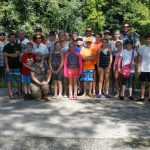
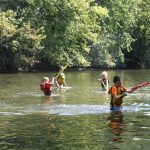
Today, in the glory of the sunshine and the beauty of God’s creation, 23 of us gathered together to spend the day enjoying each other’s company, learning something about God, and taking time to relax, breathe, put away our cell phones, and connect to something deeper within each one of us, and among us — a sense of family. We were expertly led by three guides: Joe, Jeremy, Kristin who not only instructed us on how to canoe, but also helped make the trip memorable, inviting our young people to refresh in the cool crisp water of the Conococheague, alerting us to the blue heron who seemed intent upon guiding us down the Creek, delighting with us at the large carp swimming among us, and bringing us to the perfect place to nourish our bodies and souls, when we needed a lunch break. It was a day of peace, calm, fun, and care for each other and God’s creation.

Group photo of people spending a day enjoying God’s creation.
Oh, the joy of having fun together in the water!

We ended the day reflecting upon the “best” of the day for each one of us. Answers varied from the wildlife we saw (such as a bald eagle, which was incredible!), to the varied nature of God’s creation, to the community easily formed, to the weather, to our safety, to our guides, to our sense of calm we found was finally ours to settle into.

Several of the comments offered made my heart smile– the sentiment offered was that even if they can’t get to church each Sunday, they are still welcomed, embraced, and engaged with as a part of our parish family on events like this. This is exactly the church I want us to be and live into. We say, in our mission statement, that we are an inclusive and welcoming community. This is one way we live it out: that we are not a closed club. We are not a group of people who demand a certain level of involvement or commitment to be “counted among us”. We always swing wide the door, always inviting people further into the mysterious place with God and within our parish family — and we also acknowledge and love people wherever they find themselves. Today we lived into this space. Thanks be to God!

These Youth Mini-Mission Events are designed to help us understand our relationship with our earth, and therefore, with God, the creator of the earth, and there were those among us who worked tirelessly today to help repair that relationship. One of our young people, Tom, was relentless in retrieving tires that others had foolishly and irreverently thrown into the creek. He quietly and purposefully went about his business of doing what was right, ridding the creek of pollution, finding a way to bring the tires out and then to dispose of them appropriately. It was very inspiring to see someone take this initiative to make a difference.

With care,

Mother Barbara

Approaching the Gospels Together

This morning a group of us gathered with an ease of being together, with a shared sense of wanting to learn from each other, and with a desire to look closely at our scriptures. We read the text of Jesus’ baptism in the three synoptic gospels (seeing with one view or eye): Mark, Matthew, and Luke. We begin by reading the text in Mark (the first of the synoptic gospels written) and then read the same story from Matthew and notice the similarities and differences. Then we read the version in Luke and do the same. It’s amazing the differences!

Then we begin asking ourselves these questions (focusing on the text to give us the answers):

  • What does it tell us about Jesus that he came to John the Baptist to be baptized?
  • What if anything does it tell us about Jesus’ relation to tradition?
  • Who heard the event?
  • Who saw the event?

All this examination helps us discern the differences in the gospels and helps us wonder why the same story is written in many different ways.

We had a great time discussing the following question:

  • How would you describe this experience like for Jesus: inner, outer, or what?

Then it was time for personal sharing in response to this question:

  • Is this an experience similar to one in your life? If so, what kind or kinds?

There was rich sharing of times of baptism, confirmation, reception into the Episcopal Church and ordination. It seemed that common elements were: humility, consent, affirmation, and a call to do something (or be something) different.

I looked around at the room while in the midst of this sharing, filled with joy, realizing this was another of my “dream come true” moments, which I so often have here at St. Andrew’s.

To read the scripture and view the questions we discussed today, please click here. Approaching the Gospels Section 18


The beauty of our church.

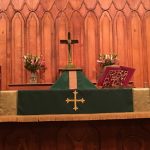
We are blessed by many people who faithfully and often quietly work behind the scenes to beautify our church. Today I am especially grateful for our flower guild. Each week, our altars are adorned with lovely flower arrangements, created with care and with artistic talent. It’s a gift that is freely shared with us and for which we are grateful.

This morning the flowers were exceptionally lovely. On this rather cloudy morning with intermittent snow showers, it was such a joy to come in and see these beautiful flowers, inviting us further into the beauty and glory of God.

It is true that the church space can shape or reflect what we believe about God. I think our church speaks loudly that we are drawn together in community through beauty, warmth, and the light of Christ which is always shining through the altar window. Thanks be to God!

Contemplative Practices: Mary Oliver Poetry

In the dimming light of the evening, draw together by the flame of an oil lamp, we gathered in a circle and read Mary Oliver’s poetry, in a contemplative way, pausing after each reading, allowing time for the words to settle into our souls.

We found her poetry to be beautiful, shocking, challenging, descriptive of the journey of the soul, and the images of nature to be stunning.

We all left a bit calmer, a bit more tuned into the beauty of our world, and a bit more engaged in the spiritual journey of our souls and community.


The Work of the People: The Ridiculous Journey of Following Jesus

A number of us gathered on Wednesday evening for a time of sharing a meal, hearing new ideas, and sharing our thoughts in a safe and caring space. We began our 6-week program on following Jesus through the use of videos by a number of theologians.

We began our study by reading scripture connected with the evening’s topic, since we as Episcopalians are people rooted in scripture. We listened to and engaged with the story of the Good Samaritan.

We then continued our study by listening to Father Greg Boyle who states that following Jesus means standing outside your circle or comfort zone and standing silently until the people you are standing with find their own voice. It sounds so simple, yet is a very complex command. We discussed the steps to get there: identifying where we draw the lines, crossing over the line into a place previously unknown to you, standing there, being present to, and being silent, until your steady presence helps the others to find their own voice. We talked about the trinitarian theology inherent in this process (God, the One who puts the desire in our hearts, Jesus, the One who offers and finds the place of healing and reconciliation, and The Holy Spirit, the One who makes the relationship alive and changes all involved).  We spoke how it can be easier and important, yet not the same thing to cross over the line, learn about the people who live in that space, walk back over to your comfort zone and advocate for them. The call is to be present to, be attentive to, and stand silently with others.

We ended our time with Thomas Merton’s prayer,

MY LORD GOD, I have no idea where I am going. I do not see the road ahead of me. I cannot know for certain where it will end. Nor do I really know myself, and the fact that I think I am following your will does not mean that I am actually doing so. But I believe that the desire to please you does in fact please you. And I hope I have that desire in all that I am doing. I hope that I will never do anything apart from that desire. And I know that if I do this you will lead me by the right road, though I may know nothing about it. Therefore, I will trust you always though I may seem to be lost and in the shadow of death. I will not fear, for you are ever with me, and you will never leave me to face my perils alone.                                        —Thomas Merton


I think we left with much to ponder. Following Jesus has so many dimensions to it which stretch our souls and minds.

Advent & Getting Ready for Christmas Party

Today we began the season of Advent, which bears the invitation to prepare our hearts and souls for the coming of the Christ child in our midst. It is a season of waiting, watching, and anticipating the fullness of life offered to us each moment through the life, ministry, death, and resurrection of Jesus.

img_1863-2

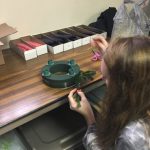
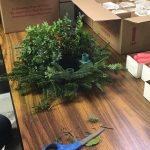
We had a great time this morning preparing for Christmas. We gathered to make Advent wreaths from fresh greens from our yard, preparing to pray our way through this season, lighting a new candle each week, until we reach the center white candle, which we will light on Christmas morning. This is a meaningful spiritual practice that can deepen our sense of anticipation and movement toward Christmas.

Beginning the creative process
Making Advent Wreath

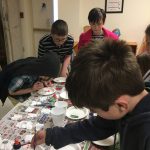
Our children also had fun making ornaments for our tree. We love the idea that each year they can return to see it hanging on our tree, knowing that they are an important part of our parish and community life.

Decorating Ornaments for our tree

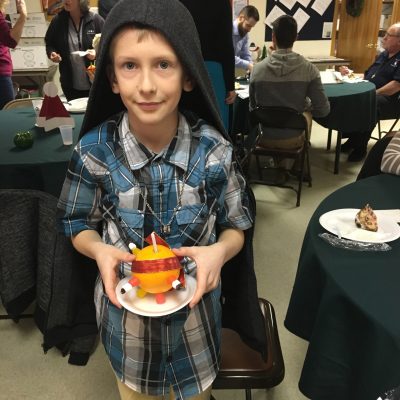
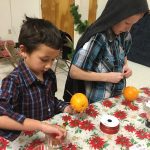
They also made Christingles, a symbolizing the light of Christ coming into our life.


img_1865

Special Candle
Special Candle

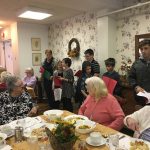
As always, one of the highlights was our Christmas caroling at The Episcopal Home. We loved it that the residents joined in with us and you could feel the warmth and joy spread through the room.

Caroling at The Episcopal Home

It was a time to be together, share joy, and open our hearts to being with each other as we wait for the Christ child.

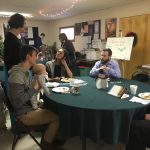
Good conversations
Good conversations
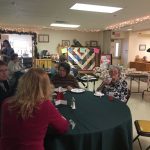
Enjoying a potluck
Enjoying a potluck

Thank you all who made this a wonderful event!


The essential paradox: Christ the King on the cross

This Sunday we celebrate the Feast Day of Christ the King. We end this liturgical year hearing the story of Jesus’ crucifixion. This has got to be the greatest paradox in all of our Christian faith and narrative. Have you ever wondered how the words “crucifixion of Jesus” are connected to “Christ the King”? What about this association could possibly make sense? In the gospel of Luke, a simple statement announces this dramatic act: Jesus is crucified, set between two criminals, one who joins in the taunting and mocking, and the other who recognizes the reality of Jesus and asks to be remembered in paradise.

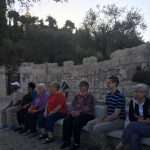
During my trip to the Holy Land, one of the most meaningful experiences I encountered was at the Garden of Gethsemane. It was the moment when I comprehended the role and truth of Jesus’ suffering — the suffering we are all invited into. Jesus suffered so that he would know and sanctify our very humanly existence which includes suffering, but most of all Jesus’ suffering was essential because the world was not yet ready to claim him as the Lord of lords, the King of kings; not ready yet to allow him to be sovereign over their lives, to move toward hope and promise, rather than despair.  Jesus only wanted our world to be changed by God’s abundant love, but people rejected it. They couldn’t see it; they couldn’t move toward or into it. Sadly, we can see remnants of that kind of disbelieving in our world today. But we can make a different choice (preview of my sermon on Sunday). We can indeed live our lives as if Jesus were our King. We can lay down our cloaks, hailing Jesus with the words, “Hosanna in the highest!” We pray it each Sunday: “for thine is the Kingdom, power and glory, now and forever.” Let us imagine together what it means for Jesus’ kingdom to be for us now, in our lives. This is what he whispered to the criminal to his side in his statement, “Truly I tell you, today you will be with me in Paradise.”

Here are some of my favorite photos from our time in Gethsemane. I hope they speak to you, as they did to me.

garden-of-gethsemane-worship
Our prayer service as we entered this space.
garden-of-gethsemane-olive-trees-and-sky
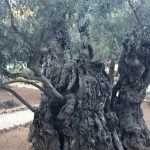
The olive trees, mighty and strong, bringing forth new growth out of a deadness within.
garden-of-gethsemane-old-olive-tree
An aged tree, surviving because of it’s ability to keep finding new life.
garden-of-gethsemane-garden-prayer
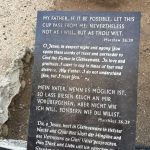
A meaningful prayer
garden-of-gethsemane-garden-peace
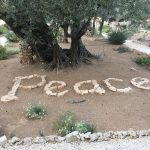
The Prince of Peace.
garden-of-gethsemane-cross
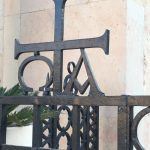
The alpha and the omega. The beginning and the end — and everything in between.
garden-of-gethsemane-cross-2
One of the many expressions of the cross of Christ in Jerusalem.
garden-of-gethsemane-church-fresco
The beauty of the frescos depicting the agony of Christ.
garden-of-gethsemane-church-franciscan-monk
People in prayer, especially the Franciscans who claimed these sites as holy.
garden-of-gethsemane-church-ceiling
The amazing ceiling of the church . Made me think that “the heavens adore thee!”
garden-of-gethsemane-church-door2
The truth of the Olive branch – the branch of righteousness.


Christ is King. Alleluia. Alleluia!

Coming together as the Body of Christ: A Pastoral Letter

Dear Friends,

This week, we as a nation participated in the election of our next president; the campaign was often polarizing, contained hateful language and hurtful rhetoric, and raised legitimate issues. Many of us are bewildered as to how we have arrived at this place of major division among good and faithful people; some are confused at other people’s reaction to the results; some are elated at the results, others are distraught and afraid. Wherever you find yourself, please know that on Sunday morning, we will come together as the Body of Christ, united by a love which is more powerful than any division humankind can construct, united by a love centered in the healing balm of Jesus, united by a love which calls us to see the face of Christ in each other, and united by a love which is about moving forward in reconciliation.

Here are some assurances I offer you:
1) I am your pastor. Wherever you fall on the political spectrum, whatever your reaction to the result of the election might be, I am your pastor. I am called, and I believe that it is my responsibility, privilege and joy, to meet you wherever you are, in any situation, with love. This, I promise you, will always be true.

2) I am your priest. I believe and affirm that the Lord’s table is broad and wide, and that all are invited. Especially in the Episcopal Church, we believe that our diversity is our strength, as we live into our baptismal covenant and respect the dignity of all people.  I believe that by God’s might we will be nourished for the work ahead, helping us to build and live into the policies and future state of the nation, which will bring God’s kingdom ever nearer.
3) I am your teacher. I will continue to preach the gospel, the good news of Christ, which, at times, will be challenging to some and comforting to others. I am also here to sit with you, listen to you, explore your questions, and offer resources to help you look at the social justice issues raised in this election and explore how the heart of the gospel informs our decisions. I look forward to the time when we as a people can find ways to come together to have conversations on these issues, to make positive changes in our community which protect the rights of all and draw the marginalized into the center of God’s care, by our actions.When Mother Betsy and I were walking the streets in the Old City in Jerusalem last week, I said to someone, who was kind enough to offer us directions, “I love your city!”. He replied, “Oh, it’s not my city. It’s everyone’s city. When we can figure out how to live in peace here, the whole world will be at peace.” I feel that same way about our parish. We are poised to be an example to others, to be a community that finds a sense of peace among people who care for each other, who respect one another, who want to learn from one another, who can hold different opinions and still all kneel at the rail and praise the God who loves us all.

Forgiveness, patience, perseverance, generosity of spirit, dedication and commitment to something bigger than ourselves will be required of each of us as we move forward as a parish community and as a nation. I trust God will pour God’s grace upon us so we can do this hard and holy work.

In Christ’s love,
Mother Barbara+