Join us for worship on this glorious day of celebration of Jesus’ resurrection!
To engage with our recorded worship service, please click below.
To download a bulletin so you can sing or pray along, please click below.
Join us for worship on this glorious day of celebration of Jesus’ resurrection!
To engage with our recorded worship service, please click below.
To download a bulletin so you can sing or pray along, please click below.
Join our prayerful community as we worship together via a recorded service. Through marvelous music, holy scripture, reflection, and the service of Holy Eucharist, we will engage with one another and with the holy. You may receive either Spiritual Communion, or Communion under Special Circumstance, in you have consecrated wafers at home. You may always pick up consecrated wafers from our sacristy.
To engage with the recorded service, please click below.
To download a bulletin for the service, please click below.
To engage with Mother Barbara’s homily, please click below.
We are grateful for your presence with us. Many blessings to you,
St. Andrew’s Episcopal Church
The Rev. Barbara Hutchinson
Seasons of Creation #2: Land
October 15, 2017
If we as an American nation were to create a written, non-partisan snapshot of the life of our country today and hand it to someone who, let’s imagine, doesn’t know our history, or if we were to place this honest account of who we are today into a time capsule, to be opened hundreds of years in the future, and ask that reader to create our backstory, the influences, the choices, the consequences that brought us to where we are today – that would be similar to the process of how the story of the Garden of Eden was written. The stories of the creation and the expulsion of Adam and Eve from the Garden of Eden, which we have labelled in recent history as “the fall”, can be seen as an ancient warning tale. This story was produced by Israelite sages, working with and editing older ancient and Near Eastern sources, most likely during the exilic period, which means the time the Israelites were held in captivity by the Assyrians in the city of Babylon. In the aftermath of their failed monarchy, they were attempting to understand their historic experiences of royal exploitation, civil war, erosion of the wilderness traditions, and their eventual conquest and dispossession. They had entered into a stage of fruitful self-reflection on the origin of human oppression and violence that had brought their people – and all other tribal people—nearly to extinction. Something had gone fundamentally wrong with the human journey, of which Israel’s national trauma was but a symptom.
The Israelites, no longer a united nation, found themselves separated from their homeland, exiled from what they perceived to have been their perfect state, a living situation within and around the temple of Jerusalem, so they needed to talk about why that exile had happened. They sensed a separation from God, since they experienced the fullness of God’s presence in the temple, which was now 900 miles from them, and they needed to reflect upon what went wrong with their relationship with God. Was God angry at them? Was it something they did to bring God’s wrath upon them? Or was this exile somehow due to their forgetting their tribal ways, of failing to continue to live in concert and partnership with the land, by building a civilization which brought people away from the land, which upset the natural balance between humankind and the creation? They wanted to create a backstory that would explain their sense of disconnection from their homeland and from God, that would explain the systems of domination rampant in their world, and to explain the killing on both sides.
Jonah, who is referred to in our gospel, faces a similar situation in Ninevah, which is also a city of the Assyrians, which was to Jonah a symbol of overwhelming and ruthless imperial power, a people who took pride in their power and their reputation of their capital city being known as a “city of blood.”
The story of the Garden of Eden is the attempt by the Israelites to explain what influences, decisions, and consequences brought them to the current state of exile, with the intention of understanding what change was required of them to live again in right relationship with each other, with God, and with all of creation.
Eve picked the apple from the tree of knowledge of good and evil. We have often been taught to interpret this act as disobedience to God, for God had forbidden Adam to eat this fruit, and although, according to the story line, Eve was not yet created when this edict was given, we assume Eve somehow knew this intuitively or that Adam had shared this with her. The fact remains that Eve chose to have knowledge, to have her eyes opened to an increased sense of awareness of the world around her. She chose to move out of the safe and idyllic container made for her by God, where there was no work, but also no challenge, no real engagement, no real purpose, where life would have been fine, pleasant, but perhaps a little boring. Instead she decided to “go for the ring on the carousel”, to live into the gusto of what life could be, to encounter the good and the bad, the joy and the pain, the place of birth and death, the place of right and wrong decisions, all whose consequences carry forward.
This life she chose sounds a lot like the life Jesus challenges us to live. Can you hear his voice saying to you, “Stay awake! Be alert! Be ready for the Kingdom of God, which is near, around and within you. Fully engage the world and bring my kingdom about. It is not going to be easy, but it will be good.” Although Jesus reminds us of the need for solitude, Jesus rarely implies we should be passive about life, but rather implores us to fully engage in it. We know from our own experiences that when we do, when our eyes are opened, this new awareness brings us into a new state of vulnerability, (that’s the hard part that comes with opening our eyes to the knowledge of good and evil) which Adam and Eve understood in our creation story, and brings us also the opportunity to accept responsibilities for our mistakes along the way and change.
Richard Rohr, a contemporary theologian, speaks of this “alive” place that Eve found herself in upon eating of the tree of the knowledge of good and evil, and which we too can find ourselves in, as being alive in the movement of the Spirit. He says, “When the Spirit is alive in people, they wake up from their mechanical thinking and enter the realm of co-creative power. As in Ezekiel’s vision, the water flows from ankles to knees to waist to neck as the New Earth is hydrated. Like Pinocchio, we move from wooden to real.”
Because of the choice that Eve made, and the choices that Israel made, life had perhaps become fuller, but also definitely harder. For the knowledge to see good and evil meant constantly struggling with people who would have different points of view regarding what constituted each polarity. There would be division amongst the people, which would lead to some wanting to influence or control others to their point of view. One can imagine Israel, with their codification of God’s laws into the 10 Commandments, as a way to set in stone this delineation of what is good, so their children’s children will learn, and ultimately their world can be restored to the place of original contentment and containment by God or of God.
Jonah too attempted to codify or put into a container the people worthy of God’s mercy, love, and compassion, deciding for himself that the Ninevites would not be in that box. He didn’t want God to save these most unlikely people, for they were evil, by all accounts of the world’s standards. Jonah, like so many of us, didn’t have the self-reflective stance of the Israelites when writing their backstory, to include the possibility that he too may have erred, he too may be in need of God’s love, mercy, and compassion, and if it’s there for him, it’s there for everyone.
Exile features heavily in our stories today, whether it is within Jonah, the interior exile he lived in without acknowledging his own need for God’s mercy, love, and compassion, or with the people of the nation of Israel who wrote the story of the Garden of Eden. We have Adam and Eve exiled from the Garden, Jonah exiled into a foreign land, Jesus predicting his exile into the darkness of the tomb, separated from human life. These places can feel dark and lonely and we can be aware of our separation from that which gives us life.
Today we celebrate our second Season of Creation, the Land. Although we can think of the abundance of the land, we can also be reminded of our exile from the right relationship with the Land, which can be traced to the time when we began to take more from the land than we needed or was right to take.
Wendell Barry is quoted as saying, “we all live by robbing nature, but our standing of living demands that the robbery shall continue”. Our excessiveness of need has shifted that relationship God set up for us from caretaker of Creation to owner or exploiter, when we began to ask our earth to over-produce crops which would be shipped to the other side of the world for a self-generated appetite for food not locally produced, when we strip the animals of their natural habitat when we deplete the rainforests, when we extract and deplete the fossil fuels, when factory farming releases vast and dangerous quantities of carbon dioxide and methane into our atmosphere, when our intensive agriculture produces fragmented and inhospitable environments for wild animal and plant species, we realize something has gone terribly wrong.
Just like the Israelites, we realize we are in a place of exile from what is right. When we enter into the awareness of this alienation, when we speak with facts around the change in our climate, we can be propelled into the next season of creation, our next season of spirituality: wilderness. Although that sounds like something to avoid, it’s actually a time when we acknowledge our yearning to restore our world to wholeness, when we engage in gathering facts and resources to know how to make a better and more equitable balance between the needs of humankind and the needs of the created world. When trying to move a global community into a place of knowledge of the good and evil we have done, or may continue to do, into a global community which yearns for the good, we can understand why people are so divided about the reality and the need for change. Change happens at different rates for each of us. It’s a big job to get us all into exile and beyond. However, Adam and Eve were two people who each ate the apple, each gained the knowledge of good and evil. Maybe there’s hope embedded in that story that tells us that there will be a time when all people will be on the same page about righting our relationship with God’s creation.
This place of exile can be uncomfortable, which could be why Al Gore named his report on global warming as “An Inconvenient Truth”. We often want to avoid going into this place, yet I believe it is God’s mercy, love, and compassion that opens our eyes, that propels us into exile, into this place of noticing, and sitting in the darkness of self-reflective behavior for a bit, not just blaming others, as Jonah did, but like the Israelites, of feeling the alienation between what we are doing and the job God gave us to do, care for the earth and for all the living creatures set under our care.
As we find ourselves in exile, as a people of God, or in our individual souls, we are invited to look at what container we have placed ourselves in and ask ourselves the questions: “Do we stay there because although it’s a bit dark, and we see only dimly, that it feels safe or comfortable or without challenge?” For often in our containers, the light is low, and we may not be able to see the false parts we have become, the inaccurate assumptions of others we carry forward, the wrongs to others and to our land we have done, and we chose to settle for this life, not fully lived. It’s not a bad way to live; it’s easier, in fact; but when I’ve lived in that place, I’ve always known there’s something richer within it or beyond it, that will take work to get to.
Because Jesus stayed in the tomb, contained with the earth, with the massive round stone rolled across its entrance, Jesus sanctified, made holy, saturated with the presence of God, the darkened container he was put in, and therefore sanctified all the darkened containers we put ourselves into. But the point of the story of Jesus is that he didn’t stay there. And his resurrection invites and implores us not to stay there either.
God’s mercy, love, and compassion draw us into these places of alienation and disconnect. We resist going there often, sometimes by saying, “We’ve always done it that way” as a reason not to move into that place of uncertainty, where the old begins to fade away before we can see the new. Or sometimes we resist the draw into exile because it’s easier to fortify the sides of our containers with bolstered arguments or fiery threats.
But the pattern of faithful living, that paschal mystery we often speak of, moves us into a place of exile, of self-reflection, of noticing the places of disconnect between what God has asked of us and what we are doing, to the land, or in our lives, or in our relationship with God, for they are all connected, of acknowledging what we have done or left undone that has caused harm. But then the Spirit turns us again toward God, when God’s mercy, love, and compassion can strip from us all that we have falsely created, to return us to what God has created within and around us.
If we listen closely enough, in these times of exile, which our own lives may be in now, or our country may be in right now, we can hear God’s voice saying, “Come and see, I am bringing you to a new way of experiencing me. Come and see.”
Amen.
St. Andrew’s Episcopal Church
The Rev. Barbara Hutchinson
Seasons of Creation Year A: Forest
October 8, 2017
There are moments in our lives, sometimes fleeting or seemingly nearly beyond our grasp, when we catch a glimpse of something beyond the ordinary, when everything lines up and everything seems right. We may describe these moments as “being in the flow”, or of a sense of wholeness or peace that overcomes us, or experiencing a surge of newness, or a spark of creativity, or a place of deep and holy nourishment, or stumbling into a thin place. These come to us by grace, for we can never orchestrate them, but only enter into them when they are revealed to us. While in these states, we are experiencing what this Forest Season of Creation is all about – that living place where nourishment abounds, where both birth and death happen, where the life-force is strong, where there is a sense of being held as part of a greater whole.
Last week at our spiritual retreat at Holy Cross Monastery, I invited us to identify these moments of “forest creation” in our lives, for you see, each Season of Creation, in my understanding, aligns with a Season of Spirituality. This season of creation, the forest, echoes the Garden of Eden, that descriptive metaphor which speaks of a time when all of creation, including humankind, was in balance and in right relationship with the will of God. I took my journal, found a quiet spot, surrounded by the trees, and began my own spiritual reflection. It was not difficult for me to identify many “forest” moments of my life. In fact, that part flowed so easily that my mind naturally began to gather those moments into spiritual categories, such as moments of healing, giving or receiving hospitality, my soul being captured through the beauty of music, shared love, or handing you the bread, the Body of Christ, and knowing deep within, that I was handing the Body of Christ to the Body of Christ, an incredibly transcendent moment.
But then something interesting happened. I began to associate the word atonement, which we understand as having something to do with Jesus’ death on the cross and our salvation, with a feeling of alignment and wholeness, at-one-ment, at-one-with-God-ment, as Richard Rohr, a contemporary theologian, would explain. And I realized that some of my most painful moments were also at-one-with-God-moments. That gave me a lot to think about as I recalled a close friend of mine, who held her daughter as she died, feeling that completeness of being close to Danielle and to God, in a profound and life-giving way. In the worst possible moment of her life, there was something being offered to her by God that didn’t make everything okay, but somehow made everything holy. This is how creation and the cross fit together today. Because of Jesus’ death and resurrection, all that we might understand as separate or broken or lost or tragic, is that, but not only that. For Jesus’ resurrection means that everything that ends has a new beginning built into it. Because Jesus experienced the full joy and pain of humankind, God sanctified both, and our salvation is our journey. This is God’s invitation to a place of “forest” creation, that alive place that holds both birth and death, joy and pain, and where there is a mutuality of shared love, hospitality, and a surge toward newness. It is this paradox of Christian faith that allows us to place within our liturgy the Prayers of People we will read at the 10 a.m. service, which are full of lightness and happiness and celebration of the birds of the sky and the fish of the sea, with the Act of Remembrance after the violent act of the shooting in Las Vegas.
Our “forest” or creation experiences often do happen in the forests. One of my earliest childhood memories of sense the presence of God (although I didn’t talk about it that way then) was sitting in the tree in my backyard, for hours on end. I was a child who often sought solitude. The tree’s trunk had split, so there was a convenient, natural seat formed where the two trunks split from the main one, which seemed to be God’s invitation to sit awhile, be still and be aware of the presence of God. Maybe your “forest” experiences happen when you take walks in the woods, or as you drive Rt. 15 along the Susquehanna River and you see the brilliant yellow, gold, and red leaves shimmering against the river, and your breath is taken away. I think our forests can be a place for us to be inspired by God, to be invited by God deeper into God’s presence, to be healed by God as the wind through the branches seems to lift the heaviness in our hearts, all of which reconnects us to the metaphoric original state of wholeness, the Garden of Eden.
We can understand the relationship between our actual forests or our forest experiences elsewhere to our redemption through Jesus’ death and resurrection, because through them we are always invited back into the ongoing creative force of God, but our texts today draw us into a much broader context, where we can begin to see the relationship between our redemption and that of God’s created world.
In our text from Genesis we hear the account of creation which is chronologically after the one in which God created the world in seven days, but this one was written first. This was the original way the ancient Israelites reflected upon the world and imagined its beginning, told in a way that held their deepest values about the created world and our relationship with it. There are a few things that stand out in this passage: Humankind was made from the dust of the earth, out of which God created every other living thing. We are made from the same substance as the plants and the trees, and the animals who inhabit them. Humankind was not set above the rest of the created order, nor was humankind created in isolation from the rest of the created order, nor was earth a mere stage for human drama. Humankind was set in intimate relationship with its environment. The first “job” or vocation given to humankind was to care for God’s creation, even before humankind was instructed to “love God and love our neighbor”. Each time we work at restoring or caring for the earth, we are doing what God asks of us. Each time we pick up debris from the stream, each time we harvest the forests in sustainable ways, each time we raise organic crops, each time we attend to the amount of fertilizer we place upon our lawns, each time we plant native plants in our gardens, each time we find ways to bring back plant or animal diversity in our local area, we are doing what God asks of us, has asked of humankind from the beginning of time.
There are a lot of sad facts about our forests. There have been more forests cleared from 1850 to the present, nearly 170 years, than in all of previous history. Due to population growth and deforestation, the amount of forest cover available to each person has declined globally by 50% since 1960. One quarter of all the total animals will be lost in the next 40 years. I thought about this last year when they built that huge P&G Warehouse – where did all the animals who were living in those fields go? There are some very sad and scary facts about our changing earth, and they are important to us if we understand that God gave us the job to care for it.
And we can take inspiration from and hear an invitation to participate in the restoration of all of the created world, humankind and all else, all formed from the same matter, the dust of the earth, from our gospel today. It’s the familiar story of Nicodemus, a rabbi, who feels a draw toward Jesus, without understanding why. He senses truth within Jesus and begs to understand, and Jesus seems to speak in riddles. What does “born again” mean? In John’s gospel, this term does not refer to a “spiritual or individual” rebirth, but rather to a new way of living in the world here and now. This isn’t eternal life that Jesus is referring to, as we might interpret it, meaning immortality in heaven, but rather as experiencing God’s presence here and now—and then living into it. This is describing our atonement moments – our ‘at-one-with-God-moments’ which draw us back into the original creativity of God, our original vocation or job given to us by God of caring for the Earth, that life-force of God which continues to unfold in our lives and in the lives of all created beings. The job God gave us was to care for creation, so that means we need to work to be open to these at-one-ment moments, to move into the creative life-force of God, so that we can be active agents to support God’s plan of salvation, for us and for all creation.
There’s one story I’d like to tell you, that I believe puts this all together for us – the fact that we’re made of the same matter as the rest of our created world, the fact that our first job is to care for our world (the plants, the animals, the forests, and the sea), the fact that because of the cross, Jesus sanctified us and all creation to be active participants of God’s salvation plan for the world, which doesn’t just include us, and the fact that our redemption means that new life can always come from what we believe to be endings.
Last month, Bill and I travelled to the Adirondacks, where I had the honor marrying two amazing people, Daniel and Kristin, whom I knew from a different part of my life. That invitation alone was pure joy, joining in a celebration where God is making something brand new, something whole and complete, out of what is already wonderful. A week or so before the wedding, Daniel reached out to me and asked if I would do “double duty”. His cousin, aged 54, had died that past year, sadly carrying on the legacy of premature heart problems. Daniel asked if I would be there when they buried his ashes and say a prayer. Of course I would. That’s a true and deep honor to meet people in their moments of deepest need. I arrived at the set time in the morning, travelling down a dirt road to reach the final destination, a family cabin on the lake, which had witnessed love born again and again, lives changed and shared, hopes grown, life experienced in its fullness. I wore my clergy collar, a pair of black jeans, and a warm sweater as cool air drifted off the lake. I met the mother of the son who died, as she held in her hands a seedling of a tree. My heart melted. We hugged, we shared, we know we could get through this together. We walked to the front of the cabin, looking at the water, encompassed by the living world around us – the trees of all shapes and sizes. The mother was carrying what appeared to me to be a seedling to plant on top of the ashes we would bury. This was not true. The container was one which held the ashes of her deceased son, settled in the bottom, so the seedling’s roots could be settled around them and planted together. Ashes to ashes, dust to dust. Lots to think about. The whole family gathered to choose the right spot for the burial and the planting of this tree. They settled on a spot, which they had cleared so there would be enough light for the seedling to grow. When one of the men took the strong shovel, and pierced the earth, what appeared was a fibrous network of roots, strong and true, roots that were supporting the large giant trees nearby. All of the soil was rich compost, of an earthy color, not like the dark brown seemingly manufactured compost we buy at Lowes. It was full of life’s energy, yearning to create new life, full of priceless nourishment. The mother planted the seedling, tapped the soil around it so it would stay in place. Someone else had fashioned a cross out of splintered wood found nearby, and placed it purposefully and with reverence near the seedling. We held hands, said the Lord’s Prayer, and felt renewed. I will never look at Ash Wednesday the same way again. Ashes to ashes, dust to dust has a new meaning to me, now having a visual to attach to what the redemption of us as people and the redemption of the created world looks like. God did not create us in isolation from the earth; God did not create the earth to be the stage for our drama. God created us to care for the earth and all its inhabitants. May we always grow in our understanding of how to do that, to live into those at-one-with-God moments, so that we may return to the ongoing life-force of creation within each one of us, which connects us to our Creator. Amen.
St. Andrew’s Episcopal Church
The Rev. Barbara Hutchinson & James Williams
Proper 19 Year A
September 17, 2017
MOTHER BARBARA
When we come across challenging texts, sometimes classified as “texts of terror”, as we have today in both our Old Testament and Gospel reading, we have to decide how to approach them faithfully. It is tempting to embrace one of two less-than spiritually healthy responses – one, to ignore the tension or negative characterization of God and choose not to see or believe it, or, two, to focus on the harsh and judgmental portrayal of God and imagine that wrath to be thrust upon our enemies or those who disagree with us and believing that this is God’s will.
Dealing with challenging texts reminds me a bit of wading through a stream, kicking up the sediment at the bottom, the dirt and the debris and the broken glass, so that, for a brief moment, the water is muddied and filled with litter, and in the first situation, rather than looking at and into the messiness, we strategically look away for a split second, while the dirt and debris settle once again, so that when we return our gaze, the water appears sparkling clean, as light from above dances on it. We choose not to see the negative or dangerous parts of the river, or of God.
If we were to take that approach with today’s passages, we would glance away from God killing the Egyptians, and when that image settles at the bottom of our minds, we only see the freedom offered to the Israelites, and we get to stay with the image of the God we like better and are more comfortable with.
Or we would divert our attention away from God’s fury toward the servant who refuses to forgive another’s debt, even though he himself was just forgiven a debt of greater magnitude, and discard the notion of God’s sending him off to be tortured for the rest of his life. This is such a scary thought that what goes around comes around, and if we chose not to forgive, we will be not be forgiven by God, that we may want to block this thought completely from our mind, burying it deep below, so it can never resurface, and focus rather only on the exuberant mercy of God showered initially on the slave in debt to his master. This glancing away from the hard truths in our passages is one approach, perhaps a survival tactic to keep our image of a wholly loving and compassion God intact, but I fear it’s not a complete and faithful response. We need to look into the messiness.
Another way to avoid the messiness is to move with gusto into the hard parts and call upon the wrath of God to crash the sea upon our enemies, and forget that mercy part. For example, we may want to believe that God will smite our enemies, will right the wrongs done to us by punishing those who inflicted pain upon us, that God will destroy the peoples who oppress us, that God will show up with power and might to eradicate the people who we imagine are on the other side of the line we have created in our stance of judgment. And truth to be told, if I had had relatives living in Florida or Texas and the hurricanes were approaching, or if I lived at the edge of the encroaching forest fire in the Northwest, I would have prayed my heart out for God to use God’s holy power and might to push that hurricane out to sea or rain down upon the fire until was extinguished. There are times when we want a powerful and mighty God to act on our behalf, eradicating those who oppose us or that which threatens our safety. But then we have situations like Charlottesville, and although there is one side of the confrontation whose beliefs I disagree with, I don’t imagine I could call upon God to destroy these people with an opposing point of view, asking God to cause them to be lying dead, as the Egyptians were along the shore, for that would go against the other part of God I know, the loving God, for somehow, I can’t forget that part of God too. Here we are in the messiness. If I want a God of power and might to always line up on the right side of my judgment and take decisive divine action to eradicate my enemies, then I have to imagine that I might be on the opposing side of someone else’s judgment, and then I would want God’s exuberant mercy to be upon me, so I must in turn, want God’s exuberant mercy to be upon them. We need to look into the messiness.
It is complex to know how to read faithfully these texts that tell us that YHWH brings both life and death and that our lack of mercy to one another rescinds God’s mercy toward us. Somehow, we need to hold those truths together with God’s power which is always about liberation and always with exuberant mercy, which are also shown in our stories.
I needed some help in making this real to you, in helping you figure out how to walk into the swirling waters, before the dirt and debris settles out of sight, so I’ve asked my friend James to help, for he has worked out how to hold the hard truths of God together with the desire of God for us to be made whole. So I turn the homily over to James now, who will draw us into the story of Moses and then share his own poignant truth.
JAMES –
In the Old Testament story today, the angel of the Lord was going before the Israelite army wherever it moved, and the pillar of cloud took its place right behind them too. God was protecting them, in the front and in the back. But then both armies, the Egyptians and the Israelites, were facing each other, head to head.
So the cloud was all alone by itself in the darkness yet the pillar of fire lit up the battlefield. It seemed to keep the armies apart because they didn’t come near one another all night long.
In the morning, Moses stretched out his hand and the sea divided, and after the Israelites came through the opening, Moses stretched out his hand again, and the sea came crashing back together again. All of Pharaoh’s horses, chariots, and chariot drivers were killed. Many people died because God was protecting the Israelites.
Maybe you think that God’s power is for good, but how then did this happen to the Egyptians? How was the killing of these people good?
Here’s what I am thinking.
God is about creating life, but when people do things that destroy other people’s lives, God works to destroy that desire in people, or in the case of the Egyptians, since their hearts would not change, God destroyed them.
I remember one time someone inadvertently hit me in the face with a basketball. Now, instead of asking if I was okay, he laughed at me. Oddly enough, that same thing, except worse, happened to him. So, I think that, when that basketball hit him, it probably took away the anger that had made him hit me, because God works to take away wrong desires in our hearts, sometimes by helping us experience what we caused someone else to experience. God didn’t necessarily hurt him, but God gave him a chance to see what it felt to be hurt.
Returning to the Old Testament story, the Lord saved Israel that fateful day from the Egyptians, and they saw their captors, the Egyptians lying dead on the shore. The people of Israel saw the amazing power of the Lord and believed in the Lord and in his servant Moses. They learned a lot that day.
MOTHER BARBARA-
They learned that God’s power is mighty, and God is always in control of what happens, and God’s strength is always used to free the oppressed, and that, when God is involved, it is always a birth to freedom. And they learned that they were worthy of God’s love, that God was entrusting this ragtag group of people who had been beaten down with building a nation which would carry YHWH’s name, and draw the whole world into relationship with each other and with God.
This is true for us too. These messy stories, with both the light and dark characteristics of God, told in hyperbolic fashion, are for us an invitation to grow in our faith, by allowing them to stir our imaginations from a spiritual numbness of an always-easy-to-like God, by allowing the chaos of the messiness to seep into our hearts, to allow God’s goodness and mercy to find those hard and vengeful parts within our souls and loosen the bonds on the goodness within. The messy stories remind us of the chaos out of which God created order in our Genesis stories. They remind us that God is creating with us all the time. Growing in faith involves us imagining ourselves as capable of more than we believe ourselves to be, a better person than we’ve ever been before, a person strong enough to bear the costs of forgiving others, a person able to acknowledge our own faults and shed our protective self-image, not so God can find our most vulnerable spot and destroy us, but so that Jesus’ resurrection power can create something holy within us. This is the resurrection power of Jesus given to us in our baptism and nourished through the Eucharist—the vision that we are worthy of God’s love, entrusted with God’s mission, forgiven through God’s mercy, and infused with the power of new life. This power is neither contained nor owned by us, but passes through us into others. Our work is to open our eyes to this power in our lives. And here’s a good way to do that.
JAMES –
At my summer camp, we had a high school group counselor offer a devotional. He talked about when he went to a different country. His morning started like any other day – he left his home and went about his day. Then, everyone met at night. They were asked, “Where did you see God today?”. That question really stuck with me. It made me wonder how I would answer that question. Where did I see God today? The Israelites saw God that day when they were saved from what was hurting them. Sometimes we see God that way too. Sometimes we see God in the caring others show us, or that we show them. Sometimes we see God in our own hearts, when we see how we may have hurt someone else and we feel sorry. Sometimes we see God in all the good things that happen to us. I’ve thought a lot about this question. I see God in a lot of places throughout each day.
My question to you is, “Where did you, or where do you expect, to see God today?
MOTHER BARBARA –
God’s power can show up in powerful and mighty ways, as in the crash of the waves which separated the Israelites from their enemies, or in a quiet moment of revelation, as shared in James’ story of the boy’s heart who had done harm, only to have harm done to him. God needs just a sliver of spiritual space for God to make a change happen. It can be in a tiny whisper, uttered in a time of gentle intimacy, or in a clap of thunder, erupting during explosive conversations, in bright flash of lightning, when it seems that our pain is exposed for the world to see, or in the breathless vacuum set around a gently falling autumn leaf, as when people transition from life into death, for even there, we are held by God, and if held by God, then loved by God and showered with God’s mercy.
Look for God today in the places where you’re asked to forgive; when your heart is telling you to forgive; when you have even been asked for your forgiveness and you think it’s going to cost you too much; where you need to be forgiven; in places where you can set people free, or where we are in need of mercy or in giving mercy.
Look for places where God shows up in your life, create sacred spaces for God to enter and grow us in our faith. Imagine a person, a way of life in which we are more capable, more faithful, and more dedicated than we could ever have believed. That’s the resurrection power within you that takes the chaos of the messiness of our sacred stories and of our own humble lives and creates for good. Amen.
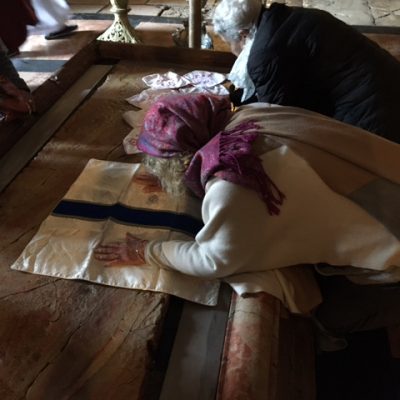
This morning I took with me the altar veil (the cloth which covers the chalice and paten) which was made out of Gretchen’s wedding dress. I chose this item to bring from St. Andrew’s, since it represented to me a true understanding of community and communion, the giving of oneself to the greater good and the glory of God. It represented to me so much of what I found as the place of my resurrection: self-emptying, surrender, commitment, and dedication to following Jesus.
Today I laid it upon the marble slab, which somehow oozes this fragrance, perhaps of myrrh, and feels like a very holy space to me. I flattened it out, in the midst of others who were placing crosses, icons, embroidery, or their hands upon the holy altar of Jesus’ healing.
I prayed for our parish, for healing and grace to abound, for courage and strength to follow the way of the cross to pervade our every move, to turn ours hearts ever more toward the ones in our neighborhoods who desperately need to be drawn into community. I felt grace. I felt abundance. I felt Jesus blessing us, this day and always.
I return to you this week, with an open heart and a renewed sense of gratitude and joy, that we have found each other and offer ministry together out of our love of Christ.