The Mystic in You

We understand that we are hard-wired to be in relationship with God and our theology tells us that God is active in our lives. Have you ever wondered how that happens? How God shows up? How we can be attentive to God’s presence? What helps us open ourselves to God?

These are all great questions and some which we explore in our book study on the book, The Mystic in You: Discovering a God-filled World. The author, Bruce Epperly defines a mystic as people who see holiness in everyday life. Wouldn’t you want to be one? Maybe you already are one?

Our conversation takes us into the world of people throughout the ages who have lived their lives this way and who can offer us insight and guidance. We looked at St. Francis of Assisi at our first session.

Here are the 4 practices offered for us to try, with St. Francis in mind —

Practice One: Finding God in the Nonhuman World

Recover reverence for life by meditating on Psalm 148, along with Francis’ Canticle to the Sun.

Breathe deeply the holiness of life. Let the air you breathe fill you with insight and energy and restore your sense of connection with all things. Take a beauty walk, opening your senses to God’s presence. Rejoice in the gifts of creation. Ask for God’s guidance in terms of how you might best respond to the crises of global climate change, species destruction, and economic and political upheaval.

Practice Two: A Gift to be Simple

Our faith calls us to simplify our lives so that others may simply live. Consider how to simplify your life. What do you need to pare away? In what ways can you live more simply? Where can you devote your resources to promote the well-being of the earth’s impoverished peoples? Consider the words from the Sermon on the Mount, along with Shaker hymn on a daily basis.

Practice Three: Welcoming People of Other Faiths

Observe your own and others’ prejudice toward persons of others faiths or no faith. In what ways do you show hospitality to the religious diversity in your community? What insights can you receive from persons of other faith traditions? Where can you contribute to reconciliation and healing among peoples of the earth? Take time to pray for people of other faith traditions, asking that they be blessed and you would discover your kinship with them.

Practice Four: Finding God in Unexpected Places

Make a commitment to reflect deeply on those who repel you. Ask God to help you see more deeply into their lives. Feast your eyes on humanity in all its variety. Look beyond appearances to see holiness in others. Listen to God speaking through their voices as you attune to god’s image within yourself and others. Pray the prayer attributed to St. Francis.

Please come to these sessions as we continue to explore and deepen our spirituality. The sessions are every other Wednesday at 5:30 p.m. at Mother Barbara’s home. The evening includes dinner (6 p.m.) then discussion (7-8 p.m.).

Youth Pre-Confirmation Class

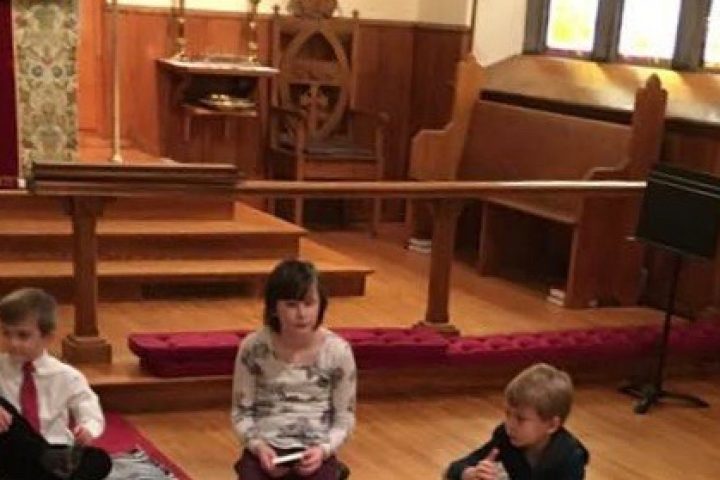
Every month our young people gather to ask remarkable questions and to learn about our Eucharistic service. We work our way through the Eucharistic service, this past Sunday learning about and creating our own Opening Acclamation and Collect (collecting prayer). Here’s an example of our young people’s great work:

Opening Acclamation —

Celebrant: Bow down and open your arms to the Lord; Let your soul be open to God; and thank the Holy Spirit for the forgiveness of sins.

People: We open our souls and feel happy. The forgiveness of sins is glorious!

The most important part of the class is when they are encouraged to ask any questions on their hearts. Their hands shoot into the air, with their minds racing, and their hearts wanting to know more about God than ever. They ask questions such as “Who created God?” or “Did those miracles really happen?”

This is an alive and energized group of young people who want to know God and know about God. How blessed we are!

Sharing of the Sacred

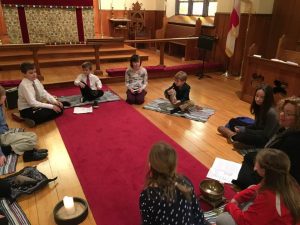
Our young people are amazing and have the ability to see the holy around, among, and within them. We wanted them to have an opportunity to share all this with their bishop, Audrey Scanlan, during her visit with us on Sunday.

Using a format that involved sharing, silence, meditative chanting, and the ringing of a singing bowl, children and adults gathered together to share the sacred in their lives and in their church experience. Themes of finding God in comfort, love, peace, wholeness, and in nature came from our hearts. It was clear that the children find God often and in many places, including in our church, through their offering of their musical talents, through the people near them, through the support others have given them, through the safety of the community, through the proximity to the altar, through their service as acolytes, and through the hearts of others. One young person said that when she sings in front of the congregation, it is clear to her that God is looking back at her through all the people gathered.

How blessed we are that we have young people who are being formed well in their faith, with eyes opened to the presence of God within, around, and among them. Thank you to all who support our young people in their faith formation. I believe it’s making a big difference to them — and to us!


Veteran’s Day Homily — The Lord said “who shall I send and who will go for us” and I said “Here am I; send me.”

SERMON FOR VETERANS DAY 2017

NOVEMBER 5, 2017

Mr. Michael Stitt

The Lord said, “Whom shall I send and who will go for us” And I said “Here am I; send me.

Forty-eight years ago, I took an oath ,something I still live by today.

I, Michael Stitt, do solemnly swear that I will support and defend the constitution of the United States against all enemies, foreign and domestic, that I will bear true faith and allegiance to the same and I  will obey the orders of the President of the United States and the orders of the officers appointed over me according to regulation and the uniform code of military justice, SO HELP ME GOD.

This is the oath that anyone entering any branch of the military takes.  It is the beginning of a long road to becoming a veteran.

Next Saturday November 11th is Veterans Day. A day for picnics, maybe a trip to a park, hiking or fishing and all kinds of sporting events.  Then there are the parades, school bands, scouts, marching units and the veterans, three generations strong.  Most people along the parade route will cheer and wave but some will laugh and jeer.  I feel sorry for those that do this. They don’t know that most of these veterans have seen the horrors of war, they endured hardship that we can only imagine and they came home to fight a personal battle for what they saw.  Just so we can enjoy the freedom that we have today.

Cindy and I are a family of veterans.  Most of Cindy’s family served during WW2, my great-great grandfather served in the Union army during the civil war, my grandfather in WW1, my father and uncles in WW2, I in Viet Neman during the Cold War, our son in Iraq and Afghanistan, and several other countries that most people don’t know exist, our grandson is a 1st Lt in the Army serving in Germany and our grand son-in-law is in Japan serving in the Air Force.  For almost  three years a blue star flag hung in our window, I wouldn’t wish that on anyone.  A blue star flag is a small banner that is hung in a window.  The number of stars indicates now many children of that household are in the service of their country during wartime.  I have read that because of the all-volunteer military only two percent of United States families have someone in the service.  In some ways, this is good but it puts a great burden on so few.

I have also read and heard people saying that  veterans are heroes.  We are not heroes.  I like to think that we are just ordinary people that have done extraordinary things.  I have met some outstanding and brave men and women during my time in service.  Medics who risk their lives to save others, doctors and nurses working tirelessly, snipers who spend days, weeks alone watching for the right moment, men who stood their ground knowing they were outnumbered. Pilots who provided  cover fire and helicopter pilots that flew into enemy fire to get their men out of harm’s way. Then there were the chaplains, men of God of all faiths who went out armed with only a bible and communion set. Well, except one Catholic priest I knew who always had his bible in his pocket, a 45 strapped to his waist and 12-gauge shotgun over his shoulder.  He often said “I might be a man of God but if I’m going to heaven from the field of battle I’m taking someone with me for company”.

I have always considered my time in service easy, at least compared to my forefathers and son. As most of you know I was a cook.  In Viet Nam, I worked in the Commanding Generals Club of the 25th division and the rest of my service was spent in hospitals in the states and Germany.  My time was not without some excitement.  In Viet Nam, I would hear the rockets passing over head headed for the airfield that was their favorite target. At night, I could see mortar rounds being lobed toward our compound.  As was the case of many of us that traveled highway one, there was a sniper who would shoot at us, he was such a poor shot that no one shot back thinking that he would be replaced with someone better. While flying with the General one day, I got to watch a B-52 strike, you didn’t see the plane, you couldn’t hear the bombs but for an area one mile wide and three miles long nothing was left except piles of burning earth.  The worst I saw and will always remember is the aftermath of it all. The damage done to the mind, body and spirit of a lot of brave men.

I was also fortunate to meet many interesting and famous people.  A lot of one, two, three, and four star generals and the grandson of Gen. George Patton.  Many government officials and a vice president that wasn’t supposed to be where he was.  Bob Hope, he was as funny off stage as on, Neil Armstrong, that was a great honor and the rest of the cast of the USO show.  While stationed at Brook General Hospital in Texas I met and talked with Lady Bird Johnson in the Presidential suite, President Johnson had just had a heart attack and was at Brooke for treatment, of course my son had to beat that by having lunch with Laura Bush while in Iraq. In Germany I was stationed at the 97th General Hospital in Frankfurt. One day the wife of a Russian officer was brought in, she had suffered a stroke and because she was a military dependent she couldn’t go to a civilian hospital.  Since I had a high security clearance I was assigned to her care team.  Can you imagine this was at the height of the cold war, Russia and the United States weren’t exactly friendly and this poor Russian woman is in an  American Army hospital. Not only was I her cook, I was also her food taster, did I mention she didn’t quite trust me. My proudest moments came several years after leaving the service.  The first being when my son graduated from officer candidate school and I was allowed to give him his first salute, a few years later his son followed in his footsteps and I was there to give my grandson the first salute of his career.

When most people think of veterans day we think of people going to war in defense of our way of life.  We see Army Special Forces, big tanks and guns, the big ships of the Navy, the fighter jets and bombers of the Air Force and Marines storming a coast line.  Most people don’t see the Coast Guard  saving people from a sinking ship or plucking people off of rooftops after a flood.  They don’t see military doctors and nurses treating people after a disaster or the Air Force loading their big cargo planes with much needed supplies. The National Guard being called out in the middle of the night to search for lost hikers and the Reserves being called to protect and serve areas ravaged by storms.  We forget about the Marines and their toys for tots and the children’s homes and hospitals all over the world getting supplies and equipment they need because a soldier cared.

This veterans day let’s not forget the real heroes.  The wives, husbands and children who had to watch us leave for far off places.  They endured being without their spouse, fathers and mothers for months sometimes years at a time.  They endured the loneliness hardships, not knowing when or if we would return, all while we were serving our country.

There is a little poem I think about this time of year.

Some people dream the dream

Some people live the dream

Some people defend the dream

God bless the defenders

The Lord said “who shall I send and who will go for us” and I said “here am I; send me. Amen.

Seasons of Creation #3 Wilderness: How do we think about, “God doesn’t give us more than we can handle”?

St. Andrew’s Episcopal Church

The Rev. Barbara Hutchinson

Seasons of Creation #3: Wilderness

October 22, 2017

“God doesn’t give us more than we can handle.” A common saying. Perhaps you’ve heard it many times in your life, or have even spoken it yourself. It’s a saying I’ve always pushed back against from a place deep within my gut, not necessarily understanding why, until I studied theology, and then I knew why. My image of God doesn’t include someone sitting upon a throne in heaven, dolling out bad things to people at opportune times, with the purpose of disrupting or destroying their lives, always attentive to the balance of good and evil in their lives at any particular moment, so people can be just on the edge of the good— or worse yet, bringing on the bad thing in life to selected people at the worst possible moments of their lives, just when they are starting to turn things around, or when they are spiraling downward.

My image of God is a flow of love, a source of desire for goodness for each part of the created world, a pull deep within each one of us for wholeness, and an inherent life-force reaching toward a rich and abundant life designed for everyone, lived within the healing embrace of Christ.

So how would I, how do you, reconcile this image of a God who looks at us through eyes of love, with the God conjured up in this popular saying that seems to imply God is actively involved in bringing bad things into our lives?

I’m not sure why we say, “God doesn’t give us more than we can handle.” Do you? Maybe it’s because when our lives are hard, and we feel out of control, our deepest yearnings are for someone or something to be in control, and even this if implies that God hands out the hardness of our lives, we’re willing to attribute that to God, rather than to simply acknowledge that our lives are out of our control.

Or perhaps it is to give ourselves a spiritual pep-talk, to bolster our strength to get through whatever difficulty we are enduring. If God thinks we can do it, then, by God, we can!

Or maybe, because it’s the only way we can figure out how we can bring God into our deepest, darkest times. Maybe we so desperately want God to be a part of our lives during times which test us, that any type of participation we can attribute to God is good.

Now, maybe that’s the key – maybe behind that almost flippant statement that “God doesn’t give us more than we can handle” is the deep desire that God be a part of the pain of our life.

Now, THAT’S something I can actually believe to be true! Who wouldn’t desperately want God to be a part of our lives’ struggles? The only people who wouldn’t are those who think God is incompetent, untrustworthy, or uncaring. But for those of us who can stretch our way into believing that God is to be trusted, then for us, the struggles we encounter can become transformational. For if God is within them, there is a chance for change. We can find that we can be changed for the better, we can come out the situation stronger, with a clearer sense of who we really are, what really matters to us, and what we are to do in this world, and we can imagine God’s involvement in the situation making a difference. The chance to change. That’s the invitation that is in the statement, “God doesn’t give us more than we can handle.” If God is a part of it, of either drawing us into experiences that shatter us at our core, that break open the façade that we are in control of everything, or make us look at life from a new perspective, or if God merely “sits with us” in the pain, then there’s a chance for change, toward clarity of who we are and what we are to do in the world.

This is exactly what happened to Jesus as the Holy Spirit led him into the wilderness for a time of testing and temptation, as we heard in our gospel today. We understand Jesus not as something separate from us. Because of the incarnation, we can enter into what Jesus did, truly following him, not just honoring who he was. Our text today tells us that the Spirit draws us into times of testing, not because God desires Jesus to have hardship in his life, or us to have hardship in ours, but so that we can come out of the time of testing and temptation stronger, as Jesus did, in our sense of identity and purpose in the world.

There are no surprises in our gospel story today. We expect that Jesus will be able to resist the devil, who is often described as one who attacks, misleads, deceives, diverts, discredits or slanders. Jesus is God incarnate, so of course, we know, or at least want to believe, God’s power of goodness will be stronger than any temptation offered by the force of evil.

But what I think we often fail to see is the transformative power of the wilderness, the time when we feel stripped to the core, as Jesus was, for 40 days and 40 nights, for Jesus was changed through the experience, and therefore we can be also. Jesus comes out with a clearer sense of his identity and purpose, and he’s famished, not just physically, but spiritually, he is ravenous to begin his ministry. That’s the piece we are invited into. Every time we want to say, “God doesn’t give us more than we can handle”, we are invited to look into the possibilities of this situation, for us to know what we care most about. If we don’t go into that place of self-reflection or exploration of how God desires us to be when we get to the other side, then, I believe, we’ve missed the point, and we’re stuck in a relationship with a God who purposefully doles out bad things in our lives, rather than a God who sits with us in them and draws us into new life. We must ask ourselves the poignant question, “What are we famished for?”

I often speak of a cycle of deconstruction and reconstruction in our spiritual lives, the pulling apart of what is known or predictable or under our control, (the deconstruction part,) and the subsequent re-assembling of the pieces into something new – the reconstruction part. I believe God is the force behind both and that the two processes happen simultaneously. Which is to say, God doesn’t wait until things fall apart in our lives to begin to pay attention to us and then to imagine how to put them back together, in a new more life-giving way, but rather, the pulling apart and the reassembling happen at the same time. Our text today and our focus this Sunday on this wilderness time in our spiritual lives introduce to us a whole other step – that moment when we realize we want more, that we yearn for something that feels more complete; when our hearts are filled with a hope for a fullness we have only yet seen a glimpse of; when we imagine a better way of life, born from the ashes of what was. Christian living is a straining forward for what is yet to come, not what was.

These moments of yearning, of passion, of hope, are liminal times, when we can identify an anticipation of being changed into something new, when we know we will hardly recognize ourselves when we look back after this moment in time, that somehow the angst will be gone, the worry will disappear as the mist rises from the valley in the early morning, when something new will define who we are. Certain moments in my own life have this liminal quality, when I could anticipate a brand-new beginning — my wedding day, the days of my children’s births, when I became a mother, and which changed my life forever, when I had a greater clarity of my identity and purpose, or my ordination as a priest, when I suddenly realized what God had in mind for me all along. These are liminal times, when there has been a yearning for something new to embrace, when I have felt more aligned to God, when I have been aware that something even more spectacular than I could ever imagine awaited me. You have those moments too. They are awaiting you, because the God I believe in doles out pregnant opportunities to each one of us, all the time.

Jesus, in his time in the wilderness, learned a few important facts about himself and the God he was manifesting on our earth: God would satisfy his needs for what he was hungry for, God would keep him safe, and God’s view of domination and prestige was the reverse of the world’s – one of humility and servanthood.

Jesus, through his temptations, shows us that it is when our lives are difficult that we chose who we will be. Like Jesus, there will be times when we are hungry, when we are tempted to doubt God’s faithfulness, times when we are tempted to reach for power or align ourselves with those who do, so we can feel safe, rather than live and make decisions as Jesus did, as God’ servant.

And yet, there are important times when we will be famished like Jesus, when we will ask ourselves the questions Jesus did: “Who am I to be?” “What will matter most to me?” “What does God have in mind for me?” “Where am I starving to make a difference in the world?” These are such important questions for us to ask ourselves, for it is within these answers that the Kingdom of God will emerge.

Many of us know from real experience that it is through times of trial and tribulation, or even temptation, that there is an opportunity for us to become our best selves. Now my experience, when people are in a place of distress or testing, their first response is not always their best response. So sometimes, finding our real selves requires patience, of ourselves, or of others, to allow God to do God’s work. But God will do God’s work. I deeply believe this.

And walking through and out of wilderness does come down to trust that God is God, and we are not. We can trust God to do God’s part, which is always and forever loving us into wholeness. Then we need to ask ourselves if we are doing our part, are we being trustworthy to God, are we joining our imagination with God’s as to what we can do with our lives, and then are we boldly living that way. Our faithfulness means we can see into another’s person’s heart and find truth; that we can become a presence of healing balm in that raw and hurtful situation we see unfold before us; that we can release the power of love, the shalom or wholeness each of us yearn for with those we encounter.

So, in times of trial, we can see an invitation to perceive what God is already creating anew – that’s the reconstruction part – but we can also see an invitation to identify our own yearnings, and that’s the transformative part, when we do that reflective part in our soul, to see if our yearning is aligned with God’s, because that’s our ticket out of wilderness, aligning our purpose with God’s purpose for us, for then we can move onto River Sunday, when all becomes recreated and new.

I will still bristle every time I hear someone take comfort in the statement, “God doesn’t give us more than we can handle”, because it still conjures us in my mind an image of an old man in heaven, doling out good or bad things in our lives, like one may deal a deck of cards, some getting the wild cards that protect them from the natural occurrences of the game of life, while others deliberately getting the ones which make you lose your turn or start all over – but when I hear that phrase, for I am sure I will because it’s part of our popular, yet un-analyzed theology, I’ll say to that person, “Yes, that’s right – God has drawn you into, and is here with you, in this bad time, so how are you using this time to be clearer about who you are, stronger about what you are to do in the world, and deeper in your trust in God’s providence, as Jesus did, when he was drawn into the wilderness by the Spirit?

That’s right. And the point that is that it should leave you hungry – starving to trust God more, to know yourself more, to yearn to become more of what God has in mind for your life, and be clearer in what you are to be doing in this world. “How is that working for you?” I’d ask. For being Christian is not a passive stance of taking life as it comes, but one of finding the chance for change hidden in each adversity, discovering what we are famished for, discovering what wholeness we want to work toward that will make the world a better place, and for holding before us the glimpse of the fullness God is offering us that can become our beacon of hope. Amen.
Youth Mini-Mission Event: Exploring the beauty of God’s creation

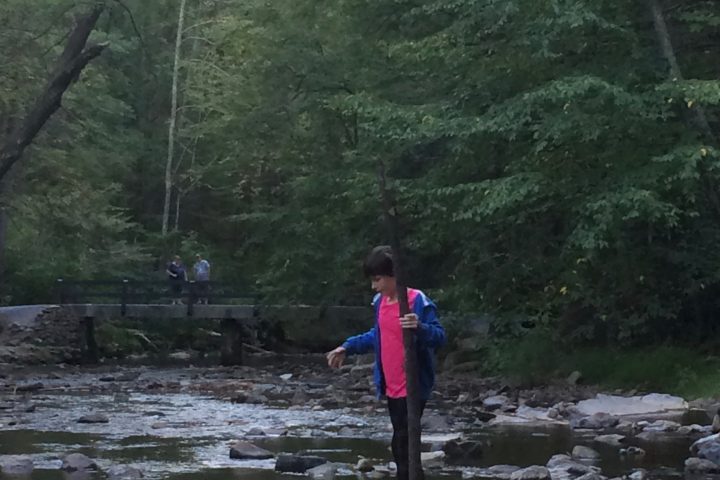
Today, in the glory of the sunshine and the beauty of God’s creation, 23 of us gathered together to spend the day enjoying each other’s company, learning something about God, and taking time to relax, breathe, put away our cell phones, and connect to something deeper within each one of us, and among us — a sense of family. We were expertly led by three guides: Joe, Jeremy, Kristin who not only instructed us on how to canoe, but also helped make the trip memorable, inviting our young people to refresh in the cool crisp water of the Conococheague, alerting us to the blue heron who seemed intent upon guiding us down the Creek, delighting with us at the large carp swimming among us, and bringing us to the perfect place to nourish our bodies and souls, when we needed a lunch break. It was a day of peace, calm, fun, and care for each other and God’s creation.

Group photo of people spending a day enjoying God’s creation.
Oh, the joy of having fun together in the water!

We ended the day reflecting upon the “best” of the day for each one of us. Answers varied from the wildlife we saw (such as a bald eagle, which was incredible!), to the varied nature of God’s creation, to the community easily formed, to the weather, to our safety, to our guides, to our sense of calm we found was finally ours to settle into.

Several of the comments offered made my heart smile– the sentiment offered was that even if they can’t get to church each Sunday, they are still welcomed, embraced, and engaged with as a part of our parish family on events like this. This is exactly the church I want us to be and live into. We say, in our mission statement, that we are an inclusive and welcoming community. This is one way we live it out: that we are not a closed club. We are not a group of people who demand a certain level of involvement or commitment to be “counted among us”. We always swing wide the door, always inviting people further into the mysterious place with God and within our parish family — and we also acknowledge and love people wherever they find themselves. Today we lived into this space. Thanks be to God!

These Youth Mini-Mission Events are designed to help us understand our relationship with our earth, and therefore, with God, the creator of the earth, and there were those among us who worked tirelessly today to help repair that relationship. One of our young people, Tom, was relentless in retrieving tires that others had foolishly and irreverently thrown into the creek. He quietly and purposefully went about his business of doing what was right, ridding the creek of pollution, finding a way to bring the tires out and then to dispose of them appropriately. It was very inspiring to see someone take this initiative to make a difference.

With care,

Mother Barbara

Simply Scripture opens up exploration of new ideas and great insights.

This past Saturday, our parish library was crammed full of people hungry to learn more about our scriptures for the upcoming month and to share their thoughts, reflections, and wonderings. We studied the Epistles for the month, which are largely from the book of 1 Timothy.

One of the topics that I think was most fruitful was an exploration of what to do when there is a word of phrase in the scripture that you don’t like.

  • Do you just skip over it?
  • Do you look up the word in the original language to see what it meant then?
  • Do you look at other translations and pick the one most congruent with your understanding? Or the one most irritating to you?
  • Do you settle into the tension and reflect upon why this word or phrase is causing such a reaction in your own soul?
  • Do you talk to others to see if this worried them as well?

The answer, of course, is “all of the above” (except the first one!).

It is always important to know the context of the passage, to look up the original word in Greek or Hebrew and look at all the possible meanings ~ and it is very important to know why this word or phrase grabs your attention. Often it’s God’s message to you to pay attention to what’s happening within you.

questionsQuestions are a good thing, in the Episcopal Church. So bring them on!