Celtic Spirituality

Each week, about 15 of us gather together, share a meal, listen to the reading of a book regarding Old Growth Forests, and then engage in a lively conversation around the content in John Phillip Newell’s book, Christ of the Celts, the Healing of Creation. This eloquent and poetic book shares with us the ideals and truths of Celtic Spirituality, such as we are all made in the image of God, we are God’s beloved, and we are intrinsically connected to all of creation and God’s creatures. The strongest words of this past evening’s reading was that it is only love, not judgment, but love which transforms us.

Our conversations are deep, insightful, and sacred. You are always welcome to join this special and holy gathering.

Taking a risk for love – Proper 28 Year A

St. Andrew’s Episcopal Church

The Rev. Barbara Hutchinson

Proper 28 Year A

November 19, 2017


Last week we called her Mary, the one who was scorned, the one who was shut out from the lavish wedding feast, the one punished because she didn’t have her life all put together, or the one who didn’t have the resources to purchase extra oil for her lamp (maybe because she had shared with others because they had none and she had extra), or maybe because life was particularly hard in that moment and she didn’t really feel like celebrating and chose not to have all that she needed to walk through those heavy doors, because she didn’t want to pretend to be happy or she didn’t want to be judged by others. We know she didn’t really miss out. As it turned out, there wasn’t a celebration at the wedding feast anyway, because there was no bride, there was no union to rejoice in. But rather Mary showed up at another party in town that evening, where they anointed each other with tears of joy, for the bride and bridegroom were there together: Jesus and the followers who became the church, and there was a lavish meal which fed their souls, as well as their bodies.

This week, let’s call the person who is scorned for his inability to “be it all” and “do it all” Mark, and let’s put him into modern context.

Mark is the youngest of three sons, and considerably so. Sometimes when his parents talk with other adults about him, he listens to their snickers and hears the word “accident” mentioned. He doesn’t know quite what that means, but he gets it that it’s not so good. He loves his older brothers and has always looked up to them, but recently, now that he’s in middle school, he feels some rather odd feelings emerging, some rather dark emotions, such as resentment or jealousy, and he spends his life confused, withdrawn, and most days finds himself wanting to crawl into a hole and disappear. Oh, his oldest brother, Jack, is amazing. He’s gotten straight “A’s” from the first grade through high school. He is in all the gifted classes and the Ivy League colleges are searching him out, and to top it off, the universities are offering him full academic scholarships, which really delights their parents, for money is tight. It sometimes feels to Mark that Jack is the favored son, but then there’s the middle son, James, or Jimmy as his friends call him. He is so fun-loving, everyone seems attracted to him like a magnet and he has trouble deciding what to do on weekends, for the many choices offered him. Jimmy isn’t gifted academically but he makes good grades and stays out of trouble – oh, and he’s fantastic at sports. He’s on the travel team for soccer, then basketball, then softball. His room is so full of trophies, Mark nearly trips on them any time he ventures into James’ room. Half the trophies at the middle school have his name of them.

Mark sees the teachers’ delight when he comes into their classroom on the first day of school, referring to him as Jack and Jimmy’s brother, but the teacher’s eyes lose their sparkle, once he starts handing in his homework or see him sit sullenly by himself during recess. He knows he’s not good at anything and so do his teachers. He’s tried for a while and made mostly B’s and C’s, but that hardly seemed worth the effort. Then finally, he just quit trying. He could never live up to his “gifted” oldest brother, so why even try? Now he makes C’s and D’s, with a few F’s mixed in. He’s not very good at sports either. He’s tried just about everything: soccer, basketball, track, but he is just a klutz at everything. Compared to his brother out there, he looks like an old lady trying to play sports, so he just quit. Interestingly though he was pretty good at the clarinet, which is something neither of his brothers could play. But he found he didn’t really like to practice. Sometimes he even wondered if he really hated to practice, or if he was just scared that he will never be really good, even if he did practice.  Or afraid that if he was really good at playing the clarinet, his parents wouldn’t notice, and that would be worse than anything. It was easier to not even try. It was safer to not even try. The mantra his parents say to him each day is, “You’re not living up to your potential.” Mark responds, in his head, “Well, how would you know? You’re too busy taking Jack off to colleges or sitting for hours on the bleachers in the steamy high school gym watching James. What do you even know about your stupid klutzy son?”

Mark found it safer not to try. Mark found it easier to put up with his parent’s chastisement than to risk failing at something, or to risk being good at something, afraid his parents wouldn’t even notice.

The familiar story we heard today in our gospel reading, the parable of the talents, can easily and not incorrectly be interpreted as admonition to lavishly use the gifts God has given us to multiply them so the Kingdom of God can come near to all people. But we’ve all heard that sermon before and although important, it can be fairly easy to dismiss or to be heard in a way that reinforces what we’re already doing, without providing any challenge or place to stretch.

So, I’m going to offer you an alternative, because like last week, it’s really important to remember the context of the parable we heard last week and this one – this is Holy Week. Jesus is preparing to die and has a few last moments to distinguish for the disciples what the Kingdom of Heaven looks like (the one fashioned after Jesus’ teaching, healing, and gathering the discarded into community through his love) and the one which will be presented by false prophets, a fake Kingdom of Heaven. This is like parents dropping their children off at college and not being able to refrain from saying, “And you’ll meet new friends, and they may think some things are right to do that you think are wrong, so don’t follow them there. Trust what you know about how we’ve raised you. Stay steady in that truth of who you are and who we have been to you.”

The challenging perspective in our parable today is when we see within it the fear of taking risk, for what does that say about what we believe about God? The third servant, like the third son, was afraid of the master (like the son of his parents), and chose not to risk either failing at something (investing the money and losing it, or in Mark’s case showing his parents yet again he isn’t good at anything) or risk being good at something (making a profit or being chosen for the middle school band) and not getting the recognition desired, that they both seemed to crave, so they could believe for a moment that they had value. For the servant, we may ask, “How would he know how much interest is enough? What would be enough? Could there be too much? Would his master think he was being greedy?” His fear of getting it wrong paralyzed him from doing anything at all, other than hiding the money in the ground. I imagine we can all remember times when fear paralyzed us as well.

Now you may have noticed that our parable presents two different images of the master, and if we imagine the master to be an allegory for God, we can connect one image of the master to the real God and the other image of the master to the fake or false prophecy of God. The first master, or God, we are introduced to is generous and trusting in his servants’ ability to handle his entire treasure as he heads out on a trip. There is no need for specific instructions, for whatever they do, will be fine, for he trusts them to do their best.

The second image of the master is one who is harsh, arbitrary in expectations and demands and is to be feared, for he punishes unpleasing results, even though he hadn’t told the slaves what he expected to happen with the talents given to them. This sounds a bit like a capricious God, one who changes his mind and expects you to keep up.  My sense is this portrayal is the prophecy of the false God.

Since we potentially have two images of God to connect with, let’s see what difference it makes to be in relationship with each one.

If we are in a relationship with a God who is generous and trusting, we most likely feel loved. And feeling loved, we can return that love and our deepest desire is to do what is best with what has been entrusted to us. It’s a way of honoring the generosity bestowed upon us.   Although we may feel a bit of fear at the magnitude of the responsibility to do what is pleasing in the eyes of this God, like we may feel the weightiness of the responsibility of caring for the earth that God has entrusted into our care, we often find this awe gives way to the trust we also feel from this God, which translates into an encouragement to dare to risk to do our best for the God who we know will take whatever we may offer, however scant or limited or broken, and will make good out of it. This generous and trusting God knows our hearts and sees the goodness and truth in us, even if we don’t, and just as when a parent, or a spouse, or a friend loves us unconditionally, we are willing to risk a bit, to take a step forward in faith, to live into the mystery a bit, knowing that person or God will delight in our efforts and not condemn us with less than stellar results. We often call this grace, this state of being, which we can enter into because of the goodness and loving character of the God we believe in.

The other God in our parable, the one that shows what the Kingdom of Heaven is not like, is the angry and vengeful God who casts this servant off into isolation and horror. A natural response to this kind of person or God is one of paralyzing fear, walking on eggshells, working hard not to be noticed, for if I am not seen, then I cannot be punished or banished or abused. Being in relationship with this type of God or person would most likely cause us to shut down insight, creativity, and engagement with a Spirit that may take us in unchartered and risky waters.

Richard Rohr, in his book, The Divine Dance, says that we become like the God we believe in. I would turn that statement a bit to add, we become like the God we believe in or the one we need to believe in to justify our behavior. This means, if we believe in an angry and judgmental God, one who casts people out into darkness and gnashing of teeth, then we can justify our being that way too. If we believe God slams shut the door of the Kingdom of Heaven on people who are unprepared or don’t try hard enough, then we too can slam that door on a good part of the people of the world and feel justified by it. But then we have to ask the question, “Is that what we really believe about God?” and if so, “Why?” “Why don’t we believe in the reshaping, the reformation, the transformation that Jesus offered us on the cross, that spoke only of God’s love for all humankind?” In this act of love, God didn’t punish the ones who got it wrong or weren’t prepared, but rather died so that they could live, and have life abundantly. And living abundantly means being willing to risk because God has given us all that we need, and more.

The other God presented in the parable, the generous, loving God, the one who gives his whole treasure away, the one which shows the character of the Kingdom of Heaven, follows along with Desmond Tutu’s statement, “If it’s about love, then it’s about God. If it’s not about love, then it’s not about God.” This is a God who gathers the scattered, draws near the injured, attracts the rejected, and draws them to the table. If we believe in this God, then we too will be one to gather the scattered, we too will sit with those at our community meals, because Jesus is already there with them and we want to be where Jesus is, w too will visit in the prison, feed the hungry, and clothe the naked.

As we say in our collect on Friday mornings during Morning Prayer, “Jesus stretched out his arms on the hard wood of the cross so that everyone may come within his saving embrace.” Believing in a God who would do that for us, and thus calls us to do that for everyone else, can feel risky. And if it is risky, then perhaps it is of God, for it does seem to me that God is the greatest risk-taker of all. God trusts us, we fallible humans, with each other and with God’s creation, and built into that trust in always intention and invitation to redemption and transformed living. When we believe in a loving God who takes risks for us, who loves us into being, then I believe we too can become risk-takers for love. This is what this parable can teach us. Be risk-takers for love.

We often say fear is the opposite of faith, largely because each time the angels show up in scripture, they begin their conversation with “Do not be afraid” for fear can prevent us from seeing, hearing, and loving God. Do not be afraid, my friends. Above all else, God has entrusted you with your love of God and it is right and good to share that love boldly with others. We can’t get that wrong, for that always will be pleasing in God’s sight.

Amen.



Shall we call her Mary?

St. Andrew’s Episcopal Church

The Rev. Barbara Hutchinson

Proper 27 Year A

November 12, 2017

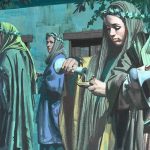
Shall we call her Mary? That woman in the photograph I used in my weekly e-newsletter, that I said I wanted to preach on today – did you notice her? How did you read her facial expression as she was watching the other bridesmaids fill their lamps with oil, while turning their backs toward her? Sometimes when I settled my eyes on her, I saw shame or regret in her furtive looks toward the others. Sometimes, I noticed envy. Other times I saw a hint of disgust. For she will be left behind. She will not have enough oil in her lamp to join in the procession to the wedding feast. And no one will share with her.

I think we should call her Mary, maybe because she has the same blue-colored robe that Mary, the mother of Jesus is often depicted in. But I like to call her Mary because there are so many Marys in our gospel stories and a Mary always seem to be present at the most important moments of Jesus’ life, and this story seems to have that same level of importance. If a Mary is always around at these important or liminal times, maybe that means we too can be around at Jesus’ important or liminal moments too, not being transported back in time, but being present to the moments Jesus shows up in our lives, here and now. Oh, the many Marys — Mother Mary, who birthed God into this world, Mary, Martha’s sister, who sat at Jesus’ feet, soaking up his teachings, Mary who lavishly poured the contents of her alabaster jar upon the feet of Jesus, offering him comfort and adoration, while foreshadowing the anointing of his body soon to be crucified, and Mary, the Magdalene, who was the first one to see the resurrected Jesus, the first apostle, who ran to tell others the good news of the risen Christ. The name Mary may have been used so frequently in the gospels because it was a common name of the time, or maybe because its frequent use allows us to see it as a generic name, and therefore one we can take upon ourselves, allowing us to see ourselves in each of those situations. Our story today seems to be one of those important moments in Jesus’ life, when he’s working hard to reveal a truth to his disciples that he really wants to leave with them.

The setting of this parable is incredibly important to understanding the message. For if we don’t know that this story is told to Jesus’ disciples alone, on the Mount of Olives, in the tension of Holy Week, when Jesus traces his steps back and forth across the Kedron Valley, setting the rhythm of threatening the status quo in Jerusalem and retreating at night into the safety and warmth of his friends’ home, and if we don’t understand that Jesus knows he will die soon, that in fact he’s orchestrating his death, we won’t comprehend the urgency of the situation, of Jesus’ giving an answer to his disciples who are struggling with the idea of his death, let alone not grasping in any shape or form what this second coming is all about, when it will be here, and what the signs will be when it comes, we can easily think this parable is about rewarding the smug, the self-focused, the selfish, the uncaring, the ones who intentionally divide communities between those who have and those who have not, for these bridesmaids who brought extra oil, but looked out for only themselves, seem to be the ones rewarded. They’re the ones who go to the wedding feast. They’re the ones on the inside of the closed door.

If we take this parable out of context, it would appear that Jesus is rewriting the beatitudes, the imperatives for faithful living which he started his ministry with, on that hill, overlooking the Sea of Galilee. The rewrite may look something like this:

Instead of blessed are those who are poor in spirit, Jesus would say, “blessed are the overly confident”, instead of blessed are those who mourn, Jesus appears to be saying, “blessed are those who cause the tears to run down the cheeks of those scorned by others”, instead of blessed are those who are meek, Jesus would be saying, “blessed are those who are haughty”, instead of blessed are those who hunger for righteousness, “blessed are those who are comfortable with their privilege”, instead of blessed are the peacemakers, Jesus would be saying, “blessed are those who rip families apart”. Nothing about this parable seems right – and it isn’t.

Matthew, who uniquely tells this particular parable, is addressing the issue of what a false reality of the Kingdom of Heaven looks like. The gospel writer knows the people in the community, several generations after the death of Jesus, are wondering when this is all going to happen, and they’re hungry to latch onto any reality of the Kingdom, even if it is false. They’re tired of hoping without seeing any sustained movement toward the Kingdom proclaimed by Jesus, because they’re exhausted from combating the forces that tell them power and might rule, and they’re afraid none of the story of Jesus is true. The stories told to them of the miracles of Jesus or the love that seemed to pour from him all the time, gathering people from the fringe and drawing them near seem distant and merely a faded memory. They are weary. They are afraid. They are losing hope, and Matthew’s Jesus needs to make it clear to his disciples what the false prophets would raise up as the Kingdom of Heaven, and he wants to make the example so distinct from what he had been talking about that the disciples would readily know it wasn’t this. It was not, nor never would be, a closed door for those who didn’t come on time, or those who weren’t prepared, or those who didn’t know yet they were invited to come on in.

There are times when I listen to the news, and all I hear about are mass shootings each week, the last one in a church of all places, and I can’t help but wonder if that could happen here at St. Andrew’s someday, and I don’t know what to do with that fear. Or I hear about devastating hurricanes and raging forest fires and I wonder what has happened to our earth, if we’ve done irreparable damage. Or I hear the news plastered with stories of the immoral behavior of our elected officials, or there’s a push toward war when all other options have not yet been explored, or division among families due to their political points of view, and I’m afraid, and I’m not sure what to do with that fear. I am tempted to lose hope and I begin to wonder if anything I am doing really has any impact in bringing in the Kingdom of Heaven. Maybe you feel that way too.  I sometimes get weary of waiting, of endlessly waiting for some sustained movement toward the Kingdom of Heaven and I get frustrated with all the obstacles that seem always strewn in its path. I wonder “Why can’t we all just get along?” A simple yet profound question. Why is this so hard? And I can understand why some church-goers feel foolish for believing it will ever happen, that the Kingdom will ever be near enough to touch, to taste, to revel in, and they drift away from church, from community, from hope.

We began our recent Diocesan convention by asking participants to name their hearts’ desires or share the deepest dilemma they are dealing with – One response was: “What does ‘make all things new’ mean? How long will it take?” It’s the same question the hearers of Matthew’s gospel were wrestling with. It was stunning to me the number of people responding to that opening question at the convention spoke about fear, concern over divisions due to differences of race, economic status, or opinions, a sense of hopelessness, and concern about survival from a natural disaster as what is most on their hearts – probably 1/3 of the people gathered that evening. If we contrast with these generalized fears, some real-life fears many of us or our neighbors have – how will they afford health care, what happens if I lose my job, will I have the strength to endure the darkness of the night, or the dark place of my soul which I meet each day – we understand how sometimes it can be easier to grasp onto a false reality than to wait for and to live into the true one of Jesus.

So, the question raised by our parable is: “how do we live in hope of the light Christ brings, when the rest of the world seems so dark?”

Part of that answer is found in our parable when we look at the characters and find there is no bride mentioned. There is no bride at the wedding feast. The custom was for the bridegroom to go to the bride’s home on their wedding day, settle with the bride’s father on the dowry, and then she and the bridegroom would process with the bridesmaids to the wedding feast, where the celebration would begin. Although the door to the wedding banquet was closed and the tables were laden with a feast, there was no union between the bridegroom and the bride, for she was not there. There was no celebration, there was no joy.  The uncaring, smug, self-centered bridesmaids, who were unwilling to share their oil with those in need, afraid that if they did, they wouldn’t have enough for themselves, found themselves in a place that felt empty, and stilted, and without joy.

If we use the common allegory of Jesus as the bridegroom and the church as the bride, our story tells us that the bride, or the church, did not show up, because we know the church does not exist where there is not love; the church does not exist where there is not sharing of resources; the church does not exist where there is division. Oh, there might be church buildings filled with people who do not love, but the living and moving and breathing Body of Christ does not show up where there is not generosity, where there is not trust, where there is not love.

There was another party going on in town that night. One where the rejected, the tired, the weary, the lonely, the ones who mourn, the poor in spirit, the meek, the peacemakers were gathered, where the healing love of Jesus flowed through and around them, where they anointed each other, maybe not with expensive oil, but with tears of joy, for Jesus was with them.

The church shows up, our church shows up when we readily offer ourselves and our resources to each other, when we ask the question, “What do you need?” or “How can I support you in the cold dark night, where fear and trembling settle in upon your soul and weigh you down like a heavy down comforter, almost making it difficult to breath?” The church shows up, our church shows up, when we acknowledge our vulnerability before God and each other, or when we acknowledge that we can’t be prepared for everything, and instead chose to trust that it is Jesus who opens the door, invites us in, and prepares the feast.

The false prophets may say to us, “You just need to work harder!” or “Claim what you’ve earned as your own!” or “Figure out for yourself what you can give away, don’t let God lead you, for you will end up with not enough!”

Mary, our woman in blue, scorned, rejected, dismissed, whose eyes, perhaps filled with contempt, or flooded with tears, but also turned to see the truth of Jesus. We can too. We can figure out how to wade through the dark times we often find ourselves in. We can trust Jesus is present with us as we make tiny steps toward the fulfillment of the Kingdom, and trust that they count. We can find strength knowing that there are people here who will be with us and love us and share with us and care about us. We can come to the feast, the banquet, the table laden with more than we could ever ask for or imagine, the altar. In the darkest of times, light will shine, and the Kingdom of Heaven will be born anew in our hearts, when our eyes are turned to see the truth of Jesus. Amen.


Putting on our own Christ-garment

September 10, 2017
14th Sunday after Pentecost Exodus 12:1-14 / Romans 13:8-14 / Matt. 18:15-20
The Rev. Carenda Baker preached at St. Andrew’s, Shippensburg

Last week I was on my way home from Chambersburg and I stopped at the Sunoco station on Walnut Bottom Road, just where the entrance/exit ramps to Rt. 81, exit 29 are located. When I went inside to pay for gas, the friendly cashier greeted me, and then said, “Are you a chef?” I had no clue where that question came from, but I laughed and said, “No, in no one’s wildest imagination would I ever be a chef!” Then she said, “Are you a baker?” Still clueless about her line of questioning, I said “No, but my last name is Baker”. Then I said, “I am an Episcopal priest”. I was wearing a black clergy shirt. As I sometimes do on the way home, I had slipped out of “uniform” by removing the detachable white collar. Without the collar, it was just a black shirt, so I finally understood why she was asking about my occupation. After apologizing to me, the cashier launched us into an incredible theological conversation. “Since you’re a pastor, let me ask you a question”, she said. “What do you think about Muslims who believe Jesus is the Son of God?” Talk about a curve ball! I told her I knew that some Muslims believe Jesus was a prophet of God. Tentatively I asked, “Is it important to you that Jesus is the Son of God?”, to which she replied emphatically and with a hint of impatience, “Yes, he is God’s Son.” She continued, “I am a Muslim and I believe Jesus is God’s Son. A lot of people tell me this can’t be. That I can’t be a Muslim and believe Jesus is God’s Son”. I responded, “I believe it is the same God we worship but in different ways. I don’t see a problem with your believing Jesus is the Son of God”. She thanked me profusely and said that I was the only Christian besides her sister she had ever met who thought we worshiped the same God, adding “and my sister is really into her Jesus as Lord and Savior”. She went on to say that her father was Muslim and her mother was Christian. Her father had told his children that he didn’t care what faith they practiced, as long as they practiced one. Just before I left, she said – gesturing toward her co-worker – “Pray for us.” I asked her name, and told her I certainly would pray for them. The exchange left me scratching my head – and smiling.

Do you know the cliche, “Clothes make the man / clothes make the woman?” When we put on a uniform of any kind, it makes a statement. Whether it’s a cap and gown, a sports, band, or military service uniform, nurses’ scrubs, a doctor’s “white coat” or a priest’s collar, how we dress says something about who we are and what we value in life.

Each of today’s Scripture readings offers us a wake-up call to become “fashion conscious”. The good news today is found in the thread that runs through the biblical story of God and humanity, and what it looks like when a God of love acts. “God is love” are words we’ve heard and read in Scripture. But this can be awfully confusing because the culture we live in believes we can love just about anything: ice cream, the Phillies or Pirates, the flowers in our garden, a certain piece of music, making money. Most often when the word “love” is used outside a community of faith, it’s referring to sentimental or romantic feelings. But love in its Christian understanding is an “action word”. It is not the same as simply liking someone or something, or having pleasant feelings. Love for Christians is made visible through actions.

We pick up the Exodus story today where the Israelites have been enslaved in Egypt for many years, and God has called Moses to lead them out of slavery. Moses tells the people something big is about to happen. At first, the passage sounds like it’s all about rules they must follow in a carefully choreographed religious ritual – sacrifice of a lamb, blood on the doorposts and lintel, eating a meal together with specific foods. And those directions are there, but the directions are all for the sake of being prepared to act. God is about to act powerfully on their behalf and they have a part to play in what will happen. They need only the essentials, because they are about to become extremely active people riding the freedom train out of Egypt. Time cannot be wasted. They dare not be weighed down with multiple layers of clothing, or have a bunch of bling jangling at their wrists and swaying round their necks. We’re talking simplicity here, minimalism. Fully dressed and ready for action. Sandals fastened and a staff in hand to help them move swiftly over a lot of rugged terrain in a short amount of time. The God of love and justice is going to liberate them. They need to be dressed for liberation.

Thousands of years later, Paul writes to the Christians in Rome, reminding them that they follow one who was willing to be completely undressed, if you will, figuratively and literally. Jesus let himself become totally vulnerable as a human being to show that the God of love acts to reveal – reveal everything that is sick, sinful, evil, divisive, and self- serving in the world – in order to save and heal the world. The Christians in Rome know the story of Jesus’ life – about his preaching, teaching and healing. They know, too, about his death and resurrection. They have chosen to follow Jesus’ as the Way, so they have “put on” Christ in their baptism.

Paul reminds the Christians in Rome what he had taught them, and what their baptism meant. Their old way of life has been stripped away, and they are newly clothed in the Spirit of Christ. God’s people do not wear spiritual “hand me downs”. Always there is a fresh and promising expression of Christ’s life in the person who is baptized.

This radical and life transforming cleansing bath, this sacrament of baptism has gone through many changes in the 2,000 year history of Christianity. In the early medieval age, between the years 300 and 400 C.E. baptism involved a two to three- year period of instruction called the catechumenate. During this period candidates to be baptized participated only in the first part of worship, the service of the Word. They were dismissed from the assembly before Holy Eucharist. Following that intense two to three year period of instruction, and after thorough examination – including an exorcism pronounced over them to insure that Satan truly had been put to flight – when the day finally came for the candidates to be baptized, usually on the night of the Easter Vigil , the men and women were separated into two different areas, because they entered the baptismal waters completely naked to be immersed. Plunged under the water – just as vulnerable and naked as the day they were born – they symbolically went with Christ to the grave in his death, and came up out of the water, raised to new life with him in his resurrection. As they emerged from the water after being baptized, each newly baptized Christian was dressed in a clean white garment, symbolic of the love, light, and life of Christ they had just put on. They now belonged to a community, Christ’s living body, the Church, and were welcomed to their first experience of receiving Holy Eucharist.

We need reminding sometimes, too, just like the Christians in Rome did. The apostle Paul tells them to “put on Christ “. What that means for us is that we readily admit we cannot conjure up Christ-likeness all by ourselves. “Putting on Christ” requires humility and vulnerability. It is not a do-it-yourself self-improvement project. It means seeking to live more and more with an undefended heart that is open to the Holy Spirit’s influence. Putting on Christ is a process and a way of life. It requires intentionality and being formed through the disciplines of prayer, Scripture reading, worship and participation in the Sacraments, and commitment to sharing ourselves and our gifts in the life of the faith community. “Putting on Christ” is what enables us to love our neighbors as ourselves, to act towards others the way we want to be treated.

In another of the epistles, the letter to the Colossians, the writer describes even more clearly what being clothed in Christ looks like. Listen to Eugene Peterson’s paraphrase of Colossians 3:12-14 in his book The Message:

“So, chosen by God for this new life of love, dress in the wardrobe God picked out for you: compassion, kindness, humility, quiet strength, discipline. Be even tempered, content with second place, quick to forgive an offense. Forgive as quickly and completely as the Master forgave you. And regardless of what else you put on, wear love. It’s your basic, all-purpose garment. Never be without it.”

The God who is love has clothed us in a gracious and spacious garment of reconciliation, restoration and right relationship. It is a garment woven with the fabric of God‘s own love. It needs no sequins, no flashy “bling”, no matching accessories to make it stand out and be noticed.

The God of love and hope acts, drawing us into the future where all things will be reconciled and made whole. And this work of reconciliation is what Jesus describes in the gospel reading from Matthew. Jesus assumes that where there are people, there will be conflict and disagreement, even among the faithful. He offers practical and wise direction about how we can, in love, care for relationships with our brothers and sisters in the faith community, how we can practice loving our neighbor as our self. The way to deal with conflict is not through separation, exclusion, punishment, or “ex- communication”. It is not about three strikes and you’re out. It is not about forgiving only a prescribed number of times, and then dusting off our hands and saying, “Oh well, we tried”. The love in action Jesus describes here means doing the hard work of tending relationships by speaking the truth in love when we disagree, while keeping our open hand extended toward the other.

We all know there are times when we just don’t like some people very much. It’s true in our families, it’s true in the culture around us, and it’s true in the life of congregations. Love does not mean we will always have feelings of pleasantness, ease, and comfort in our interactions with each other. Continuing to love in times of disagreement and conflict is neither easy nor comfortable, but it’s necessary. The fact that Jesus says when two or three are gathered in his name, he is there among them means that God is present witnessing the interactions, the efforts, the negotiations we offer to care for the community. God cares and wants to help us. Building, restoring, and maintaining relationships of truth, love, and forgiveness are that important.

The God who is Love acts – to liberate and save, forgive and heal, acts to empower us to join God in creating that future where everything finally will be reconciled and made whole. So let’s take a look at the condition of our own Christ garment. Where is it frayed, wearing thin, or maybe even starting to tear? Perhaps you are in need of liberation from something that’s dragging you down, holding you back from mirroring Christ’s love. Maybe you have difficulty accepting the fact that God believes you are worth saving. Or maybe there is a situation, a sin, a habit with which we repeatedly wrestle. Perhaps we need assurance of forgiveness and the courage and faith with God’s help, to begin again. Maybe there are tender wounded places in us that need healing, which we keep well hidden. Most of us will have at least one situation where we need the Spirit’s help to put love into action, to let Christ’s light shine through us.

We have been clothed with the Spirit of Christ, dressed like royalty in new and abundant life. The risen Christ is God’s designer label. Christ is God’s handmade wardrobe for us. Our Christ-likeness is practical, absolutely appropriate year-round wear, ready for any weather. This clothing will never go out of fashion. If anything, this garment of Christ-likeness will become even more valuable and precious the longer we wear it and grow into it.

So what do you think? Do clothes make the woman or man? Let’s take our holy fashion sense out into the world this week and see! It just might be that Christ’s light will shine so brightly in us that others will recognize Gods’ love in our actions, and they, along with us – will give glory to God in heaven. Amen.

Feeding the body and soul.

Yesterday was a spiritually “full” day, by that I mean, it was a day when the presence of God seemed to saturate us at St. Andrew’s. At expected and unexpected moments, I kept bumping into the awareness of the presence of something bigger than any of us, something more pervasive than effort any of us could sustain, and something richer than any of us could image. After a remarkable morning of glorious worship, when Deacon Wanda, Mother Carenda and I stood behind the altar, raising up in our hearts all those who have worshipped and ministered in our parish over the past five years, when we were uplifted by a homily by Veteran Amber Endrusik, our youth gathered in the afternoon to help others, and by doing so, grew their hearts.

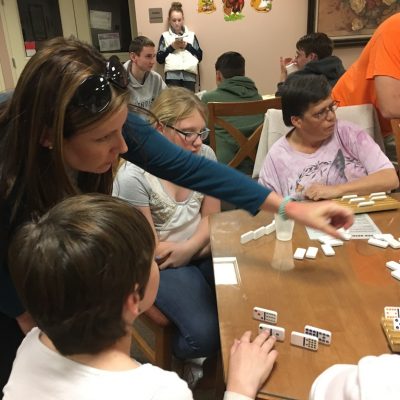
We participated in an effort called Food Recovery Network by collecting leftover food at the Shippensburg University, packed it in aluminum containers, then served it to the residents of the Episcopal Square. We presented an abundant feast, helped them fill their plates, offered them coffee, and sat and shared a meal with them. Then something marvelous happened! All of a sudden our young people were playing dominoes with them. Our young people didn’t know how to play this game, but the residents paired up with our young people and jumped right in to teach them. We went from serving others a meal to being with new friends. This is what Jesus is all about: making that shift from helping by giving to being in communion with others. We fed and were fed.

In our conversations following the meal, I became aware of how big the hearts of our young people are. They were willing to walk into the uncomfortable place of unfamiliarity to help other people. This is the zone where Jesus shows up: in our hearts, when we’re reaching out to help other people, when we’re struggling with the bigger issues affecting other people, when we want to make a difference, and when our hearts are turned toward justice. I thank God for our amazing young people, for their parents and our community who are forming them to be faithful Christians through their love of others.

Coming together as the Body of Christ: A Pastoral Letter

Dear Friends,

This week, we as a nation participated in the election of our next president; the campaign was often polarizing, contained hateful language and hurtful rhetoric, and raised legitimate issues. Many of us are bewildered as to how we have arrived at this place of major division among good and faithful people; some are confused at other people’s reaction to the results; some are elated at the results, others are distraught and afraid. Wherever you find yourself, please know that on Sunday morning, we will come together as the Body of Christ, united by a love which is more powerful than any division humankind can construct, united by a love centered in the healing balm of Jesus, united by a love which calls us to see the face of Christ in each other, and united by a love which is about moving forward in reconciliation.

Here are some assurances I offer you:
1) I am your pastor. Wherever you fall on the political spectrum, whatever your reaction to the result of the election might be, I am your pastor. I am called, and I believe that it is my responsibility, privilege and joy, to meet you wherever you are, in any situation, with love. This, I promise you, will always be true.

2) I am your priest. I believe and affirm that the Lord’s table is broad and wide, and that all are invited. Especially in the Episcopal Church, we believe that our diversity is our strength, as we live into our baptismal covenant and respect the dignity of all people.  I believe that by God’s might we will be nourished for the work ahead, helping us to build and live into the policies and future state of the nation, which will bring God’s kingdom ever nearer.
3) I am your teacher. I will continue to preach the gospel, the good news of Christ, which, at times, will be challenging to some and comforting to others. I am also here to sit with you, listen to you, explore your questions, and offer resources to help you look at the social justice issues raised in this election and explore how the heart of the gospel informs our decisions. I look forward to the time when we as a people can find ways to come together to have conversations on these issues, to make positive changes in our community which protect the rights of all and draw the marginalized into the center of God’s care, by our actions.When Mother Betsy and I were walking the streets in the Old City in Jerusalem last week, I said to someone, who was kind enough to offer us directions, “I love your city!”. He replied, “Oh, it’s not my city. It’s everyone’s city. When we can figure out how to live in peace here, the whole world will be at peace.” I feel that same way about our parish. We are poised to be an example to others, to be a community that finds a sense of peace among people who care for each other, who respect one another, who want to learn from one another, who can hold different opinions and still all kneel at the rail and praise the God who loves us all.

Forgiveness, patience, perseverance, generosity of spirit, dedication and commitment to something bigger than ourselves will be required of each of us as we move forward as a parish community and as a nation. I trust God will pour God’s grace upon us so we can do this hard and holy work.

In Christ’s love,
Mother Barbara+