Approaching the Gospels Together

This morning a group of us gathered with an ease of being together, with a shared sense of wanting to learn from each other, and with a desire to look closely at our scriptures. We read the text of Jesus’ baptism in the three synoptic gospels (seeing with one view or eye): Mark, Matthew, and Luke. We begin by reading the text in Mark (the first of the synoptic gospels written) and then read the same story from Matthew and notice the similarities and differences. Then we read the version in Luke and do the same. It’s amazing the differences!

Then we begin asking ourselves these questions (focusing on the text to give us the answers):

  • What does it tell us about Jesus that he came to John the Baptist to be baptized?
  • What if anything does it tell us about Jesus’ relation to tradition?
  • Who heard the event?
  • Who saw the event?

All this examination helps us discern the differences in the gospels and helps us wonder why the same story is written in many different ways.

We had a great time discussing the following question:

  • How would you describe this experience like for Jesus: inner, outer, or what?

Then it was time for personal sharing in response to this question:

  • Is this an experience similar to one in your life? If so, what kind or kinds?

There was rich sharing of times of baptism, confirmation, reception into the Episcopal Church and ordination. It seemed that common elements were: humility, consent, affirmation, and a call to do something (or be something) different.

I looked around at the room while in the midst of this sharing, filled with joy, realizing this was another of my “dream come true” moments, which I so often have here at St. Andrew’s.

To read the scripture and view the questions we discussed today, please click here. Approaching the Gospels Section 18


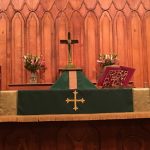
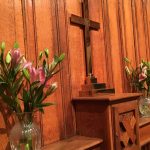
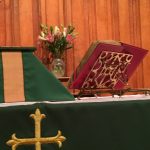
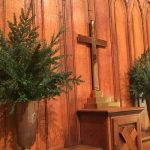
The beauty of our church.

We are blessed by many people who faithfully and often quietly work behind the scenes to beautify our church. Today I am especially grateful for our flower guild. Each week, our altars are adorned with lovely flower arrangements, created with care and with artistic talent. It’s a gift that is freely shared with us and for which we are grateful.

This morning the flowers were exceptionally lovely. On this rather cloudy morning with intermittent snow showers, it was such a joy to come in and see these beautiful flowers, inviting us further into the beauty and glory of God.

It is true that the church space can shape or reflect what we believe about God. I think our church speaks loudly that we are drawn together in community through beauty, warmth, and the light of Christ which is always shining through the altar window. Thanks be to God!

Contemplative Practices: Mary Oliver Poetry

In the dimming light of the evening, draw together by the flame of an oil lamp, we gathered in a circle and read Mary Oliver’s poetry, in a contemplative way, pausing after each reading, allowing time for the words to settle into our souls.

We found her poetry to be beautiful, shocking, challenging, descriptive of the journey of the soul, and the images of nature to be stunning.

We all left a bit calmer, a bit more tuned into the beauty of our world, and a bit more engaged in the spiritual journey of our souls and community.


The Work of the People: The Ridiculous Journey of Following Jesus

A number of us gathered on Wednesday evening for a time of sharing a meal, hearing new ideas, and sharing our thoughts in a safe and caring space. We began our 6-week program on following Jesus through the use of videos by a number of theologians.

We began our study by reading scripture connected with the evening’s topic, since we as Episcopalians are people rooted in scripture. We listened to and engaged with the story of the Good Samaritan.

We then continued our study by listening to Father Greg Boyle who states that following Jesus means standing outside your circle or comfort zone and standing silently until the people you are standing with find their own voice. It sounds so simple, yet is a very complex command. We discussed the steps to get there: identifying where we draw the lines, crossing over the line into a place previously unknown to you, standing there, being present to, and being silent, until your steady presence helps the others to find their own voice. We talked about the trinitarian theology inherent in this process (God, the One who puts the desire in our hearts, Jesus, the One who offers and finds the place of healing and reconciliation, and The Holy Spirit, the One who makes the relationship alive and changes all involved).  We spoke how it can be easier and important, yet not the same thing to cross over the line, learn about the people who live in that space, walk back over to your comfort zone and advocate for them. The call is to be present to, be attentive to, and stand silently with others.

We ended our time with Thomas Merton’s prayer,

MY LORD GOD, I have no idea where I am going. I do not see the road ahead of me. I cannot know for certain where it will end. Nor do I really know myself, and the fact that I think I am following your will does not mean that I am actually doing so. But I believe that the desire to please you does in fact please you. And I hope I have that desire in all that I am doing. I hope that I will never do anything apart from that desire. And I know that if I do this you will lead me by the right road, though I may know nothing about it. Therefore, I will trust you always though I may seem to be lost and in the shadow of death. I will not fear, for you are ever with me, and you will never leave me to face my perils alone.                                        —Thomas Merton


I think we left with much to ponder. Following Jesus has so many dimensions to it which stretch our souls and minds.

St. Andrew’s Parish Annual Meeting

Today we held our parish annual meeting. The following members were elected as new vestry members: Susan Davis, Jeanine Goodwin, and John Richardson. We are grateful for their commitment to serving our parish in this leadership role.

We also offered our thanksgiving for our two out-going vestry members: Bill Gawors, who has organized our outreach efforts for the past several years, been actively engaged in our spiritual formation programs, and who has faithfully served our parish as a verger in our worship services. We are grateful for Jim Smith, who has been involved with our development of youth mini-mission events and during his vestry term, became an Eagle Scout and had his ceremony here at our church. Thank you to both of you!

Our Diocesan Convention Delegates are: Ken Dotson, Melisa Dotson, Mike Rhodes and Susan Sanders (alternate).

Our new Senior Warden is Melisa Dotson. Tom Briggs continues his service as Junior Warden and Steve Smith continues as our Treasurer.

The Rector’s Award was given to Mike Rhodes for his faithful leadership and trusted nature and commitment to following Jesus. The Vestry Award was given to Tim and Irene Hawkins for their initiative in making the Youth Mini-Mission Events a huge success.

Our financial situation was discussed with an invitation to more fully support our ministries by additional giving.

Advent & Getting Ready for Christmas Party

Today we began the season of Advent, which bears the invitation to prepare our hearts and souls for the coming of the Christ child in our midst. It is a season of waiting, watching, and anticipating the fullness of life offered to us each moment through the life, ministry, death, and resurrection of Jesus.

img_1863-2

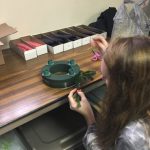
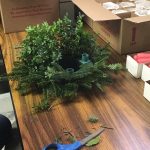
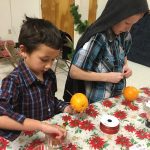
We had a great time this morning preparing for Christmas. We gathered to make Advent wreaths from fresh greens from our yard, preparing to pray our way through this season, lighting a new candle each week, until we reach the center white candle, which we will light on Christmas morning. This is a meaningful spiritual practice that can deepen our sense of anticipation and movement toward Christmas.

Beginning the creative process
Making Advent Wreath

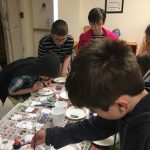
Our children also had fun making ornaments for our tree. We love the idea that each year they can return to see it hanging on our tree, knowing that they are an important part of our parish and community life.

Decorating Ornaments for our tree

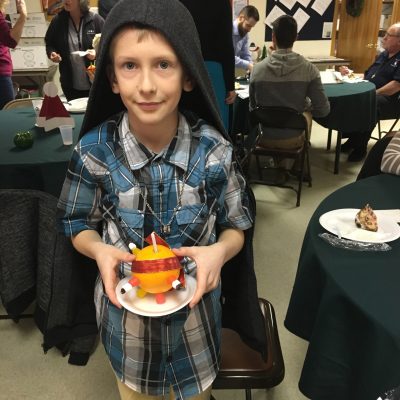
They also made Christingles, a symbolizing the light of Christ coming into our life.


img_1865

Special Candle
Special Candle

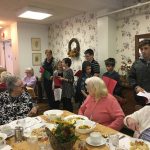
As always, one of the highlights was our Christmas caroling at The Episcopal Home. We loved it that the residents joined in with us and you could feel the warmth and joy spread through the room.

Caroling at The Episcopal Home

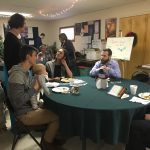
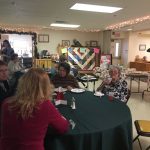
It was a time to be together, share joy, and open our hearts to being with each other as we wait for the Christ child.

Good conversations
Good conversations
Enjoying a potluck
Enjoying a potluck

Thank you all who made this a wonderful event!


The essential paradox: Christ the King on the cross

This Sunday we celebrate the Feast Day of Christ the King. We end this liturgical year hearing the story of Jesus’ crucifixion. This has got to be the greatest paradox in all of our Christian faith and narrative. Have you ever wondered how the words “crucifixion of Jesus” are connected to “Christ the King”? What about this association could possibly make sense? In the gospel of Luke, a simple statement announces this dramatic act: Jesus is crucified, set between two criminals, one who joins in the taunting and mocking, and the other who recognizes the reality of Jesus and asks to be remembered in paradise.

During my trip to the Holy Land, one of the most meaningful experiences I encountered was at the Garden of Gethsemane. It was the moment when I comprehended the role and truth of Jesus’ suffering — the suffering we are all invited into. Jesus suffered so that he would know and sanctify our very humanly existence which includes suffering, but most of all Jesus’ suffering was essential because the world was not yet ready to claim him as the Lord of lords, the King of kings; not ready yet to allow him to be sovereign over their lives, to move toward hope and promise, rather than despair.  Jesus only wanted our world to be changed by God’s abundant love, but people rejected it. They couldn’t see it; they couldn’t move toward or into it. Sadly, we can see remnants of that kind of disbelieving in our world today. But we can make a different choice (preview of my sermon on Sunday). We can indeed live our lives as if Jesus were our King. We can lay down our cloaks, hailing Jesus with the words, “Hosanna in the highest!” We pray it each Sunday: “for thine is the Kingdom, power and glory, now and forever.” Let us imagine together what it means for Jesus’ kingdom to be for us now, in our lives. This is what he whispered to the criminal to his side in his statement, “Truly I tell you, today you will be with me in Paradise.”

Here are some of my favorite photos from our time in Gethsemane. I hope they speak to you, as they did to me.

garden-of-gethsemane-worship
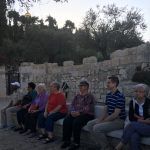
Our prayer service as we entered this space.
garden-of-gethsemane-olive-trees-and-sky
The olive trees, mighty and strong, bringing forth new growth out of a deadness within.
garden-of-gethsemane-old-olive-tree
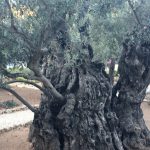
An aged tree, surviving because of it’s ability to keep finding new life.
garden-of-gethsemane-garden-prayer
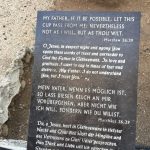
A meaningful prayer
garden-of-gethsemane-garden-peace
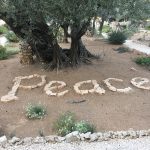
The Prince of Peace.
garden-of-gethsemane-cross
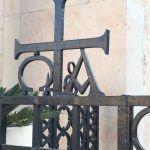
The alpha and the omega. The beginning and the end — and everything in between.
garden-of-gethsemane-cross-2
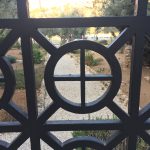
One of the many expressions of the cross of Christ in Jerusalem.
garden-of-gethsemane-church-fresco
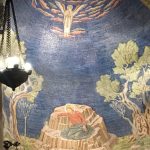
The beauty of the frescos depicting the agony of Christ.
garden-of-gethsemane-church-franciscan-monk
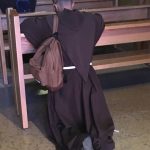
People in prayer, especially the Franciscans who claimed these sites as holy.
garden-of-gethsemane-church-ceiling
The amazing ceiling of the church . Made me think that “the heavens adore thee!”
garden-of-gethsemane-church-door2
The truth of the Olive branch – the branch of righteousness.


Christ is King. Alleluia. Alleluia!

Feeding the body and soul.

Yesterday was a spiritually “full” day, by that I mean, it was a day when the presence of God seemed to saturate us at St. Andrew’s. At expected and unexpected moments, I kept bumping into the awareness of the presence of something bigger than any of us, something more pervasive than effort any of us could sustain, and something richer than any of us could image. After a remarkable morning of glorious worship, when Deacon Wanda, Mother Carenda and I stood behind the altar, raising up in our hearts all those who have worshipped and ministered in our parish over the past five years, when we were uplifted by a homily by Veteran Amber Endrusik, our youth gathered in the afternoon to help others, and by doing so, grew their hearts.

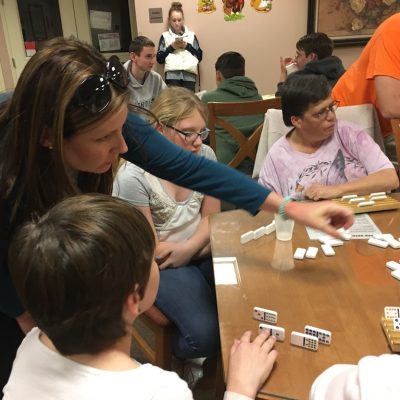
We participated in an effort called Food Recovery Network by collecting leftover food at the Shippensburg University, packed it in aluminum containers, then served it to the residents of the Episcopal Square. We presented an abundant feast, helped them fill their plates, offered them coffee, and sat and shared a meal with them. Then something marvelous happened! All of a sudden our young people were playing dominoes with them. Our young people didn’t know how to play this game, but the residents paired up with our young people and jumped right in to teach them. We went from serving others a meal to being with new friends. This is what Jesus is all about: making that shift from helping by giving to being in communion with others. We fed and were fed.

In our conversations following the meal, I became aware of how big the hearts of our young people are. They were willing to walk into the uncomfortable place of unfamiliarity to help other people. This is the zone where Jesus shows up: in our hearts, when we’re reaching out to help other people, when we’re struggling with the bigger issues affecting other people, when we want to make a difference, and when our hearts are turned toward justice. I thank God for our amazing young people, for their parents and our community who are forming them to be faithful Christians through their love of others.

Coming together as the Body of Christ: A Pastoral Letter

Dear Friends,

This week, we as a nation participated in the election of our next president; the campaign was often polarizing, contained hateful language and hurtful rhetoric, and raised legitimate issues. Many of us are bewildered as to how we have arrived at this place of major division among good and faithful people; some are confused at other people’s reaction to the results; some are elated at the results, others are distraught and afraid. Wherever you find yourself, please know that on Sunday morning, we will come together as the Body of Christ, united by a love which is more powerful than any division humankind can construct, united by a love centered in the healing balm of Jesus, united by a love which calls us to see the face of Christ in each other, and united by a love which is about moving forward in reconciliation.

Here are some assurances I offer you:
1) I am your pastor. Wherever you fall on the political spectrum, whatever your reaction to the result of the election might be, I am your pastor. I am called, and I believe that it is my responsibility, privilege and joy, to meet you wherever you are, in any situation, with love. This, I promise you, will always be true.

2) I am your priest. I believe and affirm that the Lord’s table is broad and wide, and that all are invited. Especially in the Episcopal Church, we believe that our diversity is our strength, as we live into our baptismal covenant and respect the dignity of all people.  I believe that by God’s might we will be nourished for the work ahead, helping us to build and live into the policies and future state of the nation, which will bring God’s kingdom ever nearer.
3) I am your teacher. I will continue to preach the gospel, the good news of Christ, which, at times, will be challenging to some and comforting to others. I am also here to sit with you, listen to you, explore your questions, and offer resources to help you look at the social justice issues raised in this election and explore how the heart of the gospel informs our decisions. I look forward to the time when we as a people can find ways to come together to have conversations on these issues, to make positive changes in our community which protect the rights of all and draw the marginalized into the center of God’s care, by our actions.When Mother Betsy and I were walking the streets in the Old City in Jerusalem last week, I said to someone, who was kind enough to offer us directions, “I love your city!”. He replied, “Oh, it’s not my city. It’s everyone’s city. When we can figure out how to live in peace here, the whole world will be at peace.” I feel that same way about our parish. We are poised to be an example to others, to be a community that finds a sense of peace among people who care for each other, who respect one another, who want to learn from one another, who can hold different opinions and still all kneel at the rail and praise the God who loves us all.

Forgiveness, patience, perseverance, generosity of spirit, dedication and commitment to something bigger than ourselves will be required of each of us as we move forward as a parish community and as a nation. I trust God will pour God’s grace upon us so we can do this hard and holy work.

In Christ’s love,
Mother Barbara+

Ready to come home.

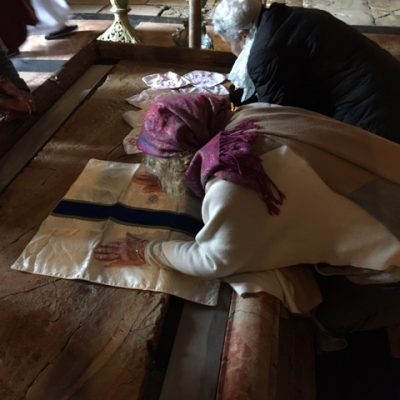
This morning I took with me the altar veil (the cloth which covers the chalice and paten) which was made out of Gretchen’s wedding dress. I chose this item to bring from St. Andrew’s, since it represented to me a true understanding of community and communion, the giving of oneself to the greater good and the glory of God. It represented to me so much of what I found as the place of my resurrection: self-emptying, surrender, commitment, and dedication to following Jesus.

Today I laid it upon the marble slab, which somehow oozes this fragrance, perhaps of myrrh, and feels like a very holy space to me. I flattened it out, in the midst of others who were placing crosses, icons, embroidery, or their hands upon the holy altar of Jesus’ healing.

img_2796-1
Mother Barbara offering a part of us to be anointed where Jesus’ body was laid.

I prayed for our parish, for healing and grace to abound, for courage and strength to follow the way of the cross to pervade our every move, to turn ours hearts ever more toward the ones in our neighborhoods who desperately need to be drawn into community. I felt grace. I felt abundance. I felt Jesus blessing us, this day and always.

I return to you this week, with an open heart and a renewed sense of gratitude and joy, that we have found each other and offer ministry together out of our love of Christ.

Stay close to the cross.

We gathered in the morning light, with the lingering clouds highlighted in a rose hue above the cross which adorns St. George’s Cathedral, and we listened to the instructions of our guide, Iyad, as we headed into the city of Jerusalem to walk the stations of the cross. The various stations are strategically placed throughout the city and many pilgrims traverse the Via Dolrosa.

2016-11-06-06-07-13

The instructions Iyad offered us seemed to be mere logistical considerations, yet they were much more for me.

Here’s what I heard him say: “Stay close to the cross”. This was a reminder to keep the group together, since we’d be crossing streets and needed to move as a group. I heard, “stay close to the place of our redemption, stay close to Jesus’ love, stay close to the healing grace Jesus so freely offered us on the cross”.

Next I heard Iyad say, “People may look at you funny for carrying a cross, but don’t worry about it”. I heard, “All that we do in the name of Christ and out of our love for Christ will not be understood by everyone. That’s okay. Be true to yourself and Christ.”

And then we headed out into the city. I heard “yalla — which had been Iyad’s cue to get moving, but I heard, “take the cross into the city, into the places we live, into the places that need to be healed, into the world, wherever you find God’s people.” (I have later come to realize “yalla” really means “Come follow me”, another good reminder to be followers along the way.

We moved as a group, headed toward the Old City of Jerusalem. We traversed the cobblestones, well polished from the millions of footsteps over the centuries. We were one of many who have made this journey. Life was beginning to emerge in the neighborhoods. We made our pilgrimage in the midst of the Muslim call to prayer, in the listening to the cock crow three times, in the awakening of sleepy cats in the alleys, in the presence of Israeli soldiers patrolling the gates to the city, past the Armenian hospice, walking in step with the Jews returning from prayer. And then we began our readings and prayers at each station, a kind of call and response, prayers led by each of us, and each of our hearts responding. Somehow the Spirit placed exactly the right reading or prayer in each of our hands, calling from the depths of our own spirits and souls that truth we needed to proclaim.


2016-11-06-06-20-24-hdr2016-11-06-06-24-222016-11-06-06-27-29

At one station, I believe it was VI, there was a woman sitting. After our time as a group, as we prepared to move along, our guide shared with us that the woman was asking for our prayers. It was a moment of grace. Mother Betsy and I instinctively moved forward, asked permission to lay hands upon her, and we prayed, and it felt as though all of us, and perhaps the whole world, was praying along. It was grace that we could offer the love Christ was sharing with us with this woman. In this exchange I heard, “taking the cross out into the city means being up-close-and-personal with others”. This ministry of taking up the cross means touching people, means sharing of ourselves, means a personal interchange. Another important piece of our pilgrimage.

We moved along and ended at the Church of the Holy Sepulcher, where we went to Calvary, where we touched the spot where Jesus hung on the cross. It was in that moment that the fruit of this pilgrimage came to bear. I know what it means for me to “return to the place of my resurrection”. It’s all about self-emptying. The greek word for this act, of course, is Kenosis, and it means the complete release within, so that we can be filled with the Holy Spirit which will guide our lives. It’s a scary thing to do. It takes into account all that I have wrestled with and been offered clarity around this week. It involves surrender, suffering, sacrifice, humility, vulnerability, and above all else, love of Christ. This step stops being scary only when we realize that emptying ourselves doesn’t leave us with nothing, but rather it leaves us with everything~ Christ in our hearts.

We concluded our pilgrimage this morning with a glorious celebration of Holy Eucharist at the Cathedral. And guess what? The sermon was about resurrection! It was one of the best sermons I’ve heard in a long time. One image the preacher left with us was a quote from his deceased wife’s book, that “resurrection is future joy brought near in the present moment” (not exact quote). His wife had described resurrection as watercolor (future joy and hope) and  seeping out over the glossy paper (our lives).

I found it. I understand this particular pilgrimage and what God spoke to in my heart. Redemption always happens. And it begins with our love of Christ and our commitment and dedication to not put it aside, and like Peter on the shore eating fish for breakfast with Jesus after his resurrection, to claim it as our own, and take the cross of Christ out into our world.

stations-leaving-ch-of-holy-sepuchler

On the move with Jesus.

We were on the move with Jesus these past few days!

The evening before, when we saw the 1st century grotto where Jesus must have spent time, either because it was his family’s home or his relatives, something shifted inside of me. I could see it. I could see the reality of what we spoke of in seminary as “the historical Jesus”. This was the real person who played and prayed, who visited relatives, met new people, created his own network of believers, I believe early on. I could so see, by watching our guide, who I believe must know everyone in Israel and the Palestinian Territory, how Jesus’ community formed him, in thought, and action, and love. I could imagine his mother, preparing him every step of the way to claim his particular and unique role in the human salvation story.

As a good Episcopalian (Anglican) I  have found it a comfortable place to rest on the 3-legged stool (Scripture, Tradition,  Reason), which freed me to uncover the truth within the scripture, without hanging my hat on the factual accuracy of each statement or story. It is true, as I have stated in my ordination vows, that I believe our scriptures contain all that is necessary for our salvation. And because I didn’t need to believe every story to be factual to contain truth, I think the reality of Jesus hadn’t been fully opened up for me, until seeing the 1st century grotto by Mary’s home. This is why I can’t wait to come home and share with you my photos and stories. I want you to capture this same glimpse of the real person of Jesus as I have! We need both, our understanding of the transcendent Christ (our risen Savior) and the earthly fully human Jesus who walked this earth, laid hands on the sick, ate meals with his cousins, aunts, and uncles, went fishing with his friends, comforted them in their sorrows, challenged their beliefs, needed times of silence and solitude, and spoke from the grotto in the hills where he preached the challenging beatitudes to an enormous crowd. I met this Jesus over the past few days.

We gathered by the river. There were fishermen there already, which made it all exactly right. We sang, “Shall we gather by the River”, renewed our baptism vows, and offered the peace to each other. It was incredibly moving to be in this space, perhaps occupied by Jesus when the dove was sent by God and ascending upon Jesus, initiating his formal time of ministry. It wasn’t a commercial site.  There were no postcard stands, nor crowds pushing upon us. It was peaceful and serene. A time of real communion. That revealed to me another part of my return to the place of my resurrection: a sense of peace and communion with others.

jordan-river-betsy-water
Mother Betsy gathering water from the River Jordan.
jordan-river-2
The calm and peaceful river.

We then went to Capernaum, where we saw Peter’s house (where Jesus healed the paralytic) and the Jewish Synagogue (where Jesus prayed and taught). It was remarkable to see the these places so integral to the ministry of Jesus.

caperneum-view-2
Ruins of Peter’s home.

We walked down to the Mount of the Beatitudes (really a hill, not a mountain) and celebrated the Eucharist.

mount-of-beatitudes-8
Beautiful sight with Sea of Galilee in the background.


Once again, surprising grace showed up! We were praying the Eucharistic prayer when another tour group arrived at the space. They were laughing, taking photos, moving around, apparently oblivious to the sacredness of the moment those of us gathered were trying to enter into. Then of course, I got it! They were also a part of our communion. No longer a distraction, but a reminder that church is not always to be tidy and orderly and set apart from the real people of God. Both times we celebrated the Eucharist outside, others have joined our group. Particularly on this day, it made me think of that special time, when Jesus was preaching on the mount, it must have been chaotic, there must  have been other conversations going on, there must have been children playing. God sets holiness right in the midst of our everyday life, which makes our ordinary lives extraordinary. Good lesson to remember.

mount-of-beatitudes-landscape-2

“Jesus said to them, “They need not go away; you give them something to eat.” 17 They replied, “We have nothing here but five loaves and two fish.”18 And he said, “Bring them here to me.” 19 Then he ordered the crowds to sit down on the grass. Taking the five loaves and the two fish, he looked up to heaven, and blessed and broke the loaves, and gave them to the disciples, and the disciples gave them to the crowds. 20 And all ate and were filled; and they took up what was left over of the broken pieces, twelve baskets full. 21 And those who ate were about five thousand men, besides women and children.

Matthew 14:16-21.