Praying with the Celtic Psalter: Does prayer fit into your day, or does your day fit into your prayer?

As part of our exploration of Celtic Spirituality, Mother Barbara has invited all of us to pray daily (morning and evening) with the book, Sounds of the Eternal: A Celtic Psalter by John Phillip Newell. Here’s a reflection by Jeanine Goodwin on her experience in preparation for our group conversation.

Wanting to get an idea of what this next flight of formation would bring, about two weeks ago I engaged in the prayers in John Phillip Newell’s psalter, Sounds of the Eternal. Soon I found myself sitting with the prayers for a few moments because things were shimmering up off the page, and soon was doing a lectio divina of sorts, reflecting on a phrase to let it lead.

One of the prayers speaks of “rekindling”, “sparks”, and “part of the blazing splendor”. It happened kind of miraculously, on the same day we heard a sermon about God calling to Moses out of a burning bush. That alone got my attention, and the thing that caught me up was that for a moment I was feeling like Moses might have, intimidated by such a big intense heat and brightness, such a clarity of call.
I found myself reaching for my current notebook, to try to capture viscerality of the insight before it slid down back into the depths of unconsciousness and have kept it at hand ever since.
From this morning what prompted a rise of the heart was, “You lift up my soul, O God, and make the eyes sparkle. You give health and life and blessing.” I realized that in the doing, partaking of as one does a sacrament, the daily practice of prayer using Newell’s psalter, I’ve noticed what happens when not doing it, almost more than what happens when I do. Keeping the notebook at hand, I can look back and see what rose up out of the text on a given day. Some days there are two entries, one in the morning, one in the evening. More often than not there’s only one. I notice when not doing it, there’s the opportunity to see what’s taking it’s place instead. I recalled the lives of the brothers at Holy Cross Monastery and saw that this practice of prayer, contemplation, is what shapes their days.
So then it rolled out thus: It’s not how my religion and spiritual practice fit into my day, but how my day fits into my practice.  The practice has started shaping the day, shapes me in my day, becomes the foundation from which my movements, and responses arise.
I’m staying tuned.
Grace. Peace.
Jeanine

Youth Mini-Mission Event: Exploring the beauty of God’s creation

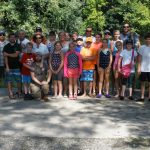
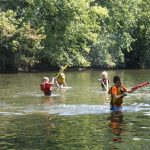
Today, in the glory of the sunshine and the beauty of God’s creation, 23 of us gathered together to spend the day enjoying each other’s company, learning something about God, and taking time to relax, breathe, put away our cell phones, and connect to something deeper within each one of us, and among us — a sense of family. We were expertly led by three guides: Joe, Jeremy, Kristin who not only instructed us on how to canoe, but also helped make the trip memorable, inviting our young people to refresh in the cool crisp water of the Conococheague, alerting us to the blue heron who seemed intent upon guiding us down the Creek, delighting with us at the large carp swimming among us, and bringing us to the perfect place to nourish our bodies and souls, when we needed a lunch break. It was a day of peace, calm, fun, and care for each other and God’s creation.

Group photo of people spending a day enjoying God’s creation.
Oh, the joy of having fun together in the water!

We ended the day reflecting upon the “best” of the day for each one of us. Answers varied from the wildlife we saw (such as a bald eagle, which was incredible!), to the varied nature of God’s creation, to the community easily formed, to the weather, to our safety, to our guides, to our sense of calm we found was finally ours to settle into.

Several of the comments offered made my heart smile– the sentiment offered was that even if they can’t get to church each Sunday, they are still welcomed, embraced, and engaged with as a part of our parish family on events like this. This is exactly the church I want us to be and live into. We say, in our mission statement, that we are an inclusive and welcoming community. This is one way we live it out: that we are not a closed club. We are not a group of people who demand a certain level of involvement or commitment to be “counted among us”. We always swing wide the door, always inviting people further into the mysterious place with God and within our parish family — and we also acknowledge and love people wherever they find themselves. Today we lived into this space. Thanks be to God!

These Youth Mini-Mission Events are designed to help us understand our relationship with our earth, and therefore, with God, the creator of the earth, and there were those among us who worked tirelessly today to help repair that relationship. One of our young people, Tom, was relentless in retrieving tires that others had foolishly and irreverently thrown into the creek. He quietly and purposefully went about his business of doing what was right, ridding the creek of pollution, finding a way to bring the tires out and then to dispose of them appropriately. It was very inspiring to see someone take this initiative to make a difference.

With care,

Mother Barbara

Civil Disobedience which changed the world – Sermon 8/27

August 27, 2017
12th Sunday after Pentecost, Year A Exodus 1:8-2:10
The Rev. Carenda Baker

What would you think if I were to say to you: “WHAT YOU DO THIS WEEK WILL CHANGE THE WORLD”? Before you make a hasty judgment about this crazy notion, I invite you to just let that statement simmer on the back burner of your minds and hearts for the next few minutes: What I do this week will change the world.

Two women once made a decision, took a risk, and changed the world. It was simultaneously a small gesture and a heroic act. They disobeyed the law of the land. And through their act of disobedience God moved to rescue a people from oppression. Their names are Shiphrah and Puah, names that are not familiar to us, but names that belong among the most well known of our foremothers in the faith.

The book of Exodus opens on a chilling note. There is a new Pharaoh in town, who is concerned about the growing population of the Hebrew people, and their potential for gaining power and joining forces with Egypt’s enemies. Pharaoh seems unaware of his own country of Egypt’s history – that for generations the Hebrew people, whom he has pegged as a looming threat, had been considered allies and honored guests. He “did not know Joseph”, the Hebrew slave, who became a trusted leader, and helped save Egypt from famine. He did not know or did not care about his country’s history.

So this new Pharaoh, driven by his ignorance, insecurity, and fear first enslaves the Hebrews, and then turns to even more sinister means to stop the population increase of Hebrews. He orders these two Hebrew women Shiphrah and Puah, who are present at and help with the birth of babies, to kill all the Hebrew boys that are delivered.
Ironically, it is the girls and women in this opening chapter of Exodus – apparently of no account to Pharaoh, of whom he should be afraid, because first these two Hebrew midwives, and then three others – Moses’ mother, his older sister Miriam, and Pharaoh’s own Egyptian daughter – prove to be his undoing. And please take note, that

Moses’ sister and Pharaoh’s daughter would likely have been young – probably teenagers.

Just think for a moment about those two midwives Shiphrah and Puah. Their daily work is to help deliver babies, to witness new life come into the world. Their daily work is to watch these tiny miracles arrive. They are the first to see and touch God’s promise and possibility, cradled gently in their hands. And now? Now they are expected to become death dealers, to participate in state-sponsored killing, to spread Pharaoh’s wave of control and terror? What are they to do? They have a decision to make. They are women of love and compassion. They deal in life and hope, in God’s dreams for the future. They decide to actively exercise their God-given wisdom and courage. They become creatively subversive. They make up a story to tell Pharaoh about why his plan to reduce the Hebrew population is not working: “We’re sorry your Majesty, but the Hebrew women are just not like Egyptian women. The Hebrew women are hardy and give birth too quickly, delivering the babies before we can get there. The Hebrew women are rough and ready, begging your pardon your Highness, so different from your genteel and delicate Egyptian women”. Shiphrah and Puah take action to de-rail the killing of Hebrew baby boys using non-violent resistance.

It is a courageous act of civil disobedience that helps change the tide of history. They are the first two links in a chain of many people who will eventually be lead out of slavery and oppression in Egypt by Moses. Liberation starts here, with two women willing to say “no” to an act of cruelty and injustice.

These two women likely never considered that their actions would change the world, but they did – by remaining faithful and doing what was in their power to do. Of Shiphrah and Puah the text says they “feared God”. They recognize the ultimate power of God over empire, and they show loyalty to God. They continue to do their life-giving work with integrity and help save a people by following the dictates of their hearts, and by heeding the call of conscience.

Maybe you’ve heard about another rescue story that happened earlier this summer on July 8th in Panama City, Florida. Roberta Ursrey, along with her two sons, 8-year old Stephen and 11-year old Noah, her mother, and other members of her family were enjoying a nice summer day at the beach. The two boys were in the water swimming when suddenly they found themselves swept away from shore by a strong riptide. The boys were suddenly unable to swim back to shore and began yelling for help. There was no lifeguard on the beach. Their mother quickly swam out to try to help, but was soon overwhelmed by the current as well, and also found herself unable to get back to shore. Her mother, the boys’ grandmother, followed them into the water in an attempt to reach them, along with other family members, and eventually others who wanted to help. Soon there were nine people unable to get back to shore, all in need of rescuing and in danger of drowning. As each minute passed, the situation became more frightening.

Someone dialed 911. Eventually a police officer arrived and called for a boat rescue, but there was grave concern that the boat would not arrive in time. It was at that moment that Jessica and Derek Simmons, both strong swimmers who had just arrived at the scene, came up with a rescue plan. They knew that even though they were strong swimmers, there was no way they could save nine people by themselves, and so they gathered the crowd on the beach into a rescue team. In a matter of minutes, first 12, then 25, then 50 and eventually 80 people worked together to form a human chain, one that reached out through the water far enough to reach the nine people at risk of drowning.

One by one the nine people were carefully passed along the human chain until all of them were brought safely to shore. The chain had been formed just in time. Roberta, the boys’ mother, had just started to black out when she was reached. She later reported that she was sure she was about to die moments before help arrived. Roberta’s sixty-seven year old mother experienced a heart attack as she was being brought to shore, and was rushed to the hospital. She is now recovering well. Surely without the quick thinking and cooperative efforts of the people on shore, lives would have been lost.

After the rescue, Roberta Ursrey said: “I am so grateful. These people were God’s angels that were in the right place at the right time. I owe my life and my family’s lives to them. Without them, we wouldn’t be here.”
Jessica Simmons, one of the quick-thinking lead rescuers said: “I knew we had to do something. To see people of different races and genders come into action to help total strangers is absolutely amazing. People who didn’t even know each other went HAND IN HAND IN A LINE, into the water to try and reach them. Pause and just IMAGINE that.”

Strong riptides and dangerous currents come in many forms, and at any moment, any of us can find ourselves in need of a human chain of support, or can find ourselves with the opportunity to be a part of such a chain.

Might it be possible that we regularly underestimate the power of our actions, and the difference we can make in the world?
Friends, our job as people of faith is to listen closely for where God is calling us to act, individually and as part of a chain with others to help bring new life into our world.

Maybe it will be when we seek reconciliation in a relationship with a family member – a friend – or a co-worker.

Maybe it will be when we admit we are holding on to a stereotype of some person or group that is false, and we ask for God’s forgiveness and help to change our thinking.

Maybe it will be the moment we find our voice to challenge another when some person or group is being mistreated. This could include a face to face encounter in person. Or maybe you will find your voice and take a stand to support the victim of cyber-bullying.

The diocesan youth and leaders serving here this weekend among the residents and staff of the Episcopal Home have worked enthusiastically to share God’s light and love. So how will each of us join in spreading that wave of goodness, faithfulness, and joy in the coming week?

Dear people of God: we have been challenged here by God’s living Word, and will receive nourishment and strength at God’s table. Let us pray to be the vessels used by the Holy Spirit to breathe hope, healing, and reconciliation – to bring the good news of liberation – that will change us and this world – to the glory of the God of our salvation. Amen.

Negative Space and God’s yearning: Sermon for 8/13/17

St. Andrew’s Episcopal Church

The Rev. Barbara Hutchinson

Proper 14, Year A

August 13, 2017

In art, negative space is defined as the space around and between the subjects of an image. Negative space may be most evident when the space around a subject, not the subject itself, forms an interesting or artistically relevant shape, and such space is occasionally used to create an artistic effect as the “real” subject of an image. The negative space, the empty space, becomes what we should be looking at or attending to, or where we find that which inspires us, and amazingly, our brain seems to leap to see this image in the negative space rather adroitly.  I’m sure we’ve all seen the image portraying a white vase and have been fascinated when our eyes seem to quickly shift to see the profiles of two silhouette faces looking at each other. The negative space is what we were actually supposed to see.

Negative space can draw our attention and reveal the truth in art, as well as, I believe, in relationships, in family dynamics. After all, don’t you often find that the family secret is what really drives the dynamics in a family? That which will never, could never be shared, contains the power to control behavior for generations to come. Sometimes you may find it is not what is said in an argument that really matters, but rather what goes unsaid. Or the absence of the same sweet tone in the mother’s voice to the son who feels less favored, seems to speaks volumes to everyone. The negative space, that which is not spoken, that which is not given, that which is lacking in response or emotion, I believe can strongly influence family dynamics.

Negative space in the way a story is told can also be a powerful tool to reveal the truth the author is inviting us into. This is true in our narrative about Joseph this morning. His father Jacob loved Rachel. It is one of the few places in the bible where love between a husband and wife is mentioned so clearly and succinctly. Jacob loved Rachel, from the moment he set eyes upon her at the well. Yet he was tricked into first marrying her sister Leah. The negative or empty space that drives this narrative is in Jacob’s heart. His other wives, the one he was tricked into marrying and the slaves given to him for procreation of children, bore child after child to him. Ten sons and one daughter were born through women he didn’t love. I imagine he felt some attachment to the children. I imagine he delighted that the promise of God was being fulfilled that he would carry forward the blessing of God to become the father of nations. And I also imagine, when he looked at the family gathered in the evening by the kitchen fire, and he looked from one to the next son, and there was a negative or empty space, always present, where he yearned for one of his own, one born from his love of Rachel. I imagine the boys picked up on this, saw the wistful look in their father’s eyes as he looked at them and then beyond them, staring off into space, and even in that fraction of a second of the gaze, they knew they weren’t enough. The empty space in Jacob’s heart held the truth that they always knew, but never talked about, they were not enough. Jacob loved Rachel. He wanted their union to bear fruit, so he could love their child with a love he not yet experienced with his other children. He longed to know how the depth of his love for Rachel, the wife he loved, would be deepened by bearing a child together.

It is no wonder that the brothers despised Joseph. Upon his birth, they saw the lift in their father’s spirit, they noticed the adoring way their father looked upon this baby. His face would shine with a gladness they had never seen before, they noticed the increased closeness between Jacob and Rachel, which had not ever been seen between their mothers and Jacob. Jacob’s empty space had been filled with Joseph’s birth. The empty space, the negative space, the space filled with longing for their father’s love and affection, within the brothers had been amplified. The negative space of longing for love drives the action in this story.

Maybe Jacob could have, should have, kept his favoritism more hidden. His blatant display of this special love of Joseph in the gift of the fancy long-sleeved coat, which signified a special status, one that reversed the cultural norm that the eldest son typically held, didn’t help. And Joseph sharing his dreams where his brothers would all bow down to him, may not have needed to be said in that way, with Joseph naively expecting them to be delighted in that fact, that the one called to be their helper would become their master. After all, hadn’t he heard the wisdom that if it’s not kind nor necessary, then don’t say it? What was he thinking? Or maybe Joseph sensed his brothers’ negative space, the unspoken bad energy, and Joseph wanted to get back at them. The only way to combat their hatred of him was to claim a sense of dominion and privilege, and we know that’s always a slippery slope.  And maybe Joseph didn’t have to come back and tattle on his brothers and be the righteous one in a way that further separated him from his brothers. But I bet none of that mattered. The fullness Jacob felt at the birth of Joseph set this plot in motion. The loneliness, the yearning for more, the emptiness in the hearts of the brothers each time Jacob looked at them and then beyond toward whom he wished for, the one he would love upon Joseph’s birth, drove the action in this story. The set up for the confrontation experienced in our narrative this morning happened way before Joseph’s dreams and his stumbling upon the brothers out in the wilderness, away from their father’s protection.

We have negative space, that which is not spoken, that which reveals the truth, that which drives the action, here in our story before Joseph is born, during his life with his brothers, and after their selling of him to the Midianites, off to Egypt.

Just imagine for a moment the horror of the family life after the brothers return without Joseph? The negative space, the words not to be spoken, that words which hold the truth that can never be shared, that the brothers came home with when they allowed their father to come to the incorrect conclusion that Joseph had been killed? The brothers may have gotten rid of Joseph physically, but he was still there in the household. I can’t imagine that any of those brothers could ever have looked their father in his eyes again, for they would see the emptiness they saw before Joseph was born and they could not bear it, because they have now caused it. Emptiness, deception, despair, this empty space ruled the household and drove the action.

There are two challenging questions for us in this story. I’ll let you pick which one fits you right now.

The first one is: Does God, like Jacob looking at and beyond his 10 sons, when looking into our souls, want more from us? Does God see our incompleteness or our unwillingness to give all that we have and all that we are to our life in God, and yearn for more from us? Do we need to look at whether we love God with all our heart, mind, body and soul? Is there more that we can give, more whom we can love, more to whom we can reach, more within us to stretch, more within us to care, space within us to move beyond ourselves. I believe God wants us to go there, until the space within us has been wholly given over to be God’s space, when all possibilities are explored, when all doors are thrown open, when we no longer quiver in fear of not having enough if we give it all away, and we embrace the love of God. God sees the negative space in our soul and doesn’t want that to be our truth.

However, of course, these challenging questions beg the larger question – does God love us in our incompleteness? In our allowing of ourselves to not be fully who we can be? Absolutely yes. As Desmond Tutu says, “There is nothing we can do to make God love us more, and there is nothing we can do to make God love us less.” Yet, that statement should not lead us into a place of complacency, for I do believe that God is yearning for what we have not yet birthed in our lives, as Jacob yearned for Joseph before his birth, so that the negative space, the unspoken parts of our lives no longer drive the action of our lives, but rather it is the God part of our souls, the creative positive part of our souls, that drives the course of our lives.

Our best chance of changing negative space to God space in our hearts is when we allow ourselves to be transformed, when we allow our faith to go from our head to our heart, when we stretch out our hand and receive something life-giving from Christ, his body and blood, and we change, and we love. As Christians, we want our actions to speak louder than our non-actions. We want the truth we claim as members of the body of Christ to be stronger than the secrets we hide.

So, the first challenging question is: does God see the emptiness or negative space in our souls and yearn for us to become more? or birth more of God’s goodness in our lives? The answer to that question for each one of us is “absolutely yes”.

The second challenging question is: rather than seeing the emptiness or incompleteness that we need to fill, does God see the negative space, wishing that we have it all? Does the generous and abundant God want to give us more? The answer to that question is undoubtedly “yes”, but the question to ourselves is “Can we receive that?” Can we take it all from God? For that will involve opening ourselves, creating a space for vulnerability, for change, for radical reorientation of our lives, to letting grace cling to and release pain, to finding ourselves worthy of God’s love.

Each challenge is right and hard, whether it is allowing ourselves to be transformed to become all that God desires of us, or whether it is allowing ourselves to be transformed to receive the fullness of God’s love. Negative space has power, but God’s love has greater power. Let us allow that, God’s love, to be what drives our lives. Amen.

 

Sermon for the Feast of the Transfiguration by Jim Smith

St. Andrew’s Episcopal Church

Mr. Jim Smith

The Feast of the Transfiguration

August 6, 2017

Good Morning. For those of you who do not know me as well, my name is Jim Smith and in two weeks I will be heading to Macalester College in St. Paul, Minnesota, where I will be pursuing degrees in Geography and International Relations. During my seemingly brief five years at St. Andrews, I have had the pleasure to serve on the Vestry, sing in our choir, and find meaningful worship opportunities that have shaped and strengthened my faith. As I look out on my parish family, I feel an overwhelming sense of community, the very feeling that gives me comfort sharing my thoughts, feelings, and reflections upon this set of scripture. My goal today is not to prophesy, but as Peter in our Epistle today suggests instead, share thought-provoking analysis guided by the Holy Spirit as we celebrate Christ’s transfiguration.
I want to first think about the miracles of God. They are wondrous and infinite; I am looking at a room full of them right now. More specifically though, we must think of the miracles of God through Christ. What first comes to mind when we begin discussing Jesus’s miracles? Christ walking on water in the stormy and turbulent Sea of Galilee, his feeding of the five thousand with few loaves and fishes, raising Lazarus from the dead, his many healings, treating those afflicted with anything from blindness to leprosy, turning water into wine? All of these miracles and the countless others were all performed for the same core purposes: to make others believe in the glory of God, to strengthen the weak of faith, and to teach vital lessons and values to the crowds of all kinds watching these unbelievable feats. I can just imagine an entire village of curious observers watching a strange man, a carpenter’s son from Nazareth, performing these acts, seeing the astounding truth of God for the first time. This miracle though, is different.
Widely considered by religious historians and scholars one of Christ’s great miracles, the Transfiguration was not performed or made known to the same type of audience. Peter, John, and James, Jesus’s most faithful and outspoken disciples, were already believers, already witnesses to the truth and power of the Lord. Why else would they have even been present? This particular mountain, Mt. Tabor in Galilee, was a treacherous climb in a rugged and inhospitable landscape. These disciples would not have journeyed over one hundred stories skyward over this craggy terrain just to pray if it weren’t with the Son of Man. So, we must then look at context, the events that surround this miracle to understand why God felt these disciples needed to witness it.

We need to look no further than the previous verses in the book of Luke, the event that Luke tells us took place six days before this one: Jesus telling his disciples of his impending death and resurrection. In Luke 9:22,

“The Son of Man must undergo great suffering, and be rejected by the elders, chief priests, and scribes, and be killed, and on the third day be raised.”

As one can imagine, upon hearing this the disciples must have been aghast and alarmed. Their Jesus? Their god? Suffering, rejected, killed? This was first time they were clearly told that the Prince of Peace was to meet his ever-so-violent end. This could have occupied days of conversation… “No Lord, you must not go, you do not deserve it. You don’t have to die; your work has just begun.” But Jesus finished this dialogue with his resistant devotees with a curious foreshadowing. Luke 9:27 tells us,

“But truly I tell you, there are some standing here who will not taste death before they see the kingdom of God.”

And Jesus, as always, was exactly right. When on the mountain, two significant figures, Moses and Elijah, came down from heaven as apparitions in dazzling white. This was the aforementioned Kingdom. But it made them no less objectionable to Jesus’s fate, who was speaking to his fellow prophets about that very subject– his departure. But then, when the cloud encompassed them, they too were thrust into God’s conversation.

“This is my son, my chosen, listen to him!”

And although these words from God the Father certainly didn’t make them fonder of Jesus’s fate, it made them less resistant. The miracle of the transfiguration was not to establish faith in Christ, but faith in his future, so that he could live and die for our salvation.

But what can we, two-thousand years later, take and learn from this episode? For the mortals in this encounter, specifically Peter, seeing and hearing their God in a brand-new way was a peak moment in their already-strong faiths. And how does he react to this mountaintop experience? By trying to hold onto it, trying to artificially extend his time with three of God’s greatest servants ever to live. Can we blame him for this response? What would you do in the face of Moses, Elijah, and Christ himself? Instead of being continuously paralyzed with awe, as many would be, Peter spoke, made a suggestion, unafraid of being wrong. Peter saw the kingdom of God and wanted more time in it, as we all would.

This sequence of events reminds me of a semi-often occurrence in my own life. Some of my closest moments with God and God’s kingdom are in my dreams, that weary, vulnerable state where we have seemingly no control. But then, just as in a frightening dream, I suddenly awake at the first sense of consciousness and excitement due to a closeness to God. Frustration replaces wonder as I realize what has happened. I may aggressively push my head into my pillow, trying once more to fall asleep, quickly attempting to reconnect and pick up my dream, my experience with God right where I left off. To my dismay this never seems to work.

The lesson we learn from these phenomena is a vital one. We mustn’t try to hold on to these mountaintop experiences. Whenever we see glimpses of the kingdom of God and reach these mountaintops we must let them shape us, our actions, our faith. How was Peter different as he journeyed down that treacherous trail? By letting our intimate encounters with God shape us, however brief or fleeting they may be, we afford ourselves the opportunity to live as servants of the Lord.

The transfiguration allowed Peter and the others an understanding of the future of Christ– no not just his suffering, rejection, death, and resurrection, but this our worship and modeling of the values he so tried to teach. My parish family, this the future of Christ!


A Festive Sunday!

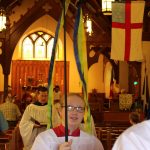
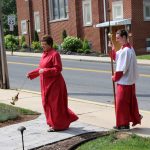
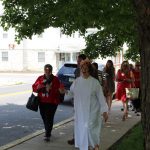
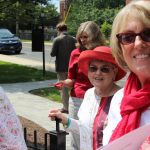
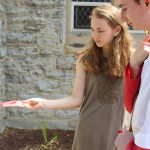
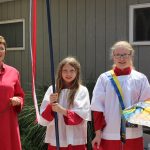
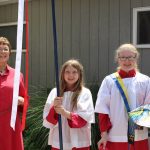
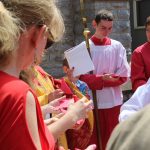
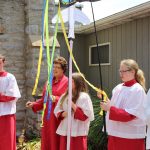
We celebrated and gave witness to the arrival of the Holy Spirit to the church as it began (Feast Day of Pentecost) and to our parish as we continue to live into the mission Jesus presented to his disciples. It was a glorious celebration! We prayed, preached, offered healing comfort and celebrated the renewing sacrament of the Holy Eucharist, only then to take the good news out into the world, as we processed to the Memorial Garden for the release of butterflies. Led by our verger, with sweet smelling incense flowing from the thurible, banners of a butterfly and dove, and envelopes containing butterflies ready to spread their wings, we gathered, prayed, and set the butterflies free. It is always with such delight that we see them take flight, knowing we have released them to live here among us, and to be a symbol of the Holy Spirit taking us out into our community and filling the world with love. I found it particularly poignant that some butterflies seems to purposefully fly directly to the church across the street — could it be the Spirit leading us all into closer connection? !! Here are some photos from our glorious celebration. Come Holy Spirit!

Youth Mini-Mission Event: Growing hearts by getting our hands dirty

I never want to take for granted the good-will of our young people. Many are teenagers and it wouldn’t surprise me, nor appall me, if once in awhile, I saw a discrediting look, or a rolling-of-the eyes, or a resistance to roll up their sleeves and do some hard physical work. Yet what I see instead takes my breath away. Rather I see willingness to do whatever is asked, or I see their capacity to stretch to meet the new requirements of the situation, which may have seemed out of their comfort zone before, or I see their ability to tell jokes and laugh together in a way I had not sensed before, or I see a sensitivity to include others, like a young resident of the WIN shelter today in our activities, which seem “normal” to us, but are anything by normal to her.

Our young people are truly amazing, which makes the work of the church in some ways easier and in some ways more challenging. We’re starting with young people who have been taught to care for others, so that makes our “work” of engaging them in mission events easier, for their hearts are already headed that way. It makes our “work” of engaging them in mission events more challenging, for it means we need to invite them into hard situations, so they realize caring for others comes at a cost. Sometimes that cost is discomfort that the world isn’t as we wished it would be for all people.

Today our young people and accompanying adults went to the new Women-In-Need shelter, which is designed to provide safe refuge for victims of domestic violence and sexual abuse. I have been on the board of WIN and then active as a volunteer and active as a PA Advocate for victims of domestic violence and sexual abuse. It has been a time of intense learning and sorrow at the way others have been forced to live. I have learned a lot about life through this experience.

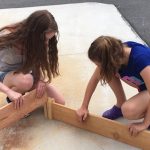
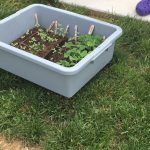
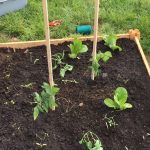
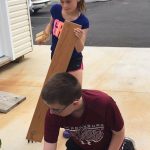
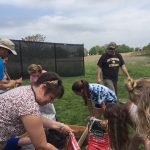
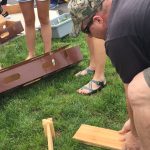
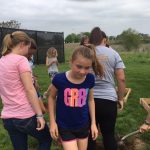
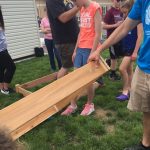
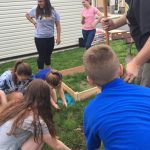
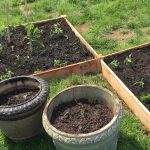
Our physical work today involved clearing sod from the garden area, assembling the raised beds, filling them with topsoil, and planting vegetables and herbs, either grown from our seedlings planted months ago and nurtured by the Hawkins family or provided by WIN. Our spiritual work may have involved asking the question why some people’s lives unfold this way and where God is in it all.

There were two stunning moments today for me. One was when one young resident (9 years old) came and joined us in the planting and fun. She laughed, planted plants and giggled over the jokes about the “creek” created by the overflow of the hose. She had a chance to have “normal” fun, a real treat to her, I suspect.

The other joy was one of the women in the shelter who came to help us plant. We asked her advice on where to plant the cucumbers, and she clearly knew her stuff. She offered good advice on where and how to put the plants together. I don’t know if we realized the value of asking her opinion, but I bet it meant the world to her. Most women who come to the shelter have no idea of who they are or of any value they have, so she clearly is making great progress. That’s to be celebrated.

Today was a great day of service. My heart is filled with gratitude that we are a church who makes this a priority and see it as a way to be formed in our faith.

Please see the photos below or view the photo gallery on our website: www.standrewsshippensbur.og.

Many blessings,

Mother Barbara

Dirty hands for a good cause
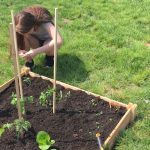
Building the raised garden bed
Thinking about how this will all fit together
The seedlings we planted weeks ago
Figuring it all out
Planted beds, ready for tending
Let’s build this thing!
Creating flower pots with zinnias to cheer the heart
Our budding photographer
Adding the soil.
Even the adults help out
Working together
Sorting it all out.
Here we are!


5th Anniversary of the Ordination of Deacon Wanda Kloza

We were blessed this morning to celebrate with The Rev. Deacon Wanda Kloza as we as the church celebrate her 5th Anniversary of her ordination. Wanda was raised us by our parish as a deacon and has served our parish and the diocese faithfully these past five years. Wanda continues to inspire, challenge, and empower us to serve God by serving our neighbors, and to do it in community.


Shortly after I arrived here at St. Andrew’s, I was asked to represent the parish and offer our support to Wanda’s ordination as a deacon. As we sat before the Standing Committee, Wanda was asked, “Why do you need to be ordained to do what God has called you to do?” A typical answer could be, “Well, if I have a collar around my neck, then people will recognize that I am doing God’s work, or they’ll feel comfortable talking with me about their problems,” since often the response involves the value of being recognized as someone representing the church. That’s important, but Wanda, however,  gave the most extraordinary answer to this question, and one which will always reside in my heart. Wanda said, “I will have bound my heart to God in a brand new way.” Wanda understands that ordination sets us aside to represent the church in our world ~ and Wanda understands it is a deep and solid spiritual commitment to bind our heart to the God whose heart fills the world with love. Wanda is a deeply faithful person who understands how to surrender completely to the God she loves.

While Wanda was at St. Andrew’s, she was instrumental in the development of SPO (Shippensburg Produce Outreach) and has continued her ministry of feeding the hungry as a Diocesan deacon, spearheading the Diocesan ministry of “Feed My Sheep”. Wanda continues to be involved with our parish, worshiping with us when she is able, and with involvement in our Youth Mini-Mission Events.

I’m sure you feel the same way I do, life is always better when Wanda is around! There’s a spark of energy, an openness to the Spirit, and a drawing together of community which she so naturally brings with her.

Congratulations, Deacon Wanda! We love you!!

Blessings,

Mother Barbara

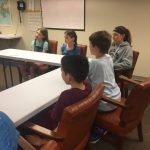
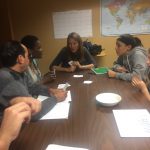
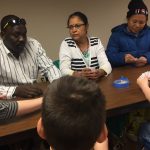
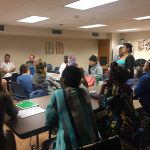
Youth Mini-Mission Event – ESL Class with refugees

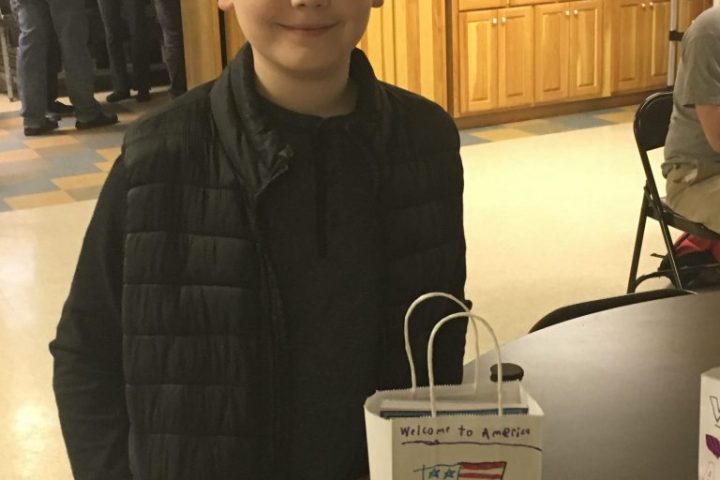
On the Monday after Easter, our young people and adults went to Catholic Charities in Harrisburg to meet and work with refugees who were in an ESL (English as a 2nd Language) Class. It was a wonderful way to take the gift of the joy of Easter (the risen Christ) out into the world, to help make a difference to those in need. Jesus instructed us to “welcome the stranger” and that’s exactly what we did.

We shared our goodie bags which we created before and brought with us a number of bilingual dictionaries to offer to the class.

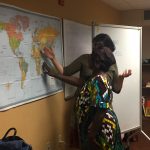
The class was amazing! We began with the teacher asking the students to show us where they come from, pointing their home country out on a large geographical map. We were fascinated so many people come from Bhutan. There are 7000 refugees in the Harrisburg area from this country. These are people from Nepal who have been pushed out of the country and forbidden to return. We also met a man from Iraq and a number of people from Central Africa.

ca. 
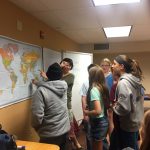
We discovered how easy it is to communicate with people who don’t speak the same language. Laughter and love seem to be universal languages.

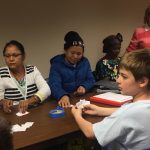
We helped the students learn how to speak some beginning word sounds, since sounds such as “f” are not found in their native languages. We played “Go Fish” to help them with this exercise. We also engaged in conversation, asking them basic questions, and responding to their questions. It was fascinating and heart-warming to be a part of something that is helping people settle into our country and learn our language.
 

          I
We had a wonderful time. Our hearts were stretched and filled with a sense of compassion and love. There were many ideas of how to extend this ministry. Hopefully, there will be more to come!

All of us, together!

Youth Mini-Mission Event – Serving residents at Bethesda Mission

Our youth began Holy Week by serving others. As adults who plan these events, our focus is on our young people experiencing what it means to follow Christ. We don’t use that language necessarily, and although we debrief afterwards and are willing and ready to talk about what the church does and thinks about the work we’ve just done, the emphasis has always been on developing the hearts of our young people to care about others. If we can do that well for our young people, there will be a place for faith in their lives, for they will discover, almost unexpectedly, that their hearts will be turned toward bringing goodness and healing into the world, and there aren’t too many better definitions of what faith is all about than that!

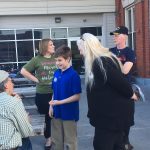
We gathered at Bethesda Mission, a homeless shelter for men in Harrisburg. There were 25 of us from St. Andrew’s, there to tour the facility and the serve the guests (those who come through the Soup Line, who are not residents of the home) and the residents (those who live at the shelter and are actively engaged in steps toward creating a better life for themselves).

Deacon Wanda met us there as she had made the contact with the mission. She did a great job of engaging us with the residents, encouraging us to pray for those who had asked for our prayers, and to hold the mission in our thoughts.

We were delighted that the facility was so well run and kept. There was a brand-new medical and dental clinic available to the residents. The hallways were freshly painted. Everything was spic and span! They also provide lockers for the residents to have a safe place to keep their belongings, which is so important.Also, they recognize that when people come off the street, they come “as they are”. They offer them a package of clean towels and sheets and toiletries, and treat each person with dignity and respect.

They have a well-filled pantry, stocked with donations from companies and individuals. Anytime you would like to donate food, there is an outside donation center where you can drop off clothing or food. We brought lots of new men’s crew socks, since that’s something that often is needed.
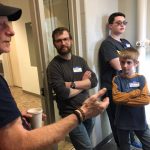
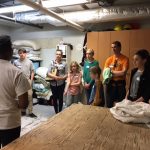
They do have an over-abundance of men who stay there than beds, and pull out these mattresses at evening so all have a place to sleep.


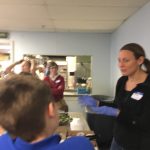
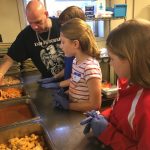
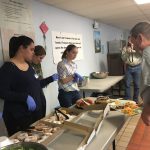
We had a great time serving the meal to the guests and residents. Some offered salad, others desserts (very popular) while others served the main course of fish, rice and beans and vegetables. All the residents were so grateful for our presence. I loved it that our young people felt so at ease with everyone, always wishing them “a good evening”. It’s the little things that really matter and our young people naturally thought of just the right things to do and say.


After we had fed them all, we went out to eat our dinner and to enjoy each other’s company.


It was a great day and wonderful way to enter into the holiness of Holy Week, by doing what Jesus did, feed the hungry.

Youth Mini-Mission Event – Refugee Resettlement

During these winter and spring months, our young people will be learning about and helping people who are displaced. These people will include refugees (people who come legally into our country to escape persecution), people who find refuge in domestic violence shelters (Women in Need), people who live at a Ronald McDonald House while their children are being treated at a nearby hospital, people who are homeless, people who are in military service, children of migrant workers who move with the farming work, and people returning home from military service.

This past Sunday we were blessed that Nina, an American citizen who came to our country and specifically to Shippensburg 22 years ago with her family due to persecution in Bosnia, shared her story with us. Nina and her son are amazing people who are dedicated to make the best of their lives here, in gratitude for the opportunity afforded them. Nina’s family were sponsored by Memorial Lutheran Church, whose members helped her parents find work, and who helped them settle into school and our community.

We also were fascinated by the story of David Luo, a faithful member of our parish family, who shared his journey into American citizenship as a refugee as his father resisted the actions of the Chinese government in the Tiananmen Square protests. Christina Luo, then shared her experience as an attorney helping those seeking asylum due to persecution in their home country. It was a very rich experience we were able to share.

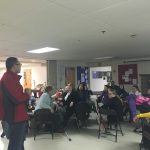
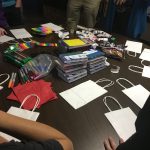
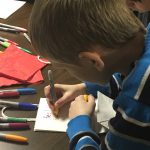
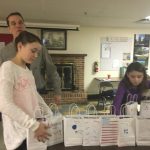
Our young people then prepared goodie bags for the adult refugees they will be helping in their ESL class sponsored by Catholic Charities in Harrisburg. Nina shared how helpful these classes were for her parents, which makes our work seem very meaningful. It is a gift that we can teach our young people how to take Jesus’ commandment to “love one another as I have loved you” very seriously.

Absalom Jones Feast Day Celebrated Feb. 12th

This past Sunday we celebrated the Feast Day of Absalom Jones, the first African-American Episcopal priest. He helped form St. Thomas Episcopal Church in Philadelphia. Absalom Jones was born into slavery and ultimately was freed and bought freedom for his wife. He had the love of Christ in his heart, was a great evangelist, and was dedicated to breaking the bonds of slavery and to do it in the name of Christ.


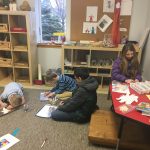
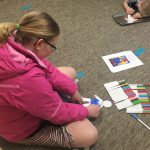
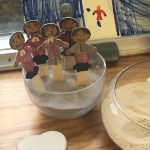
Our Godly Play class heard the story of Absalom Jones and then created puppets depicting characters in his story. Mother Barbara also preached on the texts celebrating his feast day and told the story of how he answered Jesus’ commandment to “love one another as I have loved you”. To read the sermon, please go to the sermon archive on this website.

Here are some photos from the day:

Absalom Jones is part of our Episcopal heritage. It’s good to continue our education about him and our Episcopal story.