To download a bulletin so you can sing along, join in the prayers, and read the weekly announcements, please click below.
To watch the marvelous Virtual Choir alone, please click below.
To download a bulletin so you can sing along, join in the prayers, and read the weekly announcements, please click below.
To watch the marvelous Virtual Choir alone, please click below.
We gathered this week in a time of conversation regarding the book by Richard Rohr, The Universal Christ. What I am noticing that completely delights me is that people are asking very basic questions. One might imagine that means they are at the beginning of their spiritual journey. Oh, not so! It actually means they have travelled quite a distance, so they can begin to wonder and question within their faith, where they are not satisfied with what they were always told was true, but rather, they want to know the truth deep within them.
We began our conversation around original sin or original goodness. It is interesting to note that the focus on original sin with the emphasis on the 2nd creation story (the fall) rather than the 1st creation story (the goodness of all creation) came into being in the 4th and 5th centuries and was not a part of the early church writings or theology. It was a very interesting conversation.
This discussion led us naturally into the exploration of the question — if we focus solely on the life of Jesus, without considering his death, what do we learn about the nature of God, about ourselves, and about our relationship with God? A corollary question is — if we focus solely on the death of Jesus, without considering his death, what do we learn about the nature of God, about ourselves, and about our relationship with God?
Some answers offered were:
About his life: Jesus was a teacher, healer, lover, walked alongside people, never gave us, believed people were capable of change, and had a perseverance about him that was astonishing.
About his death: Jesus understands vulnerability and woundedness, there are things worth pushing up against (power, oppression) that is worth risking everything (causing “good trouble”), and that Jesus can enter into, understand, and redeem our suffering.
When we put all of this together, we can realize that we are in relationship with a God who loves us, believes in us, invites us to grow and change, walks alongside us in vulnerability and woundedness and redeems it (offers new life) and is asking us to be healers, which at times, means pushing up against that which is not of God.
We then engaged in a contemplative exercise on Gratitude, launched from Rohr’s statement, “The only way, then, to increase authentic spirituality is to deliberately practice actually enjoying a positive response and a grateful heart.” We drew to heart a recent experience for which we were grateful and asked the following questions:
We meet every other Thursday at 2 p.m. If you would like to join our group, you are very welcome to do so. Just email Mother Barbara for the Zoom link.
We continue our exploration of the Early Church Writings, working our way into the Gospel of Matthew. This past week, we read aloud the first 5 chapters of the gospel and then delved into the historical context, learning about Matthew’s take of Jesus as the “new Moses” and how he built his case for that connection, between the genealogy, wise men, exile into Egypt, baptism, and then the Sermon on the Mount (on the mountain as when Moses received the 10 commandments on mt. Sinai)/ We spent time intentionally sitting with and reflecting upon the beatitudes, how they connect with Matthew’s gospel, and what they mean to us now.
We continue our study on Wednesday, 4th. Please email Mother Barbara for the Zoom link.
For the study guide, please click below.
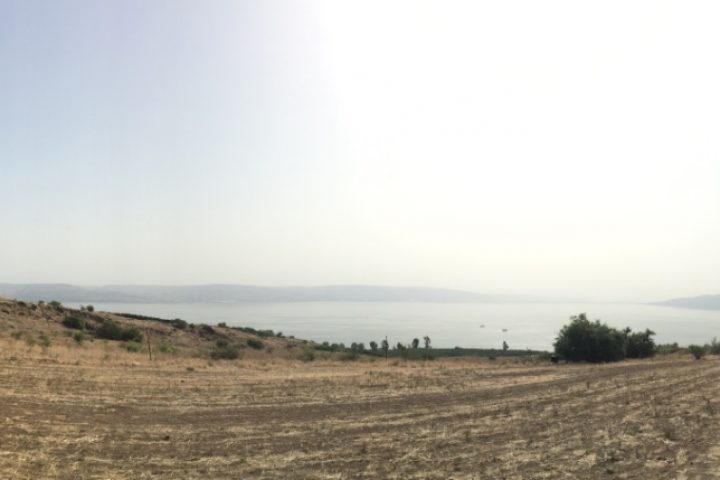
The image shown above is of the site near the Jordan River where Jesus offered his teaching on the beatitudes.
To download a bulletin so you can sing along, join in the prayers, and read the weekly announcements, please click below.
To engage in the homily alone, please click below.
We are delighted you are worshiping with us from the safety and comfort of your home. Please settle into our worship and allow your heart to be strengthened, your soul restored, and your body refreshed by this worship service of prayer, scripture reading, glorious music, and a homily.
To download the bulletin so you can read along and sing the hymns, please click below.
To listen to only the homily, please click below. We are blessed to have Canon Chris Streeter to be leading worship with us.
This past week we gathered first to hear the Letter to the Colossians read aloud, for that was what was always intended, that we would hear the good news, rather than read the good news, since it offers additional opportunities to engage with the sacred text. Often we find when we read the entirety of a book of the Bible, we gather a larger message, rather than hearing only a snippet of the text on Sunday mornings.
This past week we delved into this letter, which is attributed to Paul, but generally believed not to be Paul’s authorship. Several of the topics considered were: 1) prayer for spiritual wisdom, 2) exploration of the Hymn of Christ, 3) proper meaning of the crucifixion, and 4) maturing in Christ.
To download the study guide prepared by Mother Barbara, please click below.
Our conversations are designed to know the scripture at depth, to explore how they interact with our lives today, and to see the larger arc of the development of Christian thought. All are welcome to participate!
Refresh your spirit as you listen, watch and participate in this beautiful and holy time of music, prayer, reading of the Holy Scripture and the Holy Eucharist. Prepare your hearts for a rest and refreshing. Click below to access the bulletin for this service and to participate from home.
To view the video for this service click below and allow your spirit to be filled with joy.
To download a bulletin to follow along with the hymns, readings, and responses, please click below.
To listen to the homily only, please click below.
We gathered this past Wednesday to explore Paul’s 2nd Letter to the Corinthians as part of our exploration of the Early Church Writings.
We explored such topics as 1) affliction and consolation, 2) power in weakness, 3) the gospel being the treasure in clay pots (we’re the clay pots), 4) the development of the notion of a judgment day and the role of the resurrected Christ at that time, and 5) Paul’s emphasis on mercy and compassion.
We always study the historical context of the writing and identify new theological concepts and then apply the text to our own lives.
To read the Class Outline with Questions to ponder, please click below.
Our youth at St Andrew’s Episcopal Church are growing in knowledge and understanding of the Holy Scriptures as they study together and take time to ask many valuable questions. We did an 8 minute youtube romp through all the books of the Bible, spoke of the timeline, origins, the different languages.
Their pre-class work was to take a virtual tour of the Bible Museum in Washington DC prior to class. We discovered that there are many Bible translations. Stay tuned to our next updates to see how our youth are learning and growing together spiritually which will strengthen them both now and through to adulthood.
This past Wednesday, we gathered by Zoom to explore the writings of Paul, especially focusing on his letter to the Thessalonians. In this short letter, he sets the stage for the structure and dynamics of the early church, with an emphasis on his “new family” imagery, his use of his famous triad, “faith, hope, and love”, and his charge for “simple and unobtrusive” living. We learned some about the person of Paul, looked at the historical context of this letter, studied some important themes, applied his writing to our liturgies, and then imagined the comfort and challenge his writing may offer to our current context. It was a time of sharing, discovery, and engagement with our sacred texts.
If you are interested in joining our next session, please contact Mother Barbara at rector@standrewsship.org.
To read the notes from our session, please click below.