We celebrated Palm Sunday in a very different way, but it was not a “less than” experience, and in many ways, it became a “more than” experience.
Some of the responses I heard to the Palm Sunday pre-recorded service were, “I felt like I was with my whole parish family”, “It was wonderful!”, “BEAUTIFUL, BEAUTIFUL. Hearing you say the Palm Sunday service is the woods was wonderful. I felt like I was there with you”, “It brought tears to my eyes”.
It is our hope that you are worshiping with us, not merely “watching” the service, but allowing your heart to be changed through it. This may take some time for you to make that adjustment — but one thing that can help is for you to be involved in the pre-recorded service. There are many opportunities for you to be one of the lectors, or offer your musical gifts, or lead part of the service. If you are interested, please email me at rector@standrewsship.org.
We encouraged everyone to discover something from their own yard or context that they would use for palms and to process through their house or in their woods, and offer a litany of blessing of their spaces, so we can expand our understanding that our space which we live in is holy space, just like the space in our sanctuary. Here are some photos of doors or mailboxes decorated with the expression of palms on Palm Sunday that worked best for them.
Proclaiming “Hosanna in the highest” in a new way.
To engage in the worship of Palm Sunday, please click here.
Almighty and everliving God, in your tender love for the human race you sent your Son our Savior Jesus Christ to take upon him our nature, and to suffer death upon the cross, giving us the example of his great humility: Mercifully grant that we may walk in the way of his suffering, and also share in his resurrection; through Jesus Christ our Lord, who lives and reigns with you and the Holy Spirit, one God, for ever and ever. Amen.
This past Wednesday we gathered together, enjoyed a meal together, and then engaged in a presentation that wove together Mother Barbara’s experiences and photographs of her Holy Land trip with scriptural references to the locations where Jesus traveled and all set within the cultural and political context of Jesus’ time. There was an opportunity to hear Mother Barbara’s spiritual insights from each of the locations as well as quiet time to reflect upon our own insights gleaned from the images and text.
We looked at the significance from a biblical and contextual perspective for the following locations where Jesus was cited to have been or traveled to, according to the gospels: Bethlehem, Egypt, Nazareth, the Jordan River, Capernaum, and the Sea of Galilee.
If you were unable to attend this evening’s spiritual formation event and would like to hear more about these sites or view Mother Barbara’s photographs, please see her to make arrangements to learn more.
We will offer Part II to this presentation which will focus on Jerusalem and the areas around the city (Garden of Gethsemane, Bethany and Bethpage, Pool of Bethsaida).
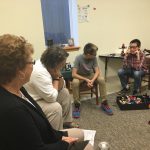
On the first Sunday of the month we gather to explore the gospels together, using a Contemplative Dialogue approach which encourages everyone’s participation and which understands that wisdom is found in the hearts of everyone gathered. Today was no exception. We compared the texts of Mark, Matthew, and Luke and many unsettling topics settled into our hearts. Sometimes the path toward knowledge and truth lead us into difficult places first. We traveled a bit into what unclean spirits mean to us today, how do we name evil, how does evil divide us, what happened to the evil spirits when they were cast aside, and perhaps most importantly, why did the forces of evil recognize Jesus as the Son of God but the goodness within people didn’t. What’s that about? Good questions, right? No easy answers, that’s for sure. But good soulful conversation. Please join us next month for our next exploration.
This morning a group of us gathered with an ease of being together, with a shared sense of wanting to learn from each other, and with a desire to look closely at our scriptures. We read the text of Jesus’ baptism in the three synoptic gospels (seeing with one view or eye): Mark, Matthew, and Luke. We begin by reading the text in Mark (the first of the synoptic gospels written) and then read the same story from Matthew and notice the similarities and differences. Then we read the version in Luke and do the same. It’s amazing the differences!
Then we begin asking ourselves these questions (focusing on the text to give us the answers):
What does it tell us about Jesus that he came to John the Baptist to be baptized?
What if anything does it tell us about Jesus’ relation to tradition?
Who heard the event?
Who saw the event?
All this examination helps us discern the differences in the gospels and helps us wonder why the same story is written in many different ways.
We had a great time discussing the following question:
How would you describe this experience like for Jesus: inner, outer, or what?
Then it was time for personal sharing in response to this question:
Is this an experience similar to one in your life? If so, what kind or kinds?
There was rich sharing of times of baptism, confirmation, reception into the Episcopal Church and ordination. It seemed that common elements were: humility, consent, affirmation, and a call to do something (or be something) different.
I looked around at the room while in the midst of this sharing, filled with joy, realizing this was another of my “dream come true” moments, which I so often have here at St. Andrew’s.
A number of us gathered on Wednesday evening for a time of sharing a meal, hearing new ideas, and sharing our thoughts in a safe and caring space. We began our 6-week program on following Jesus through the use of videos by a number of theologians.
We began our study by reading scripture connected with the evening’s topic, since we as Episcopalians are people rooted in scripture. We listened to and engaged with the story of the Good Samaritan.
We then continued our study by listening to Father Greg Boyle who states that following Jesus means standing outside your circle or comfort zone and standing silently until the people you are standing with find their own voice. It sounds so simple, yet is a very complex command. We discussed the steps to get there: identifying where we draw the lines, crossing over the line into a place previously unknown to you, standing there, being present to, and being silent, until your steady presence helps the others to find their own voice. We talked about the trinitarian theology inherent in this process (God, the One who puts the desire in our hearts, Jesus, the One who offers and finds the place of healing and reconciliation, and The Holy Spirit, the One who makes the relationship alive and changes all involved). We spoke how it can be easier and important, yet not the same thing to cross over the line, learn about the people who live in that space, walk back over to your comfort zone and advocate for them. The call is to be present to, be attentive to, and stand silently with others.
We ended our time with Thomas Merton’s prayer,
MY LORD GOD, I have no idea where I am going. I do not see the road ahead of me. I cannot know for certain where it will end. Nor do I really know myself, and the fact that I think I am following your will does not mean that I am actually doing so. But I believe that the desire to please you does in fact please you. And I hope I have that desire in all that I am doing. I hope that I will never do anything apart from that desire. And I know that if I do this you will lead me by the right road, though I may know nothing about it. Therefore, I will trust you always though I may seem to be lost and in the shadow of death. I will not fear, for you are ever with me, and you will never leave me to face my perils alone. —Thomas Merton
I think we left with much to ponder. Following Jesus has so many dimensions to it which stretch our souls and minds.
This Sunday we celebrate the Feast Day of Christ the King. We end this liturgical year hearing the story of Jesus’ crucifixion. This has got to be the greatest paradox in all of our Christian faith and narrative. Have you ever wondered how the words “crucifixion of Jesus” are connected to “Christ the King”? What about this association could possibly make sense? In the gospel of Luke, a simple statement announces this dramatic act: Jesus is crucified, set between two criminals, one who joins in the taunting and mocking, and the other who recognizes the reality of Jesus and asks to be remembered in paradise.
During my trip to the Holy Land, one of the most meaningful experiences I encountered was at the Garden of Gethsemane. It was the moment when I comprehended the role and truth of Jesus’ suffering — the suffering we are all invited into. Jesus suffered so that he would know and sanctify our very humanly existence which includes suffering, but most of all Jesus’ suffering was essential because the world was not yet ready to claim him as the Lord of lords, the King of kings; not ready yet to allow him to be sovereign over their lives, to move toward hope and promise, rather than despair. Jesus only wanted our world to be changed by God’s abundant love, but people rejected it. They couldn’t see it; they couldn’t move toward or into it. Sadly, we can see remnants of that kind of disbelieving in our world today. But we can make a different choice (preview of my sermon on Sunday). We can indeed live our lives as if Jesus were our King. We can lay down our cloaks, hailing Jesus with the words, “Hosanna in the highest!” We pray it each Sunday: “for thine is the Kingdom, power and glory, now and forever.” Let us imagine together what it means for Jesus’ kingdom to be for us now, in our lives. This is what he whispered to the criminal to his side in his statement, “Truly I tell you, today you will be with me in Paradise.”
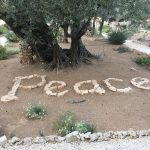
Here are some of my favorite photos from our time in Gethsemane. I hope they speak to you, as they did to me.
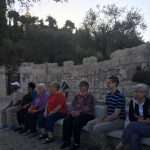
Our prayer service as we entered this space.
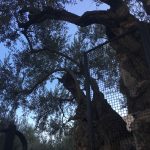
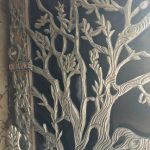
The olive trees, mighty and strong, bringing forth new growth out of a deadness within.
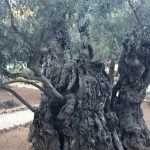
An aged tree, surviving because of it’s ability to keep finding new life.
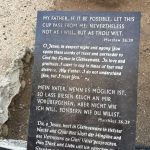
A meaningful prayer
The Prince of Peace.
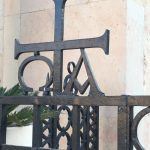
The alpha and the omega. The beginning and the end — and everything in between.
One of the many expressions of the cross of Christ in Jerusalem.
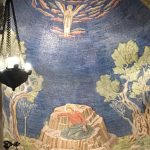
The beauty of the frescos depicting the agony of Christ.
People in prayer, especially the Franciscans who claimed these sites as holy.
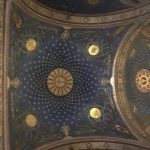
The amazing ceiling of the church . Made me think that “the heavens adore thee!”
The truth of the Olive branch – the branch of righteousness.
We were on the move with Jesus these past few days!
The evening before, when we saw the 1st century grotto where Jesus must have spent time, either because it was his family’s home or his relatives, something shifted inside of me. I could see it. I could see the reality of what we spoke of in seminary as “the historical Jesus”. This was the real person who played and prayed, who visited relatives, met new people, created his own network of believers, I believe early on. I could so see, by watching our guide, who I believe must know everyone in Israel and the Palestinian Territory, how Jesus’ community formed him, in thought, and action, and love. I could imagine his mother, preparing him every step of the way to claim his particular and unique role in the human salvation story.
As a good Episcopalian (Anglican) I have found it a comfortable place to rest on the 3-legged stool (Scripture, Tradition, Reason), which freed me to uncover the truth within the scripture, without hanging my hat on the factual accuracy of each statement or story. It is true, as I have stated in my ordination vows, that I believe our scriptures contain all that is necessary for our salvation. And because I didn’t need to believe every story to be factual to contain truth, I think the reality of Jesus hadn’t been fully opened up for me, until seeing the 1st century grotto by Mary’s home. This is why I can’t wait to come home and share with you my photos and stories. I want you to capture this same glimpse of the real person of Jesus as I have! We need both, our understanding of the transcendent Christ (our risen Savior) and the earthly fully human Jesus who walked this earth, laid hands on the sick, ate meals with his cousins, aunts, and uncles, went fishing with his friends, comforted them in their sorrows, challenged their beliefs, needed times of silence and solitude, and spoke from the grotto in the hills where he preached the challenging beatitudes to an enormous crowd. I met this Jesus over the past few days.
We gathered by the river. There were fishermen there already, which made it all exactly right. We sang, “Shall we gather by the River”, renewed our baptism vows, and offered the peace to each other. It was incredibly moving to be in this space, perhaps occupied by Jesus when the dove was sent by God and ascending upon Jesus, initiating his formal time of ministry. It wasn’t a commercial site. There were no postcard stands, nor crowds pushing upon us. It was peaceful and serene. A time of real communion. That revealed to me another part of my return to the place of my resurrection: a sense of peace and communion with others.
Mother Betsy gathering water from the River Jordan.
The calm and peaceful river.
We then went to Capernaum, where we saw Peter’s house (where Jesus healed the paralytic) and the Jewish Synagogue (where Jesus prayed and taught). It was remarkable to see the these places so integral to the ministry of Jesus.
Ruins of Peter’s home.
We walked down to the Mount of the Beatitudes (really a hill, not a mountain) and celebrated the Eucharist.
Beautiful sight with Sea of Galilee in the background.
Once again, surprising grace showed up! We were praying the Eucharistic prayer when another tour group arrived at the space. They were laughing, taking photos, moving around, apparently oblivious to the sacredness of the moment those of us gathered were trying to enter into. Then of course, I got it! They were also a part of our communion. No longer a distraction, but a reminder that church is not always to be tidy and orderly and set apart from the real people of God. Both times we celebrated the Eucharist outside, others have joined our group. Particularly on this day, it made me think of that special time, when Jesus was preaching on the mount, it must have been chaotic, there must have been other conversations going on, there must have been children playing. God sets holiness right in the midst of our everyday life, which makes our ordinary lives extraordinary. Good lesson to remember.
“Jesus said to them, “They need not go away; you give them something to eat.” 17 They replied, “We have nothing here but five loaves and two fish.”18 And he said, “Bring them here to me.” 19 Then he ordered the crowds to sit down on the grass. Taking the five loaves and the two fish, he looked up to heaven, and blessed and broke the loaves, and gave them to the disciples, and the disciples gave them to the crowds. 20 And all ate and were filled; and they took up what was left over of the broken pieces, twelve baskets full. 21 And those who ate were about five thousand men, besides women and children.
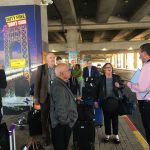
I could easily describe my experience of the past 48 hours in one phrase: “twilight zone”. It was a disconcerting and frustrating time of waiting, delays, lines, and ultimately confusion and frustration. On Wednesday evening, our plane from Newark to Israel was delayed and ultimately cancelled.
From the very beginning, our pilgrimage has taken unexpected turns. Already I have found myself surrounded by people speaking a foreign language to each other and to me, with an expectation of my comprehension. I have been beyond exhaustion. Members of our group spent a night sleeping on the floor. Another has already lost something important. It seemed like an eternity since I handed over all my possessions (my suitcase) to strangers, with now limited expectation I’d ever see it again. We have made some decisions we may not have made in the past (such as hopping onto an airport hotel shuttle at 3 a.m. to go to a hotel with which we hadn’t yet obtained a reservation). We have heard others grumble loudly, and we have grumbled ourselves. We have also laughed and nearly been brought to tear by that laughter, and also by the absurdity of our thwarted plane trip to Tel Aviv. We have prayed. We have tended to each other, and at least most of the time, could muster at least a speck of generosity of spirit toward ourselves and others.
Disorientation is the pathway toward reorientation. I preached about this a lot this summer when we explored the psalms, since it’s Walter Brueggeman’s theory of orientation-disorientation-reorientation. I realized on the 10+ hour trip to Israel today (which finally happened) that we had just experienced our period of disorientation, so that our reorientation could emerge on the rest of our pilgrimage.
Outside Tel Aviv Airport
Do I wish there had been no delays and we had been walking the streets of the Old City Jerusalem, rather than the hallways of the Newark airport yesterday? Absolutely!
But I bet it is important that we have lived in the “twilight zone” a bit. I bet it matters that we are being disorientated, so we can be resurrected into something new during this trip. Disorientation must always proceed reorientation, it’s just so hard when we want everything to go the way we expect and want. And yet, so often leaning into that unexpectedness is exactly what brings us into a new place with God.
We did finally land in Tel Aviv this afternoon and our feet have touched Holy Land. Thanks be to God.
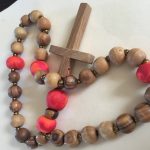
We want everyone who would like to be able to make Anglican Prayer Beads and learn how to pray them.
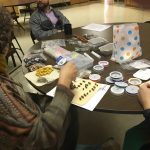
So we brought the beads to the people today. Thank you, Jeanine, for making this possible!
Here are some photos of people creating beads from clay, choosing the right spacer beads and laying it all out, and then stringing them.
If you would like to make a set and haven’t had the chance to do so, just let us know. We want you to be able to engage in this way to connect more deeply with God.
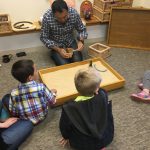
This Sunday we had a special offering for our young people ages 9-12 year olds.
Once a month we engage the curriculum “Building Faith: Brick by Brick”. It’s a time when our young people listen to a story from our scripture and then reflect on how it connects to their life, and then they build with LEGOs something in response. It’s all about helping our young people hear something from God’s story and figure out how it’s a part of their story.
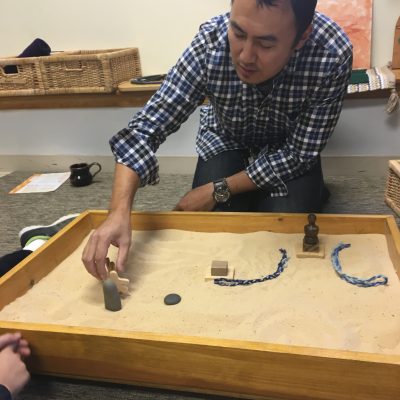
Amazing story-teller, David Luo, drew us into the story of our ancestors, Abraham and Sarah, who listened to God, followed God, and trusted God, and accepted from God the blessing of children who would shape the future of God’s people.
It was captivating to hear the story, to understand the deeper themes of loyalty, faithfulness, and hope, which can be present to us even in the times when it doesn’t seem realistic that what God tells us can be possible.
The children were drawn to the desert, were captivated by the figures, thought the river was fascinating, and wondered about the stones which represented Abraham and Sarah’s claiming God’s presence among them.
It’s wonderful how we invite our children into learning the themes which create the larger arc of the biblical stories.
On our rainy Saturday morning, we gathered in the cozy and restful Parish Library and explored scripture together. One of the gifts of our time together is that we never do know where the conversation will go as we sit with and engage the scriptures. This time we looked at the scriptures from the Hebrew Bible (Old Testament) for the month of October.
This time we focused on the harvest imagery which is threaded through the various scripture passages from Lamentations, Jeremiah, and Joel. What was fascinating was how our conversation shifted to the period of dormancy, when God appears to be silent, but just as plants are actually in motion inside while appearing to be at rest or even dead from the outside, we discerned that God offers us silence (not an absence of God, but a quiet time with God) so that we can process what God has already revealed to us. Sometime the timing’s not right yet for us to move forward, sometimes our gifts haven’t come enough to fruition to be ready for use for the kingdom. The truth revealed to us in community and through conversation was that when God comes knocking at our door, our response can be simple (yes or no) but the impact on our life is profound and complex.