Lenten formation class

We gathered to discuss the spiritual practice of “Learn”. This series designed by The Episcopal Church ties each of the 7 spiritual practices to one of the readings during the Great Vigil of Easter. The one chosen for this week was Proverbs, which speaks about the force of wisdom present from before time with God the creator.

We engaged with the idea that we are to take time each day to learn “about God” and to “learn God” — in other words, use both our mind and heart to learn about and engage with God in our daily lives. One of the riches of our evening was when we shared what we believe we have become wise in and how we have used our wisdom (grown through our love of God) in offering it to others and changing the world to become more Christ-like.

Ways to Pray Formation Series

This past Wednesday evening, after a time of laughter, joy and a meal shared together, we settled down into a deep and profound conversation about our spiritual lives. We had each completed a Spiritual Type Inventory, based upon our natural preferences for the order in worship, in the structure and time of worship, style of prayer, music, preaching, support of causes, membership criteria, ritual and liturgy and concept of God. The four spiritual types articulated in this inventory are “Earth, Water, Air, Fire”.

To complete the inventory, please click on the link below.

We then opened up the conversation, to what specific part of the Sunday worship experience draws your heart the most. The answers were diverse and deeply profound. The idea set within our Christian lives is to deepen that experience. Our current spiritual practices keep us where we are now with God, but our spiritual life is never static, we are always called to go deeper, so we can live into and out of God’s blessing which meets us in our prayer life.

If you would like to talk with Mother Barbara or Dina Carter Ishler, our Field Placement Intern, about this Spiritual Types Inventory or how you might be able to deepen your practice, please reach out to them. You can call the parish office (717-532-8089) and leave a message for them to contact you.

The Mystic in You

We understand that we are hard-wired to be in relationship with God and our theology tells us that God is active in our lives. Have you ever wondered how that happens? How God shows up? How we can be attentive to God’s presence? What helps us open ourselves to God?

These are all great questions and some which we explore in our book study on the book, The Mystic in You: Discovering a God-filled World. The author, Bruce Epperly defines a mystic as people who see holiness in everyday life. Wouldn’t you want to be one? Maybe you already are one?

Our conversation takes us into the world of people throughout the ages who have lived their lives this way and who can offer us insight and guidance. We looked at St. Francis of Assisi at our first session.

Here are the 4 practices offered for us to try, with St. Francis in mind —

Practice One: Finding God in the Nonhuman World

Recover reverence for life by meditating on Psalm 148, along with Francis’ Canticle to the Sun.

Breathe deeply the holiness of life. Let the air you breathe fill you with insight and energy and restore your sense of connection with all things. Take a beauty walk, opening your senses to God’s presence. Rejoice in the gifts of creation. Ask for God’s guidance in terms of how you might best respond to the crises of global climate change, species destruction, and economic and political upheaval.

Practice Two: A Gift to be Simple

Our faith calls us to simplify our lives so that others may simply live. Consider how to simplify your life. What do you need to pare away? In what ways can you live more simply? Where can you devote your resources to promote the well-being of the earth’s impoverished peoples? Consider the words from the Sermon on the Mount, along with Shaker hymn on a daily basis.

Practice Three: Welcoming People of Other Faiths

Observe your own and others’ prejudice toward persons of others faiths or no faith. In what ways do you show hospitality to the religious diversity in your community? What insights can you receive from persons of other faith traditions? Where can you contribute to reconciliation and healing among peoples of the earth? Take time to pray for people of other faith traditions, asking that they be blessed and you would discover your kinship with them.

Practice Four: Finding God in Unexpected Places

Make a commitment to reflect deeply on those who repel you. Ask God to help you see more deeply into their lives. Feast your eyes on humanity in all its variety. Look beyond appearances to see holiness in others. Listen to God speaking through their voices as you attune to god’s image within yourself and others. Pray the prayer attributed to St. Francis.

Please come to these sessions as we continue to explore and deepen our spirituality. The sessions are every other Wednesday at 5:30 p.m. at Mother Barbara’s home. The evening includes dinner (6 p.m.) then discussion (7-8 p.m.).

Where did Jesus walk? Why does it matter to us?

This past Wednesday we gathered together, enjoyed a meal together, and then engaged in a presentation that wove together Mother Barbara’s experiences and photographs of her Holy Land trip with scriptural references to the locations where Jesus traveled and all set within the cultural and political context of Jesus’ time. There was an opportunity to hear Mother Barbara’s spiritual insights from each of the locations as well as quiet time to reflect upon our own insights gleaned from the images and text.

We looked at the significance from a biblical and contextual perspective for the following locations where Jesus was cited to have been or traveled to, according to the gospels: Bethlehem, Egypt, Nazareth, the Jordan River, Capernaum, and the Sea of Galilee.

If you were unable to attend this evening’s spiritual formation event and would like to hear more about these sites or view Mother Barbara’s photographs, please see her to make arrangements to learn more.

We will offer Part II to this presentation which will focus on Jerusalem and the areas around the city (Garden of Gethsemane, Bethany and Bethpage, Pool of Bethsaida).

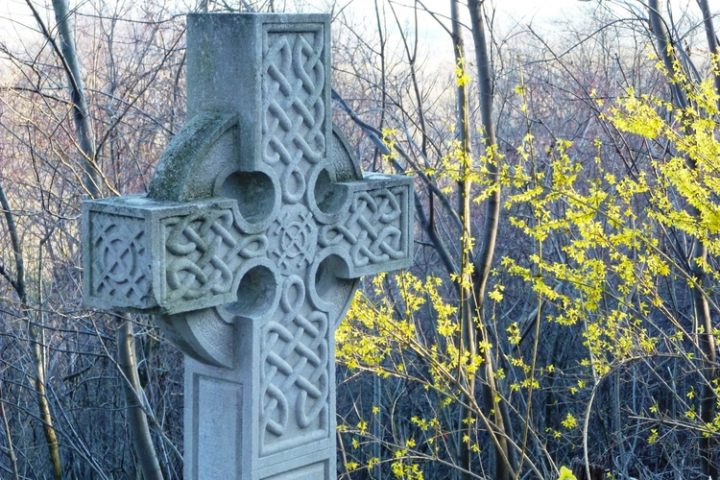
Celtic Spirituality

Each week, about 15 of us gather together, share a meal, listen to the reading of a book regarding Old Growth Forests, and then engage in a lively conversation around the content in John Phillip Newell’s book, Christ of the Celts, the Healing of Creation. This eloquent and poetic book shares with us the ideals and truths of Celtic Spirituality, such as we are all made in the image of God, we are God’s beloved, and we are intrinsically connected to all of creation and God’s creatures. The strongest words of this past evening’s reading was that it is only love, not judgment, but love which transforms us.

Our conversations are deep, insightful, and sacred. You are always welcome to join this special and holy gathering.

Approaching the Gospels Together

On the first Sunday of the month we gather to explore the gospels together, using a Contemplative Dialogue approach which encourages everyone’s participation and which understands that wisdom is found in the hearts of everyone gathered. Today was no exception. We compared the texts of Mark, Matthew, and Luke and many unsettling topics settled into our hearts. Sometimes the path toward knowledge and truth lead us into difficult places first. We traveled a bit into what unclean spirits mean to us today, how do we name evil, how does evil divide us, what happened to the evil spirits when they were cast aside, and perhaps most importantly, why did the forces of evil recognize Jesus as the Son of God but the goodness within people didn’t. What’s that about? Good questions, right? No easy answers, that’s for sure. But good soulful conversation. Please join us next month for our next exploration.

Celtic Spirituality Series 2 Session #1

What is your deepest desire or yearning? This was the question answered by those gathered Wednesday evening as we continued our exploration of Celtic Spirituality. Some of the answers were: all people could be safe, a connection to something bigger than myself, acceptance, reunion, harmony, love that transcends boundaries, contentment, a sense of well-being, a more even playing field for all, unity. Not surprisingly, we realized that our deepest desires are also what we imagine God’s deepest desires to be. This notion of the connectedness of our deepest desires with God’s is consistent with the understanding in Celtic (and some Western) Spirituality that we are made in the image of God, therefore, our deepest desires are of God, therefore we are made from a place of goodness, not sinfulness, and therefore our work as humans is to return to (be remembered with) the place of union with God.

In John Philip Newell’s book, Christ among the Celts: The Healing of Creation, Newell makes the statement: “Christ is the memory of what we’ve forgotten”. This is consistent with the writings of Joan Chittister (a Roman Catholic nun) who speaks that “Prayer is the memory of the Beloved, the filter, the scrim, through which we begin to see all reality, all life, all decisions, all purposes and all goals.” We had an insightful conversation around the role of the Eucharist, of the gospel and of grace in drawing us back into the remembrance of what we’ve forgotten, of Christ.

We left the evening pondering how the Church, how Christ, and how our spiritual practices support our return to Christ and to the deepest desires within us, which are of God.

We closed with this prayer from John Philip Newell’s book, Sounds of the Eternal: A Celtic Psalter:

We seek your presence, O God, not because we have managed to see clearly or been true in all things this day, not because we have succeeded in loving or in reverencing those around us, but because we want to see with clarity, because we long to be true, because we desire to love as we have been loved. Renew our inner sight, make fresh our longings to be true and grant us the grace of loving this night that we may end this day as we had hoped to live it, that we may end this day restored to our deepest yearnings, that we may end this day as we intend to live tomorrow, as we intend to live tomorrow.   Amen.

Our next session is on Wednesday, February 7th beginning at 5:30 p.m. at Mother Barbara’s home. All are welcome.


Praying with the Celtic Psalter: Does prayer fit into your day, or does your day fit into your prayer?

As part of our exploration of Celtic Spirituality, Mother Barbara has invited all of us to pray daily (morning and evening) with the book, Sounds of the Eternal: A Celtic Psalter by John Phillip Newell. Here’s a reflection by Jeanine Goodwin on her experience in preparation for our group conversation.

Wanting to get an idea of what this next flight of formation would bring, about two weeks ago I engaged in the prayers in John Phillip Newell’s psalter, Sounds of the Eternal. Soon I found myself sitting with the prayers for a few moments because things were shimmering up off the page, and soon was doing a lectio divina of sorts, reflecting on a phrase to let it lead.

One of the prayers speaks of “rekindling”, “sparks”, and “part of the blazing splendor”. It happened kind of miraculously, on the same day we heard a sermon about God calling to Moses out of a burning bush. That alone got my attention, and the thing that caught me up was that for a moment I was feeling like Moses might have, intimidated by such a big intense heat and brightness, such a clarity of call.
I found myself reaching for my current notebook, to try to capture viscerality of the insight before it slid down back into the depths of unconsciousness and have kept it at hand ever since.
From this morning what prompted a rise of the heart was, “You lift up my soul, O God, and make the eyes sparkle. You give health and life and blessing.” I realized that in the doing, partaking of as one does a sacrament, the daily practice of prayer using Newell’s psalter, I’ve noticed what happens when not doing it, almost more than what happens when I do. Keeping the notebook at hand, I can look back and see what rose up out of the text on a given day. Some days there are two entries, one in the morning, one in the evening. More often than not there’s only one. I notice when not doing it, there’s the opportunity to see what’s taking it’s place instead. I recalled the lives of the brothers at Holy Cross Monastery and saw that this practice of prayer, contemplation, is what shapes their days.
So then it rolled out thus: It’s not how my religion and spiritual practice fit into my day, but how my day fits into my practice.  The practice has started shaping the day, shapes me in my day, becomes the foundation from which my movements, and responses arise.
I’m staying tuned.
Grace. Peace.
Jeanine

Approaching the Gospels Together

This morning a group of us gathered with an ease of being together, with a shared sense of wanting to learn from each other, and with a desire to look closely at our scriptures. We read the text of Jesus’ baptism in the three synoptic gospels (seeing with one view or eye): Mark, Matthew, and Luke. We begin by reading the text in Mark (the first of the synoptic gospels written) and then read the same story from Matthew and notice the similarities and differences. Then we read the version in Luke and do the same. It’s amazing the differences!

Then we begin asking ourselves these questions (focusing on the text to give us the answers):

  • What does it tell us about Jesus that he came to John the Baptist to be baptized?
  • What if anything does it tell us about Jesus’ relation to tradition?
  • Who heard the event?
  • Who saw the event?

All this examination helps us discern the differences in the gospels and helps us wonder why the same story is written in many different ways.

We had a great time discussing the following question:

  • How would you describe this experience like for Jesus: inner, outer, or what?

Then it was time for personal sharing in response to this question:

  • Is this an experience similar to one in your life? If so, what kind or kinds?

There was rich sharing of times of baptism, confirmation, reception into the Episcopal Church and ordination. It seemed that common elements were: humility, consent, affirmation, and a call to do something (or be something) different.

I looked around at the room while in the midst of this sharing, filled with joy, realizing this was another of my “dream come true” moments, which I so often have here at St. Andrew’s.

To read the scripture and view the questions we discussed today, please click here. Approaching the Gospels Section 18


Contemplative Practices: Mary Oliver Poetry

In the dimming light of the evening, draw together by the flame of an oil lamp, we gathered in a circle and read Mary Oliver’s poetry, in a contemplative way, pausing after each reading, allowing time for the words to settle into our souls.

We found her poetry to be beautiful, shocking, challenging, descriptive of the journey of the soul, and the images of nature to be stunning.

We all left a bit calmer, a bit more tuned into the beauty of our world, and a bit more engaged in the spiritual journey of our souls and community.


The Work of the People: The Ridiculous Journey of Following Jesus

A number of us gathered on Wednesday evening for a time of sharing a meal, hearing new ideas, and sharing our thoughts in a safe and caring space. We began our 6-week program on following Jesus through the use of videos by a number of theologians.

We began our study by reading scripture connected with the evening’s topic, since we as Episcopalians are people rooted in scripture. We listened to and engaged with the story of the Good Samaritan.

We then continued our study by listening to Father Greg Boyle who states that following Jesus means standing outside your circle or comfort zone and standing silently until the people you are standing with find their own voice. It sounds so simple, yet is a very complex command. We discussed the steps to get there: identifying where we draw the lines, crossing over the line into a place previously unknown to you, standing there, being present to, and being silent, until your steady presence helps the others to find their own voice. We talked about the trinitarian theology inherent in this process (God, the One who puts the desire in our hearts, Jesus, the One who offers and finds the place of healing and reconciliation, and The Holy Spirit, the One who makes the relationship alive and changes all involved).  We spoke how it can be easier and important, yet not the same thing to cross over the line, learn about the people who live in that space, walk back over to your comfort zone and advocate for them. The call is to be present to, be attentive to, and stand silently with others.

We ended our time with Thomas Merton’s prayer,

MY LORD GOD, I have no idea where I am going. I do not see the road ahead of me. I cannot know for certain where it will end. Nor do I really know myself, and the fact that I think I am following your will does not mean that I am actually doing so. But I believe that the desire to please you does in fact please you. And I hope I have that desire in all that I am doing. I hope that I will never do anything apart from that desire. And I know that if I do this you will lead me by the right road, though I may know nothing about it. Therefore, I will trust you always though I may seem to be lost and in the shadow of death. I will not fear, for you are ever with me, and you will never leave me to face my perils alone.                                        —Thomas Merton


I think we left with much to ponder. Following Jesus has so many dimensions to it which stretch our souls and minds.

The essential paradox: Christ the King on the cross

This Sunday we celebrate the Feast Day of Christ the King. We end this liturgical year hearing the story of Jesus’ crucifixion. This has got to be the greatest paradox in all of our Christian faith and narrative. Have you ever wondered how the words “crucifixion of Jesus” are connected to “Christ the King”? What about this association could possibly make sense? In the gospel of Luke, a simple statement announces this dramatic act: Jesus is crucified, set between two criminals, one who joins in the taunting and mocking, and the other who recognizes the reality of Jesus and asks to be remembered in paradise.

During my trip to the Holy Land, one of the most meaningful experiences I encountered was at the Garden of Gethsemane. It was the moment when I comprehended the role and truth of Jesus’ suffering — the suffering we are all invited into. Jesus suffered so that he would know and sanctify our very humanly existence which includes suffering, but most of all Jesus’ suffering was essential because the world was not yet ready to claim him as the Lord of lords, the King of kings; not ready yet to allow him to be sovereign over their lives, to move toward hope and promise, rather than despair.  Jesus only wanted our world to be changed by God’s abundant love, but people rejected it. They couldn’t see it; they couldn’t move toward or into it. Sadly, we can see remnants of that kind of disbelieving in our world today. But we can make a different choice (preview of my sermon on Sunday). We can indeed live our lives as if Jesus were our King. We can lay down our cloaks, hailing Jesus with the words, “Hosanna in the highest!” We pray it each Sunday: “for thine is the Kingdom, power and glory, now and forever.” Let us imagine together what it means for Jesus’ kingdom to be for us now, in our lives. This is what he whispered to the criminal to his side in his statement, “Truly I tell you, today you will be with me in Paradise.”

Here are some of my favorite photos from our time in Gethsemane. I hope they speak to you, as they did to me.

garden-of-gethsemane-worship
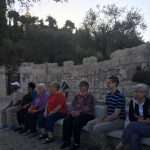
Our prayer service as we entered this space.

garden-of-gethsemane-olive-trees-and-sky
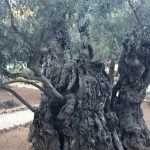
The olive trees, mighty and strong, bringing forth new growth out of a deadness within.

garden-of-gethsemane-old-olive-tree
An aged tree, surviving because of it’s ability to keep finding new life.

garden-of-gethsemane-garden-prayer
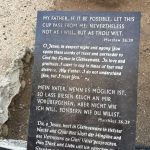
A meaningful prayer

garden-of-gethsemane-garden-peace
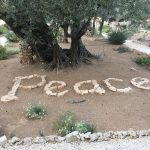
The Prince of Peace.

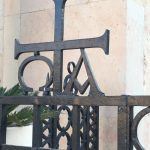
garden-of-gethsemane-cross
The alpha and the omega. The beginning and the end — and everything in between.

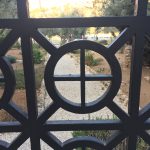
garden-of-gethsemane-cross-2
One of the many expressions of the cross of Christ in Jerusalem.

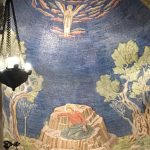
garden-of-gethsemane-church-fresco
The beauty of the frescos depicting the agony of Christ.

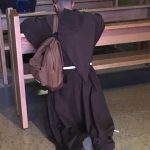
garden-of-gethsemane-church-franciscan-monk
People in prayer, especially the Franciscans who claimed these sites as holy.

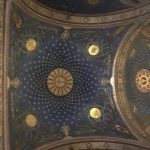
garden-of-gethsemane-church-ceiling
The amazing ceiling of the church . Made me think that “the heavens adore thee!”

garden-of-gethsemane-church-door2
The truth of the Olive branch – the branch of righteousness.


Christ is King. Alleluia. Alleluia!