Vergers Voice #40

A TOUR OF ST. ANDREW’S

I am sure many of you have given tours of your home to friends and family members when they visit for the first time. It’s exciting to tell people what changes you have made and things you have done to make your home just the way you wanted it. Well, that’s the way I feel when I talk about St. Andrew’s.

Over the years I have conducted many walking tours, given talks and written a lot about our church but it has been a few years and many of you are new. It might be time to take that walk again. Over the next few weeks on the Sundays that I am the verger I would like to take you through different areas of St. Andrew’s. I want to tell you how and why the rooms were built the way they are, what changes have been made and interesting things that have happened in the past 110 years.

Let’s start as your walking to the front door. A hundred years ago you would have been standing on a dirt street, with a small grassy area to the front of you and sand stone steps leading to the red doors. The wall, sitting area, and iron railing were only added about ten years ago. I must tell you that those things did cause me to get into a bit of trouble. At the time we were doing a large landscaping project. These were changes on the original landscaping plans and required a permit which I forgot to get, since work had already started I got called before the historical review board. As I entered the room trying to figure out how I’m going to explain this. I looked around to see a priest, two deacons, three lawyers and the whole vestry behind me, we got our permit. The stone steps we use now are a fairly new addition, after over a hundred years the original sandstone steps had become very worn and uneven, they are now the foundation for the new paver stones.

The front doors are the original ones built in John Phillips factory, which was located just about a block from here. The red color, we use burning bush red, is a traditional color for many church doors. It marks the holy ground that lies just beyond those doors. It is really like a billboard telling people that beyond those doors there is a peaceful and holy place, a place of refuge.

As we go through the doors we are now in the narthex, which means an entrance hall or gathering space. It’s a little small but it does seem bigger since a few things have been taken out. This area is just the beginning, on the original plans, this front section of the church was called a battlement tower, but since the bell was installed it’s called the bell tower. Our bell tower is about forty feet high from the ground to the highest stone. Two rooms are above the narthex, that’s where the funny little steps go. The first is just an open area and then you go up a ladder to the bell room.

The second floor of the bell tower has always brought up some ideas of what it was used for. Some say it used to be the rector’s office but it was never used for this purpose. Although I have told three rectors that is where their office was but they never believed me. Others have said it was a room for a sexton that took care of the church furnace but this wasn’t the case either. Then I was asked if the vergers slept there. I responded that unlike Quasimodo we do not sleep in the bell tower but it would be nice to have a place to take a nap when I’m here all day.

The third floor is the bell room. It is interesting that even though this room is about twenty-four feet above the first floor it is about four inches larger in length and width. This is because as the tower got higher smaller stones were used. You would think that a church would have plans for a bell when it was being built but that wasn’t the case at St. Andrew’s. Our bell wasn’t installed until October 12,1975. Father Ron Lynch, the vicar at the time, saw a need for a bell and asked a long-time member, Edith Jones, to consider purchasing one. A 29-inch, 500 lb. Brass bell was ordered from the McShane Bell Foundry of Baltimore Maryland. It arrived in May and sat in the front yard about six months until the men of the church figured out how to get it up three stories. After cutting holes big enough for the bell to fit though and installing timbers for the bell to sit on, a block and tackle was used to pull the bell up to the top floor. Our bell is rather unique because it has two clappers. A regular clapper that the bell hits when it is swung, that is what you hear every Sunday and a tolling hammer that hits once with every pull of the rope. It is used for funerals, on Good Friday and other special events. Now when you come in to the narthex and look up you will know why the wood panel is there.

The next time we will talk about the Nave.
Back to the Verger’s Voice!

Vergers Voice #39

Feeling Uncomfortable with Ashes to Go

Ash Wednesday, March 1, 2017 was the first time Ashes to Go was offered in Shippensburg.  There were no TV cameras, no newspaper reporters and no protesters, just Mother Barbara and me with a sign that said, Ashes to Go, St. Andrew’s Episcopal Church, some handouts and our containers of ashes.  We stood on the sidewalk near the post office, a very busy place at noon time, feeling rather uncomfortable for our own reasons.  I was never very comfortable with evangelism, I feel like a lot of Episcopalians that the best strategy is to just be ourselves, loving people, listening to them, praying for them, and being whatever help we can.  Then here I am standing on a busy sidewalk with a cross of ashes on my forehead and offering something a lot of people didn’t understand.

I also believe it was the smudge of black ashes that I was uncomfortable with.  I have had ashes imposed for more years than I want to remember but if I was planning on going somewhere after the service I was sure to clean them off before I left.  I was concerned people would stare at the black mark on my forehead and I would have to explain why it was there.  No it’s not dirt, no I didn’t forget to wash my hair, yes I am a Christian and I had ashes imposed on my forehead to mark the start of Lent.  Then here I am standing on a busy sidewalk with a cross of ashes on my forehead prepared to answer those same questions.

The longer we stood there we come to realize that although we were uncomfortable being out in public with our faith for everyone to see, we were making the people passing by just as uncomfortable.  They would read our sign as they parked their car or as they were walking up the sidewalk but they would pass us with their heads down or looking the other way.  As more and more people came from the post office after receiving their mail they would pass by reading their junk mail as if it was the most important information they ever received. Those that did response to us said they would be in their own churches later that day but I couldn’t help but think why more people didn’t stop.  Did they think were selling something, asking for money or trying to convince them to come to St. Andrew’s? I hope that wasn’t the reason.  One young man told us he wasn’t allowed because he wasn’t Catholic.  He was a little surprised when Mother Barbara explained that we weren’t Catholic either and it was perfectly alright for him to receive the cross.  He bent forward as I imposed the ashes and Mother Barbara said a prayer on his behalf, we all said amen and he walked away cheerfully expressing his faith for all to see.

Why weren’t more people like that young man? Was it a lack of understanding or a lack of faith? Was it that they were afraid we were selling something they didn’t want or that we would convince them to come to a place they weren’t ready to go.  I don’t have a answer for that.  I do know that I am willing to try this again.  I kind of like having that uncomfortable feeling and I think both Mother Barbara and I enjoyed making other people uncomfortable with us being there. We made them think about their own faith or lack of and what it means to be a Christian and that can be a good thing.

Let’s do this again next Ash Wednesday with more people involved.  Sometimes it’s good to be uncomfortable together.

Back to the Verger’s Voice!

Vergers Voice #38

Is it true the Vergers sleep in the bell tower?

Unlike Quasimodo, your vergers do not sleep in the bell tower.  This may seem like a silly question to some but for anyone who has observed our comings and goings you may have wondered.  Of course, you may have overheard my wife telling people that she is planning on hiring someone to build a room up there for me if I don’t quit spending so much time in church. Then again it would be nice to have a place to take a nap once and while, especially on days we are here from early morning to late at night.

It’s true that vergers everywhere tend to spend a lot of time in church. Most vergers take part in everything that happens.  You may not see them but they have done something to make the event happen and sometimes that takes several hours of planning and prep work. With three of us, it makes things a lot easier and we can take the time to make sure everything runs smoothly.  I have talked to many vergers from across the country that have told me that it is not uncommon for them to have four or five services every Sunday.  Then there are the times when you have a Saturday night wedding, which means someone has to be here early Friday afternoon to get ready for the rehearsal, early Saturday afternoon to get ready for the wedding and staying to clean the church for Sunday services.  That doesn’t include reserving parking areas, meeting with the photographer, florist, and the families. For funerals there are meetings with the funeral director, arranging extra parking, being here for flower deliveries, setting up the PLC for receptions, helping the altar guild set up the church, meeting with the family and cleaning the church afterwards.  An hour service can easily mean several hours of planning time for us.

With Lent fast approaching this will be the start of a very busy forty days for us.   We will be helping Mother Barbara plan the Holy Week services over the next month.  Starting on April 12th with the Healing Service at the Episcopal Home, we will be here most of the day and evening on the 13th for Maundy Thursday, then Good Friday from 1 to 3 for the Verger’s vigil and then back at 5 to get ready for the evening service.  The Easter Eve Vigil starts at 7 pm but we will be here at 5 to get things ready, then Bill will be here at 7 am on Sunday to open for Easter Day.  Thinking about it maybe we should just sleep in the bell tower.

Even though we can’t be here all the time, please be assured that Bill, Mike and I will always be here when you need us.  It is something we love to do and we hope we can do it for a very long time to come.

Back to the Verger’s Voice!

Verger’s voice #37

The Door That Does Not Open

I was asked the question “Where does the door on Prince St (that appears near where the organ is) go?

I am sure a lot of people have wondered about this.  Here’s a door that looks just like the other doors of the church. It has a stone step to help you get in, a knob and it is facing a very busy street but it will not open. You can pull on it, turn the knob and knock for someone to leave you in but try as you may it just won’t open.  You may be surprised to know that it even has an address, 23 North Prince St.

If you look at old pictures and prints of the church you can see that this door was part of the original church building and at one time it was usable.  If you could enter it today you would find yourself standing beside all the organ equipment that you don’t see from inside the church.  From 1908 until 1929 when the Moller organ was install, this room was part of the chancel.  In all my digging into the history of St. Andrew’s I have never came across any drawings or pictures of that time frame, so I am not sure what this area was used for.  I have read that in the beginning except for special services, attendance was very sparse and on most Sunday’s everyone would sit in the chancel or choir area.  This would lead me to believe that there may have been pews there.

Our Moller organ is much larger than it looks.  What you see as you are walking up to communion is just the front part and the console.  Behind the wood panels and the gold pipes above, the whole room is filled with pipes, chimes, wiring and air tubes, plus all the framework that holds it together.  If you would venture in to the back area of the organ you will find two small walkways.  As you enter and walk straight ahead you will come to the interior side of the door in question.  From there you can turn right and walk behind all the pipes and etc. of the organ.  As crowded as it is we still manage to store some things there.  Two large stepladders, old torches, and the poles used along the pews at Christmas and at weddings can be found there.

For some reason after the organ was installed this exterior door was sealed shut.  I am sure it has something to do with the organ equipment being sensitive to changes in temperature and dust.  So it will stay closed.  If you would like to see what I have been talking about, you are more than welcome to take a peek.  There is a small wood panel door on the left side of the organ console, it is a little hard to open but it leads to the organ equipment area.  There is a pull cord for the light inside the right side of the door.  I am sure if you look after the late service on Sunday’s Jerry would be happy to tell you how it all works.  Don’t forget to turn the light out when you leave.

Back to the Verger’s Voice!

Verger’s Voice #31

ARE WE PREPARED FOR THE UNEXPECTED?

Several months ago Bill and I attended a workshop in Chambersburg titled Congregation Security. It was attended by a surprising number of people from many churches in the area.  The workshop was sponsored by the South Central PA Task Force which is a non-profit organization that helps businesses, industry, governments and churches learn about, prepare for and recover from different types of disasters. Then this past August Mike and I attended a workshop in Lancaster, sponsored by the same group, that was much longer and covered more topics. We heard from the state police, sheriff’s department, fire and emergency medical personal, the district attorney’s office and security experts from the task force.

We learned that there are many different types of crisis that we need to prepare for, such as crime, terrorism, medical emergencies, fire, floods, snowstorms, and accidents.  You might say “this is a House of Worship we don’t need to worry about those kinds of things”. I wish I could say that was true but the truth is churches are considered soft targets for many types of crime.  A medical emergency can happen anytime, anywhere and one lit candle can cause a major fire. What would happen if there was a fire in the Episcopal Square, Episcopal Home or a flood like we had in 1972 from hurricane Agnes. What if a winter storm closed Rt. 81 and stranded hundreds of people, like it did last winter to our west or a train that was hauling dangerous chemicals derailed right outside of town.  Will we be prepared to help?

Terrorism is really not a concern for this area according to the FBI and Homeland security. I do get updates on this weekly. We are luckily that we live in an area with low crime rates and three very good police forces (Shippensburg, University, and State Police) that patrol the area. Our town is not without crime though, drug related crime, arson, shootings, home and business robbery are not unheard of. Many churches in the area have been entered and money and valuables taken. Here at St. Andrew’s we have had some problems in the past but nothing was taken and corrective measures have been put in place. Our biggest problem is vandalism, where spray paint is used.  This seems to happen about once a year somewhere on our property. I would advise that if you see something out of the ordinary to report it to Mike Rhodes or me as soon as possible.  Also, if you are in the building alone keep the doors locked and make sure to lock all doors when you leave.

Medical emergencies are rare but they have happened and we are prepared if something happens again. If an emergency happens your vergers may ask you to help in some way but until we do let us handle it.  If you are a doctor or nurse please let us know.  You may be asked to call 911 or go to the Episcopal Home and ask the LPN on duty to give aid.  You may also be asked to wait outside to direct the first responders and hold the doors for them.  If we feel there is a need we will ask everyone to go to the PLC and continue the service there and we will update you when we know more.

A fire can start in the blink of eye for many different reasons and we have prepared for it as best possible.  Fire extinguishers are in place throughout the building and we ask everyone to observe the locations, so that if needed they can be gotten quickly.  If you do not know how to use a fire extinguisher we will be glad to teach you.  The Nave is equipped with an alarm system, if this sounds the fire companies are called by the alarm company. We ask everyone to leave the building as quickly as possible.  The PLC is also equipped with an alarm system and a sprinkler system.  If the alarm sounds, leave as quickly as possible, the fire department will have already been called.  If there is an emergency at the Episcopal Home part of our alarm system is tied in with theirs so our outside alarm may sound, the residents of the Home will be moved to the PLC by the Home staff.

No one can be completely prepared for natural or sometimes manmade disasters but there may be ways that we can help.  A flood, snowstorm, power outage, major fire, or accident could easily displace hundreds of people and overwhelm our local hotels and other shelters.  Could we open our doors as we have in the past?  Unlike a lot of places we are not totally dependent on electric for heat and to prepare food.  We could give people a warm place to stay until the danger is over?  Will you be prepared to help?

All of us hope and pray that none of this will ever happen but sometimes it does.  Can we say that we are prepared for the unexpected?

Back to the Verger’s Voice!

Verger’s voice #35

For this vergers voice I’m going to try to answer three questions. The first, someone asked, “If the Altar was always in the same place.”  No, the Altar is not in its original place but it is not far from it.  At one time all Altars in the Episcopal Church were against the East wall. The East wall of a church is always the wall behind the Altar no matter if it facing East or not. Ours happens to face more South-East than true East.  That is one reason the sun shines so brightly in the window above the Altar on Sunday morning, but it also means that God in smiling on us.  In some churches where the Altar is made of stone or is built directly into the wall and can’t be moved, they use a moveable Altar or table.

Until about 1980 our Altar was against our East wall. Up until this time during communion the priest would face the Altar, with their back to the congregation.  I knew that the trend to move the Altars away from the wall started when the 1979 Book of Common Prayer was approved for use but I was not sure why.  So, I asked Mother Barbara for an answer and the following is what she had to say.

Yes, it is a good question, with a rather complex answer.  The main answer is because of the shift in the theology represented with the 1979 Prayer Book.  That’s when the shift took place and the altars were brought out away from the wall. The shift in theology was all about the priest not action on behalf of the people (back to the people as though representing the people to God) but rather acting with the people in celebrating communion, facing and being a part of the people.  Communion in the 1979 Prayer Book is seen as an act that we all partake in equally, although in different roles.  The 1979 Prayer Book made the shift that the people in the pews were considered the ministers of the service and much more lay involvement was encouraged.  It took away the focus on the priest in the service(as you’ll notice in Rite 1, the priest says nearly all the service with very little participation from the parishioners—except as we do with a Rite 2 form of the POP).  The Rite 2, which came to be in the 1979 Prayer Book basically says we all do it together, we want everyone involved, everyone is necessary, and God shows up in the midst of us—not because the priest does something on behalf of the people, but with the people.

I am not sure if the Altar we use today is the original one to the church, early pictures are not clear enough to tell, but if it wasn’t, it was put in the very early days of the church.

Are the floors original?

Our hardwood maple floors are original.  Over the years they have been refinished at least once that I know of, and the carpet was an added feature.  In the 70’s the ECW noticed that the floor in the Altar area was very worn so they brought in sanders and brushes and went to work.  Also during the 70’s the Nave and Channel area floors were refinished.  Since the pews had to be removed, these were taken to the PLC and refinished by the members of St. Andrew’s.

Are you the coolest verger?

I hardly consider myself cool, but being a verger in the Episcopal Church is one of the coolest things you can do.  You get to meet and help a lot of great people and know you are making a different in people’s lives. You have over four thousand brothers and sisters worldwide doing the same thing that you’re doing, worrying about the same things and facing the same problems.  Here in the US we have a great organization behind us, helping us learn and grow in our ministry.  Here at St. Andrew’s Mike, Bill and I have the best people helping us with our journey. It can’t get much cooler than that.

Back to the Verger’s Voice!

Verger’s voice #36

Does St. Andrew’s have a program to welcome new people to our church?

It may not be the most known thing going on at St. Andrew’s and it is hardly the newest, since it has been going on for a very long time but yes, we do have a welcome program for newcomers. Here at St. Andrew’s it keeps evolving as we find new things to do to help new people feel more comfortable with their new church home and as time goes on we will get better at it.

The Episcopal Church has always been welcoming.  It’s no secret that 70% of us were not born into the Episcopal faith.  Most of us come from other Christian denominations or from no church background at all. We are really a church of refugees.  So what do we find so inviting? Maybe it is the “middle of the road” label the Episcopal Church has.  Something between Roman Catholicism and Protestantism.  We have the reverence and rootedness of an ancient tradition alongside a clear devotion to the Bible and priesthood of all believers.  It might be that we are a little wishy-washy in the way we think.  We are willing to listen to both sides of an argument and find a way to compromise.  That is why you will often hear that in the Episcopal Church “you don’t need to check your brains at the door” where open and honest dialogue is welcome.

A while back I gave a children’s talk about an old cowboy.  He was in the city on Sunday morning and found himself outside the largest and most beautiful church he had ever seen and he decided to go in for the service.  As he walked in the door no one said hello or welcomed him and as he walked further in no one made room for him in the pews or even looked at him. He noticed that everyone was dressed in expensive clothes, while he had on well-worn jeans, shirt and boots that spent many days in the saddle but they were clean and pressed. He sat there alone in the pew looking at his bible that was worn from reading it on the trail.  The preacher got up and gave a sermon on heaven and hell and how much money the church needed for it’s good works and after the service the preacher came to the old cowboy and said;” before you come back again ask God what the proper attire is to come to this church”.  The old cowboy was in the city for a while and he went to the same church the next Sunday.  He was dressed the same way and again he was shunned.  After the service the preacher came up to him and said I thought I asked you to ask God what the proper attire is for church?  The old cowboy looked at him and said,” I did ask and he said he has never been in this church and wouldn’t know”.

Another story I’ve told is about a young man who had fallen on hard times.  He was usually seen with long dirty hair, ragged clothes and no shoes to wear.  He was often seen outside of church on Sunday mornings but he would never go in, he would just watch as people entered.  Then one day after the service had started, he came in, to the surprise of everyone. The pews were crowded that Sunday and not finding a seat the young man walked to the front and sat down on the floor. The Sr. Warden, a gruff old man, got up from the pew where he was sitting and walked up to the young man, the church was quiet, not knowing what he was going to say. The Sr. Warden didn’t say a word, he just smiled at the young man, took his shoes off and sat down on the floor beside him. The people were stunned but after a moment people started getting up, leaving their shoes behind, they all sat on the floor with the young man. Which church would you want to attend?

What does St. Andrew’s do to welcome everyone?  The first thing is what we do before anyone comes through our doors.  No matter how you come into Shippensburg you will see a sign that says “The Episcopal Church Welcomes You” they’re everywhere.  Next is our website, one of the best in the Episcopal Church that tells and shows you everything about St. Andrew’s.  Then there is our Facebook page and we even have twitter. Although we may not be able to answer the phone when you call the answering system gives a friendly greeting and tells about our service times.  When you do come in the door everyone is greeted by two friendly faces and there is a guest book that can be signed. We have three vergers here at St. Andrew’s and our main and most important job is the Ministry of Welcome. At the passing of the peace new people can be a little overwhelmed but I think that might be a good thing.  When you leave Mother Barbara, one of the vergers and sometime others are there to see you off and we always offer a small bag of items, including a handmade set of Anglican Prayer Beads and a cool St. Andrew’s water bottle, to welcome people that may be visiting.

New people are always invited and we hope they take the time to come to our coffee hours, it is a great place and time to meet everyone.  We try to have a newcomers dinner at least once a year, this is a good time to meet some of our vestry members , learn a little more about St. Andrew’s and have a good time.  In the fall when new students are getting ready to start college a group goes to the University Chapel with other churches of the area to welcome the new students, we get to tell them about St. Andrew’s and invite them to visit.

I know that at times we may miss someone who is new or just visiting our church but I know everyone does their best to be welcoming when you see a new face.  I think our newcomer program is alive and well and it will just keep getting better.

Back to the Verger’s Voice!

Vergers voice #34

You would think that a church would have plans for a bell when it was being built but that wasn’t the case at St. Andrew’s.  What we now call the bell tower was designed as a battlement tower, since it was modeled after a church in England.  Our bell didn’t come to much later.  I am not sure whether it was because there wasn’t money in the budget for it or no one saw a need for one but St. Andrew’s didn’t have a bell until October 12, 1975.

Father Ron Lynch saw a need and asked a long time member of St. Andrew’s to consider purchasing one for the church.  Edith Jones stepped forward and donated a little over $4000.00 for the purchase of a bell.  I’ve read different stories on now the bell was obtained, the first said it was purchased from a church in Rhode Island and shipped to the McShane Bell Foundry to be reconditioned.  After checking with the historian of that church, we found no records of that happening.  What I did find were invoices from the McShane Bell Foundry to Mrs. Edith Jones and a letter confirming a delivery date.  This told me that our bell was made to order for St. Andrew’s.

The McShane Bell Foundry was started in 1856 in Baltimore, Maryland.  Since that time they have made hundreds of thousands of bells of every size for Cathedrals, Churches, Municipal Buildings, Universities and schools all over the world.  If you are a fan of the show Dirty Jobs starring Mike Rowe you may have seen the one at the McShane Foundry.  I found it interesting to learn that they are the only bell foundry that uses fresh horse manure in their molding sand.  They said that it helps to make the ring tone of their bells better.  What they made for us was a 29 inch 500 pound bell, it is installed with a normal clapper that hits the side of bell when the bell is moved, that is what you hear on Sunday mornings.  It also has a tolling hammer that will strike the bell once every time the rope is pulled.  We use this sometimes at funerals, ringing the bell one time for each year that person was alive.  It is also rung 33 times at 3 pm on Good Friday (can you guess why?) and at other times for special events and remembrances. I started ringing the bell on Good Friday several years ago when I became a verger as part of the verger’s vigil.  This is something vergers all over the world do to honor Jesus Christ.

Now we have a problem, we have a 500 pound bell sitting in the front lawn of the church and it has to be in a small room three stories up from where it is.  It took the men of the church about six months to figure out how to do this.  I’m sure it also took a lot of nagging from the church ladies to get it done that soon.  They got the area prepped by cutting a hole big enough for the bell to fit through the ceiling of the narthex, the floor of the second story and another in the third story. Then they attached a heavy strap to a beam near the ceiling of the bell room and a large block and tackle to that.  After rolling the bell up six steps and into the narthex they tied the ropes onto the bell and started pulling. They got the bell to the top and moved it onto the beams that they had prepared.  Pretty simple when you think about it.  Now when you are in the narthex and look up and see a wood panel in the ceiling, you will know why it is there.

Back to the Verger’s Voice!

Verger’s Voice #33

Music has always been an important part of St. Andrew’s and our organ has been central to that love of music.  Silent Night has been played 87 times as our midnight Mass has ended on Christmas Eve, with more magnificent music at Easter.  It has been played at countless weddings and too many funerals. It has been played for community concerts, the seating of eight Bishops and many Christmas services for the college community.  During the 60’s the sounds of soul and rock music came from its pipes and now we hear classical music after the late service. For many of us the organ is a very important part of our church life.

The organ we have now wasn’t built when St. Andrew’s opened.  Our first organ was a foot powered instrument (that would keep Jerry in shape) and used in the St. Andrew’s chapel.  This organ was donated by a Miss McNalty of Chambersburg. Howard Mitten was the first organist.  It was used in the Chapel from 1904 until the church was finished in 1908.  Although, our records do not say whether it was moved to the new building, I feel certain it was.  It would have been used there until 1930 when our present Moller Pipe Organ was dedicated.

In 1925 John Clifford Phillips passed away and not long after that Mrs. Phillips contacted the Moller Pipe Organ Company of Hagerstown, Maryland to supply an organ for a memorial to her husband.  Construction started sometime in 1929 and the new organ was dedicated in 1930.  The Moller Company was known worldwide for making some of the finest pipe organs of the time. The company was started in Greencastle, Pennsylvania and later moved to Hagerstown.  In it’s almost 100 year history Moller made 12,000 pipe organs, three which are in the chapels of our military academies.  They also made two of the largest organs in the world, a church organ named opus and a theater organ named mighty-mo.  Moller Pipe Organ Company closed their business in 1992.

Our Moller organ was not without its problems.  It was always very slow to start up and at times depending on the weather wouldn’t play at all.  Then for a while there was the bat problem.  By the early 70’s someone would have to turn the organ on before 8 am so that it would have enough air pressure to work for the late service.  It was finally discovered that the electrical wiring wasn’t heavy enough to carry the load.  The Episcopal Church Women donated the funds to upgrade the wiring system, adding new lights in the nave and fixing the organs electrical problems. About the same time money was given by the Mears family and Father Ron Lynch to install French Tromette Pipes and upgrade other components.  This was done as a memorial to Richard Bradley Mears.  As for the bat problem, bats and sometimes small birds were getting into the organ equipment room and trying to use the gold pipes in the front as a roosting place.  The trouble was they could get in to the pipes but there wasn’t enough room for them to fly out.  I have been told that at times during a quiet moment during the service you could hear little scratching sounds, so the pipes would be taken outside and dumped out.  The holes where they were coming in were found and sealed, so end of the bat problem.

As stated before Howard Mitten was our first organist and he served until 1927 when he passed away.  Records do not name anyone as organist until the late 1940’s when a Mrs Corl was hired.  She played until 1970 when she retired.  In 1950 Lawrence Bradshaw was attending what was then Shippensburg State College and Mrs. Corl taught him to play the organ.  Between 1953 and 1960 he served as a sub-organist and until 1970 shared the bench with Mrs. Corl.  Upon her retirement Lawrence was hired full time.  Lawrence retired in 1980 and Anne Herman took over as choir director and organist.  Since her retirement Jerry Weale has taken over the duties of the choir and organ.

Back to the Verger’s Voice!


Vergers Voice #32

On January 29th 2017 I invited anyone who had a question about St. Andrew’s, the Diocese of Central Pennsylvania, or the Episcopal Church in general to write their question on an index card found in the pews and drop them in a basket at the front doors or in the PLC.  I promised they would be answered here on the Vergers Voice and on one of bulletin boards in the PLC.  I would like to thank those who started this off.  This is the answer to the first question.

I was asked to talk about the vestments that vergers wear but first let me tell you the story of the verger.

A Verger is a committed lay minister within the Church who assists the clergy in the conduct of public worship, especially in the marshalling of processions.  Vergers can be full-time or part-time, paid or volunteer.  Their duties can be purely ceremonial or include other responsibilities, such as parish administration, leadership of the worship committee, or sexton.

The office of Verger has its roots in medieval times. The Verger was the Protector of the Procession.  The Verger led the way for the procession as it moved the Vestry around the church or cathedral and into the front doors.  The procession often moved through crowds of people and animals and the Verger was there to clear a pathway with his Virge.  The office and Ministry of the Verger shares certain similarities with the former “Minor Orders” of Porter, Lector, Exorcist, and Acolyte. Vergers are responsible for the order and upkeep of the house of worship, including a broad scope of activities such as preparation for liturgy, conduct of the laity, grave-digging (yes we do that here) and building and grounds maintenance.  The Verger in today’s church is a lay assistant to the Clergy.  He or she reports to the clergy and proceeds with the liturgical style directed by them.  The Verger also assists the Altar Guild, Acolytes, Layreader, Chalice Bearers, Sextons, Musicians, and other lay participants as needed.  The above was from the book “Of Vergers, Vestments, and Virges” written for the Verger’s Guild of the Episcopal Church.

Here at St. Andrew’s we have developed a job description for the position of verger, which myself, Bill and Mike have signed and agreed too.  It includes twelve line items which I will share with you here.

  1. The verger will have a broad knowledge of all areas of St. Andrew’s Episcopal Church and the Episcopal Church in general. He or she should be able to convey that knowledge to the members of St. Andrew’s parish and visitors.
  2. The verger should be familiar with the liturgies of the Episcopal Church and assist the priest with planning , designing, implementing and executing the same.
  3. The verger should be knowledgeable about the requirements of and assist in preparing for Episcopal visitations.
  4. The verger may recommend to clergy solutions to liturgical problems (movement, space, etc.)And provide feedback to the clergy on effectiveness or anticipated problems.
  5. The verger will assist the clergy with planning and executing special services (weddings, funerals, holy days, etc.) and coordination with the altar guild, choir, servers, acolytes, greeters and others as necessary.
  6. Anticipate and be prepared to direct/prompt participants of the service as necessary. Be prepared to fill in at any area during the service.
  7. The verger will work closely with members of Altar Guild, Flower Guild, Acolytes, or any other participants in the liturgy.
  8. Under the guidance of the Rector, Jr. and Sr. Warden and/or Building and Grounds Committee Chairman the verger will assist with the general security of the parish property.
  9. The verger will oversee the care of the Memorial Garden, keep records of names of those whose ashes are placed there and prepare grave sites as needed.
  10. When necessary, assist with writing and developing customary and checklists for special occasions and services.
  11. Prior to each service, check the arrangements in the church, ensuring that all is proper and that all necessary items are in place.
  12. Other duties as assigned by the priest/rector.

When it comes to vestments they tend to be as varied as the duties we perform.  If you would happen to be at the church or cathedral that is hosting the annual verger’s conference (its in Atlanta this year) there is always a procession of verger’s on Sunday morning.  Usually, at least 150 vergers attend and very few of the vestments are the same.  There are three standard styles of gowns worn today, Verger’s gown, Chimere and Scapula but the color and style depends on the verger’s taste and pocket book and what their rectors want.

No matter where you go you will see the verger in a black cassock.  In some places, especially cathedrals the cassock may be another color due to local custom and in smaller churches the cassock is not worn except for ceremonial functions.

There is no hard and fast rules about the shape and adornment of a verger’s gown.  The gown or cape as it sometimes called is centuries old and todays garment is a symbolic reminder of our past. In the 16th, 17th and 18th centuries in the Church of England and Catholic Church vergers were required to carry books and vestments for the priest or bishop.  The gowns had no pockets so cloth or rope was sewn to the gown to carry these items so the verger’s hands were free to carry and use his Virge.  These pieces of cloth were called lappets and they still adorn the gowns today but only as decoration.

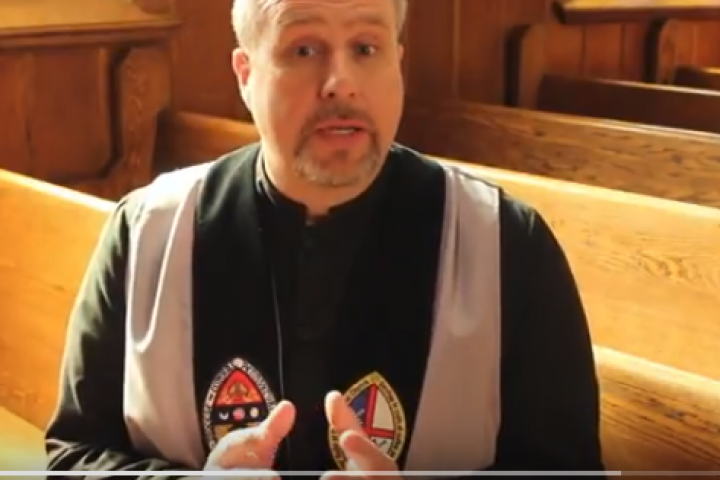
The gown or cape is a heavy garment and was really meant to be worn as a coat for protection from inclement weather and in a time when churches were unheated.  The Chimere (like the ones Mike and I wear) were adopted to simplify the gown and is something that can be worn comfortably in warmer weather.  It is similar to the Bishop’s Chimere, sleeveless, light, simple and yet distinctive. The main difference from the Bishop’s Chimere is the symbolic yoke around the collar and front panels.  Most times you will also see a patch on the Chimere for the Vergers Guild and another for the Diocese that the verger is a member of.

The Scapula is a very simple garment that is worn over the cassock.  It is just a long piece of fabric that drapes over the front and back of the wearer.  Many vergers have several of these and wear them in the color of the Liturgical Season of the Church.

In some Episcopal churches bands, tabs, collars and bowties are worn by both vergers and clergy.  There are many styles single tab, double tab, wide bands, bow ties for men and ruffles and a ruffled band called a Jabot for ladies.  They all were adapted from the scarf that clergy and vergers would wear to protect their necks when they traveled by horseback.  These ties represent the law of God when worn by the clergy, the law of the land when worn by officers of the court and the law of the church when worn by vergers.

Just like Bishop’s and Priest’s, vergers have head coverings that they can wear.  Where the Bishop has their Mitre and Priest’s have the Biretta, vergers have either the Oxford bonnet or the Canterbury cap to choose from.  The oxford bonnet is a round hat with a flat top that sits atop the head.  It is the same as the hat worn by the Yeomen of the Guard who protect the Tower of London.  The Canterbury cap is a square hat that fits tight to the head, the style derived from a hat worn in medieval time.  It gets its name from the Archbishop of Canterbury who wore a hat like it. Hats are not very poplar for vergers in the Episcopal Church but you will find in the Church of England bonnets and caps are worn quite often.

Like to know more, visit the verger’s webpage at vergers.org or on Facebook vergers of the Episcopal Church and our own vergers of central Pennsylvania.

Back to the Verger’s Voice!