The Little Church

IMG_6269
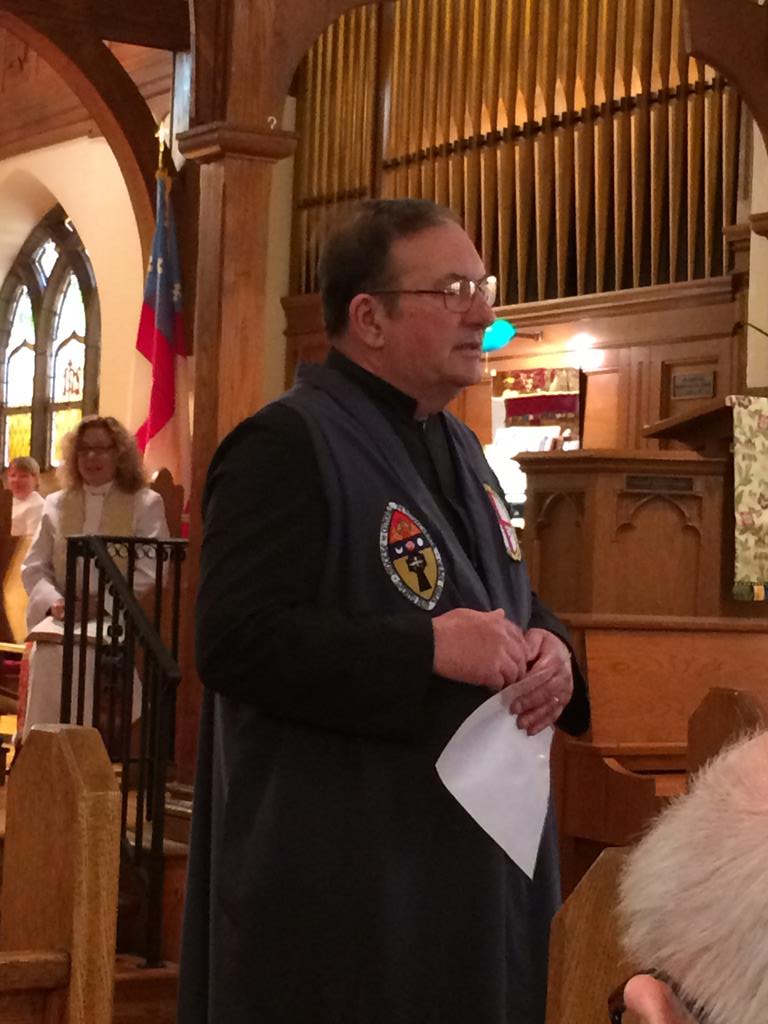
Mike tells the story of the “little Church”
IMG_6273
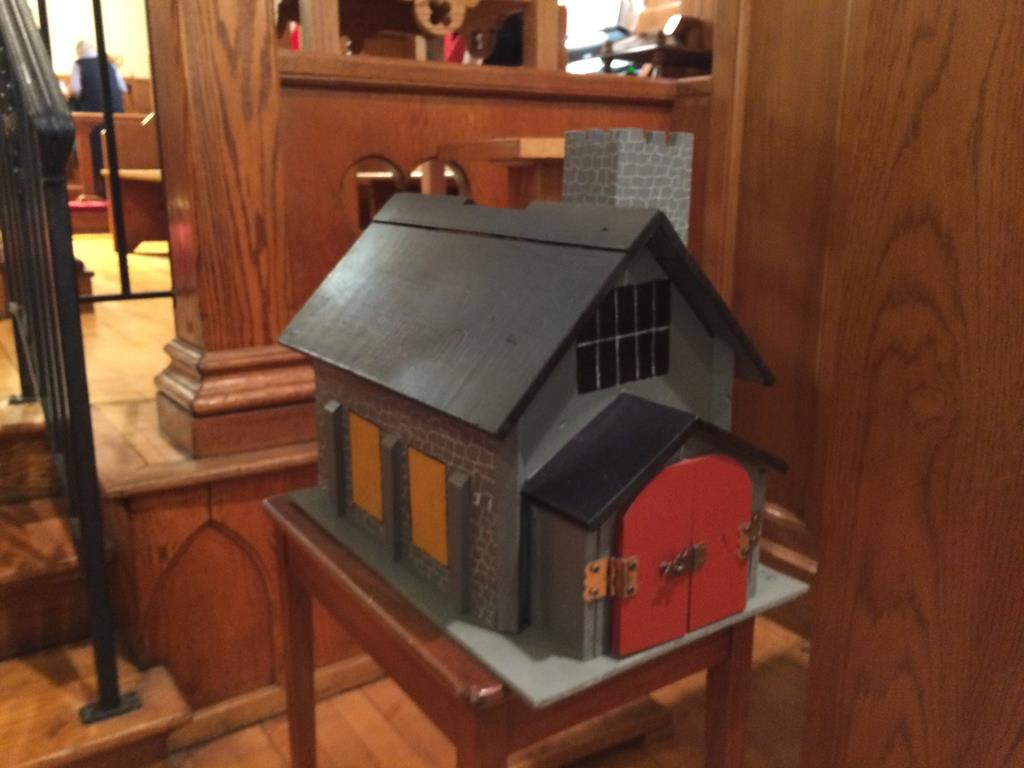
What a pretty “Little Church”
IMG_6271
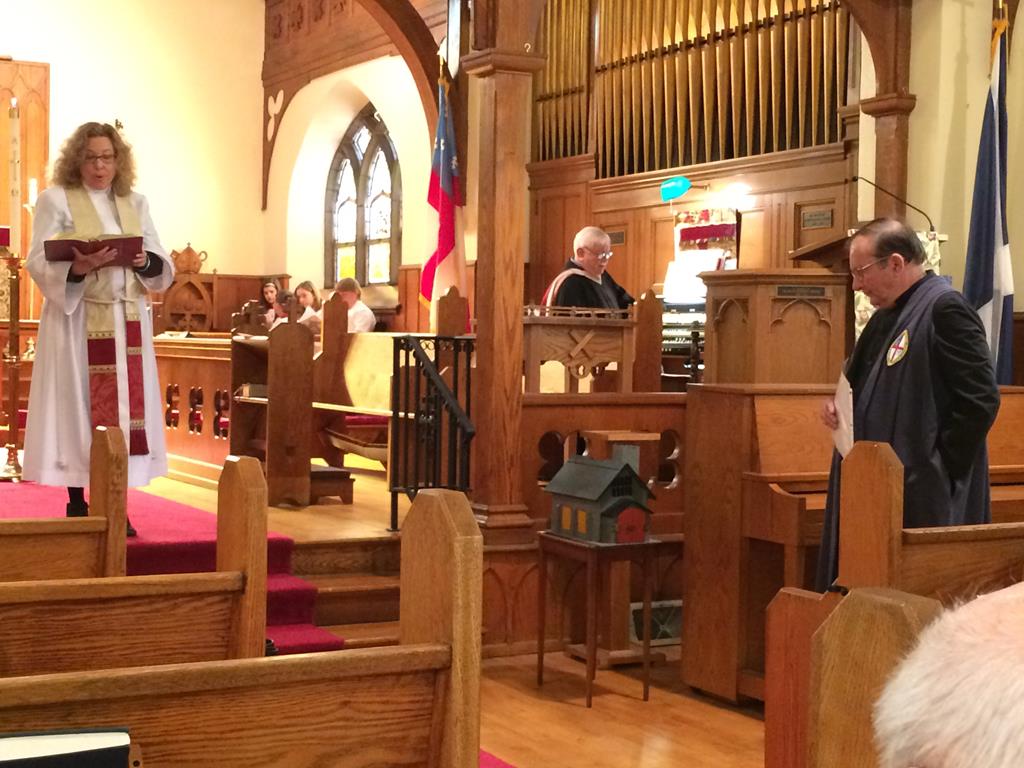
Mother Barbara blesses the “Little Church”

Mike Stitt today told the story of “The little Church” under the altar. The story was told in one of Mike’s Verger Voice Articles. It is a fantastic read, please click here to read it.


IMG_6274
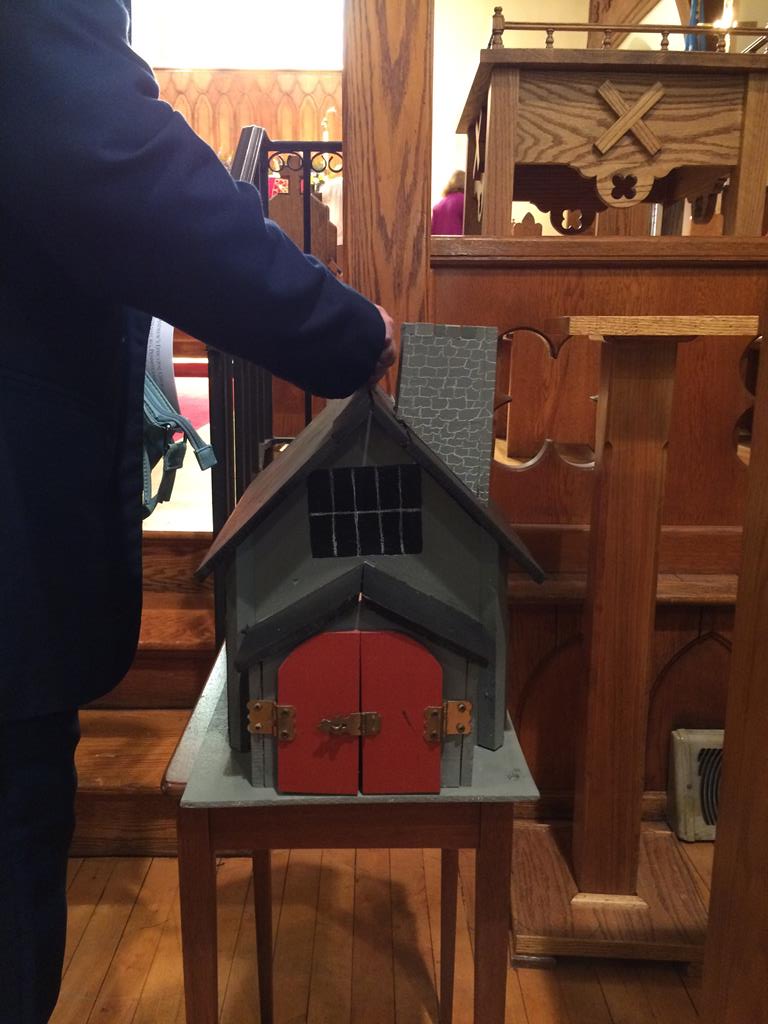
People shared of their treasures today and placed money in the “Little Church” to help fund the community meal ministry.

Below are some pictures of the event from the Service on April 3rd. The Little Church will be brought out once a month for special offeriengs that will be used to help fund the Community meals that St. Andrews give to the community.

Verger’s Voice Installment 30

THE THREE TREES

Once upon a time on a mountain very far away, there were three little trees who stood and dreamed of what they wanted to become when they grew up.

The first tree looked up at the stars and said: “I want to hold treasure, I want to be covered with gold and filled with precious stones. I will be the most beautiful treasure chest in the world.”

The second little tree looked out at the small stream trickling by on its way to the ocean. “I want to be traveling mighty waters and carrying powerful kings.  I will be the strongest ship in the world.”

The third little tree looked down into the valley below where busy men and women worked in a busy town. “I don’t want to leave the mountain top at all.  I want to grow so tall that when people stop to look at me, they will raise their eyes to heaven and think of God.  I will be the tallest tree in the world.”

Years passed, the rain came, the sun shone, and the little trees grew tall and strong. One day three woodcutters climbed the mountain.

The first woodcutter looked at the first tree and said, “This tree is beautiful. It is perfect for me.” With a swoop of his shining ax, the first tree fell. “Now I shall be made into a beautiful chest, I shall hold wonderful treasure!”, the first tree said.

He second woodcutter looked at the second tree and said, “ This tree is strong. It is perfect for me.” With a swoop of his shining ax, the second tree fell.  “Now I shall sail mighty waters” thought the second tree.  “I shall be a strong ship for mighty kings”

The third tree felt her heart sink when the last woodcutter looked her way. She stood straight and tall and pointed bravely to heaven.  But the woodcutter never even looked up.  “Any kind of tree will do for me” he muttered.  With a swoop of his shining ax, the third tree fell.

The first tree rejoiced when the woodcutter brought her to a carpenter’s shop. But the carpenter fashioned the tree into a feed box for the animals. The once beautiful tree was not covered with gold, and not filled with treasure.  She was coated with saw dust and filled with hay for hungry farm animals.

The second tree smiled when the woodcutter took her to a shipyard, but no mighty sailing ship was made that day. Instead the once strong tree was hammered and sawed into a simple fishing boat. She was too small and too weak to sail to an ocean, or even a river, instead she was taken to a little lake.

The third tree was confused when the woodcutter cut her into strong beams and left her in a lumberyard. “What happened?” the once tall tree wondered. “ All I ever wanted was to stay on the mountain top and point to God…”

Many days and nights passed , years come and went. The three trees nearly forgot their dreams.

Then one night, a golden starlight poured over the first tree as a young woman placed her newborn baby in the feed box. “I wish I could make a cradle for him”, her husband whispered. The mother squeezed his hand and smiled as the starlight shone on the smooth and sturdy wood. “ This manger is beautiful.” she said. And suddenly the first tree knew he was holding the greatest treasure in the world.

One evening a tired traveler and his friends crowded into the old fishing boat. The traveler fell asleep as the second tree quietly sailed out into the lake.  Soon a thundering and thrashing storm arose.  The little tree shuddered.  She knew that she did not have the strength to carry so many passengers safely through with the wind and the rain.  The tired man awakened.  He stood up, stretched out his hand, and said “Peace” The storm stopped as quickly as it had began.  And suddenly the second tree knew he was carrying the King of heaven and earth.

One Friday morning, the third tree was startled when her beams were yanked from the forgotten woodpile. She flinched as she was carried through an angry jeering crowd.  She shuddered when soldiers nailed a man’s hands to her. She felt ugly and harsh and cruel.

But, on Sunday morning, when the sun rose and the earth trembled with joy beneath her, the third tree knew that God’s love had changed everything. It made the third tree strong.  And every time people thought of the third tree, they would think of God.  That was better than being the tallest tree in the world.

Author: Unknown

Back to the Verger’s Voice!

Verger’s Voice Installment 29

THE LITTLE CHURCH UNDER THE ALTAR


For twenty years a little church lived under our Altar. The first five years after it was builtit was taken out the first Sunday of every month.  Then one Sunday it was forgotten and was never gotten out again.  The poor little church sat there under the Altar year after year with no purpose , not too many people even knew it was there or knew why. Then one day, just about this time of the year,  the little church was taken out from where it lived and dusted off.  The little church must have been excited thinking it would be used for a good cause again but alas it was just moved to a closet in the Sacristy.

Our little church is a model of St. Andrew’s. It is made of wood but the sides are gray like the stone walls, the roof is black like the slate and there are two red doors. It was built by Frank Kraker (Ivy Kraker’s husband) around 1995 and was used for donations for blessings for special events, like birthdays and anniversaries.  Frank was one of those people you could always count on for doing things like this. He was always doing something around the church and every Sunday as soon as the service ended you would find him picking up bulletins left in the pews and straightening the hymnals and BCP’s. The books had to be in just the right order and spaced just so.  When you wanted to hear a good story, Frank was the one to tell it.  If it took the men longer than necessary to get something done , it was because we wanted to hear the end of the story.  Frank was one of those people that was a verger of the church and just didn’t know it.

As said before, our little church was taken from it’s home under the Altar the first Sunday of the month and anyone having a birthday or anniversary that month could come forward for a blessing for their special day and a donation would be put in the church. The money would then be used to help families in the parish who may need help with expenses.  After about five years, less people were coming forward and the practice was discontinued.  The little church was left under the Altar until 2014 when we were getting ready for Maundy Thursday and it was taken out and put in a closet in the Sacristy.  This could have been the end of the story, our little church could have stayed in that closet for another twenty years with no one knowing it was there.  One person remembered the little church, remembered its purpose of helping people in need and suggested we use it again.

We are going to make our little church happy again. It is going to be cleaned and polished and given a purpose again.  For a short time it will be put back in it’s old home under the Altar. Then on the first Sunday in April it will be brought out and placed in it’s new home somewhere in the Nave.  Then each time you walk by remember why Frank made it and drop your spare change in, maybe a little more on your birthday.  All the proceeds will benefit our outreach projects like SPO, Community meals, Kings Kettle and the summer lunch program. Just think about all the people we will be helping and how happy our little church will be.

Back to the Verger’s Voice!

Verger’s Voice Installment 28

AN HOUR A DAY

I usually spend about an hour a day pecking away on the keyboard writing the verger’s voice, it has become one of my better habits. Although, some days I sit down at the computer and stare at the blank screen, my fingers are on the keyboard but nothing appears. Then there are other days when I can’t stop typing and two or three installments will be done before I know it.  These last couple of weeks has been one of those times when nothing appeared.  It is not like I have nothing to write about, in twenty-seven installments I haven’t even touched the history of our parish.  We still have two rectors to talk about (I’ll let Mother Barbara write her own history) and then there is the Episcopal Home and Episcopal Square.  I want to tell you about the bell in our tower, the Mary Garden, and the fireplace bricks.  There is so much I want to tell you about St. Andrew’s but the words just wouldn’t appear on the screen.

When I couldn’t will my fingers to type anything, I would work on sorting papers from our archives. Three file boxes and a few large cardboard boxes filled with papers, pictures and old records.  Old bulletins went in one pile, newspaper clippings in another and letters and pictures were put in smaller boxes.  Then as I began putting each pile in some type of order and putting each page in a notebook, I suddenly realized this wasn’t the time to write about our history but to show you. For the next few weeks you will find four white notebooks on one of the tables in the parish life center.   These books tell the story of St. Andrew’s better than I ever will.

The first book contains bulletins from years past. The oldest is from 1906 when the cornerstone was laid.  That had to be an exciting day as the masons laid the large stone and the Bishop set it with three taps of the hammer.  Then there is the bulletin from the soul/rock mass held here in the 60’s, can you imagine, rock and roll in an Episcopal church. Most of the others are from Christmas and Holy week through the years but be sure to look for a few other special services.

The second book has letters and papers that are very important to our history. Letters from 1903 that John Clifford Phillips wrote to arrange funding for St. Andrew’s.  Letters from the Bishops of the diocese and important papers to organize a mission here.  Letters and papers that show how we got to where we are today.  There is also a transcript from an interview that Deacon Janice Fritz and Father Ted Babcock had with Father Ron Lynch, this is a must read.

The third notebook is filled with newspaper clippings from over the years. Most are from the 40’s,50’s,  60’s and early 70’s when things in the church were big news.  Early articles are from the Harrisburg paper and the Churchman, writing about our beginnings here.  Father Lynch had a knack for getting his picture in the paper, so there is a whole section about his years here.  You will find things about building the PLC, the Episcopal Home and Episcopal Square and some of our members that made the news.  This book isn’t finished, as St. Andrew’s makes the news we will keep adding to its pages.

The last book is pictures I found, you can also find other picture albums in the library. For some of us it will be like looking at an old family album and for newer members you may see someone you just met. As your looking through this book feel free to pull a picture out and write a comment or add a name. If you have a picture you would like to add to the collection, just give it to one of the vergers.

My hope is that you will enjoy these notebooks as much as I enjoyed putting them together.

Back to the Verger’s Voice!

Verger’s Voice Installment 27

Our last Vicar, Our first Rector,

The Rev. Canon William F. Murphey has the unique distinction of being the last Vicar of the mission of St. Andrew’s and the first Rector of St. Andrew’s Episcopal Church. Father Murphey came to St. Andrew’s in 1984 to continue the work of Father Ron Lynch of building up the mission. Father Murphey worked tirelessly for the next eight years, when St. Andrew’s gained parish status in the Diocese of Central Pennsylvania.  Then served as Rector until his retirement in 1998.  Father Murphey served St. Andrew’s a total of fourteen years.

Bill Murphey is a native of Scranton, Pennsylvania. He graduated from Lehigh University and the Berkeley Divinity School at Yale.  He was ordained to the priest-hood at Trinity Church, Bethlehem, Pennsylvania in 1957.  Prior to coming to Shippensburg in 1984 Rev. Murphey served churches in Bethlehem, Catasaqua, Hanover, Wellsboro and Harrisburg.

For many years Father Murphey served as coordinator of youth activities in the Diocese. He also served on the standing committee and other organization of the Diocese. In 1991 he was made an Honorary Canon of St. Stephen’s Cathedral in recognition of his leadership and service to the Episcopal Diocese of Central Pennsylvania.

While living in Shippensburg he was a member of the board of directors of the Episcopal Home and the Episcopal Square and a member and past president of the Shippensburg Area Ministerial. He was also a member of the board of directors of the Shippensburg Foundation Summer Music Festival, a member of the Cumberland Valley Torch Club and the Shippensburg Rotary Club.

In 1997 Father Murphey and the members of the Vestry at the time saw the need to increase the size of the parish life center to make room for more classrooms, offices and activities. A Building to Serve Campaign, spearheaded by Father Murphey, Bob Rose, Walter Pledger, John Gregor and Wells Shoemaker raised $300,000 for the construction.  Father Murphey retired before the construction was finished, he did get to watch the progress from his home right next door. Then on November 29, 1998 he was asked to return with Rev. Lynch, Rev. William Neal of Chambersburg and Rev. Roy Turner, the interim rector for the dedication of the new section of the Parish Life Center.  A plaque was unveiled in the second floor hallway honoring Father Murphey for his service and dedication to the church.

Father Murphey was and still is a fun loving man of faith. Never without a smile on his face and a willingness to listen to a good joke.  He is the type of person that makes everyone happy just being in his presence. In many ways St. Andrew’s is the place it is due to the Rev. Canon William F. Murphey being our first Rector.

Back to the Verger’s Voice!

Verger’s Voice Installment 26

ARE YOU READY FOR LENT?

All of us have said, I am giving that up for Lent. It could be traditional things like meat, butter, sugar, eggs, milk and fish or it could be more modern items like ice cream, chocolate, cell phones, internet or television(like that’s going to happen). According to the gospels of Matthew, Mark, and Luke, Jesus Christ spent 40 days fasting in the desert, where he endured temptation by Satan.  Lent originated as a mirroring of this, fasting 40 days as a preparation for Easter.  Every Sunday was seen as a commemoration of the Sunday of Christ’s resurrection and so as a feast day on which fasting was inappropriate. Accordingly, Christians fasted from Monday to Saturday (6 days) during 6 weeks and from Wednesday to Saturday (4 days) in the preceding week, thus making up the number of 40 days.

Depending on what date Easter is, in any given year,( that’s another story,) Lent can start as early as the 4th of February and as late as the 10th of March.  This year it is the 10th of February, which is Ash Wednesday, the start of Lent. To get ourselves prepared for Lent we start with Shrove Tuesday.

What is Shrove Tuesday? The concept behind this practice is found in 1 Corinthians 9:27 , where the Apostle Paul states; “I buffet my body and make it my slave.” Ironically, Shrove Tuesday has evolved into a day of frivolity and indulgence, during which people participate in as much pleasure and self-gratification as they can ( think about the dozen donuts you will probably eat.) Originally, Shrove Tuesday was a three day celebration that started on Sunday and ended on Tuesday night with a large feast.  By the 20th century however, the event was restricted to the Tuesday observance.  It was about this time that Carnival became associated with Strove Tuesday, in part from the Spring Equinox celebrations that were practiced by the Romans and the ancient tribes of Europe.  The word “carnival” comes from the Latin carmem levare, meaning “ to take away the flesh”.  Public revelry and carousing became the tradition for Carnival around the world and as a result the Church restricted the observance to a single day.  For Anglicans, the name Shrove Tuesday is derived from the word “shrive” which means to confess and receive absolution.  The name denotes a period of cleansing wherein a person brings their lusts and appetites under subjection though abstention and self-sacrifice.

There is a variety of customs that have derived from different regions around Europe and the Americas.

England began the tradition of serving pancakes and for this reason the day is known as “Pancake Day”. It was a good way to use up as much milk, fat, and eggs as possible before Ash Wednesday.  In the UK pancake races form an important part of the Shrove Tuesday celebrations. It is a opportunity for large numbers of people to race down streets tossing pancakes.  The object of the race is to get to the finish line first, while carrying a frying pan and flipping a pancake as you run.  It all started in 1445, a woman of Olney heard the shriving bell (a church bell rung to call people to confession) while making pancakes and ran to the church in her apron, still clutching her frying pan.  The Olney pancake race is now world famous.

In Germany the day is called Faschingsdienstag and is filled with parties, parades, people in outlandish costumes and of course eating. Germany is where the fastnacht comes from, it is a very sweet raised dough that is fried and covered with sugar.  Here in the U.S., the fastnacht  is usually the same as a glazed donuts but a true fastnacht has no hole and is usually square.

In Eastern Europe and in many South American countries it is Carnival, the most famous being in Rio De Janiero.  Participants in parades, parties and balls wear masks and costumes many that are quite flamboyant and elaborate.  Rio has a parade of multi-colored feathers, which include hundreds of dancers dressed in costumes decked with feathers, all dancing the samba. The day is filled with eating, drinking, fortune telling and practical jokes.

We can thank France for Mardi Gras which means Fat Tuesday.  This is when all of the fat and fatty foods are consumed before Ash Wednesday. The most famous Mardi Gras is in New Orleans with all the balls, parties and parades but you will find  Mardi Gras being celebrated all over the south and even here at St. Andrew’s.

Then at midnight the parades are over, the parties end and Ash Wednesday starts. It is the first day of Lent and the beginning of forty days of fasting.  Ash Wednesday gets its name from the practice of blessing ashes made from palm branches blessed on the previous year’s Palm Sunday and placing them on the heads of participants to the accompaniment of the words “Remember that you are dust, and to dust you shall return”.  Some churches still sprinkle ashes on top of the head but  in modern day churches  a cross is marked on the worshipers forehead.  You can learn more about the Episcopal service for Ash Wednesday in the BCP on page 264.

I invite you, therefore, in the name of the Church, to the observance of a holy Lent, by self-examination and repentance; by prayer, fasting, and self-denial; and by reading and meditating on God’s holy Word.

As written in the BCP , page 265.

Have a Holy Lent.

Back to the Verger’s Voice!

Verger’s Voice Installment 25

THE GROWING YEARS—THE LAST VICARS OF ST. ANDREW’S

The 60’s and 70’s was not a good time for the Episcopal Church and St. Andrew’s was no exception.  Vietnam, racial tension, and changes in church policy all led to a decline in church attendance across the United States. The Rev. Ron Lynch was called to St. Andrew’s right in the middle of all this.  A young priest with little experience but with a lot of energy came to a church that the Diocese had given up on.  During the time after Father Wolfgang left, attendance had dwindled to 15 to 20 people, no college students were attending and the Episcopal Home was in decline.  The diocese told Father Lynch that if something wasn’t done the Church would be sold.

What Rev. Lynch lacked in experience as a priest, he more than made up for it in the knowledge he had for the people of the church, the college and the town.  In September of 1960 Ron Lynch started his college career at what was then Shippensburg State College.  He knew at the time that he wanted to be a priest in the Episcopal Church and that he would be going to seminary soon after graduation.  He sought out the nearest Episcopal Church and volunteered to do whatever he could.  He sang in the choir, helped Father Wolfgang with his ministry to the college students and anything else that needed done. During his time as a student at Shippensburg he played in the band as a percussionist, something that he would continue after returning as vicar at St. Andrew’s.

Ron Lynch grew up in Lewistown , Pa., and attended Lewistown High School, where he acquired a love of music.  He became a drummer in the high school band and after graduation, he joined the local Elks Band. After enlisting in the Air Force he became a member of the Air Force Drum and Bugle Corps and eventually was stationed in Japan.  While stationed there he became interested in being a missionary, after seeing the problems the practicing Christians there were facing.  However, a lack of a college education delayed his plans.  He was accepted at Shippensburg in 1960 and majored in business education.  After graduation he attended the Virginia Theological Seminary in Alexandria, Va.  While there he served as chaplain of the Episcopal Armed Forces Center in Washington and an internship as chaplain of the Iowa State Correctional School for Boys in Elnora, Iowa.  After graduating from seminary he was assigned as curate at St. John’s in York.  During his time in York, he served as a member of the advisory board of the York County Youth Council, as a counselor in two York youth centers and as acting chaplain for York College.

Father Lynch seemed to have a knack for self-promotion.  In his fifteen years at St. Andrew’s he took every opportunity to get his picture and the church in the news. Before and after every major improvement to the church, his work at the college, trips to Japan, playing in the college band and announcing at football games all seemed to become front page news.  When there wasn’t any headline news, he would take out large ads with his picture in the middle, telling everyone about the Episcopal Church and the upcoming services.  This might not be what the church is all about but it worked.  Things started happening, people started coming and St. Andrew’s was saved from being sold.

During Father Lynch’s time here he did see many improvements.  New lights and wiring were installed, thanks to the ECW. The floor in the Altar area was refinished, again thanks to the women of the church.

Money was raised to restore the stain glass and the interior of the church was repainted The Moller organ was repaired and updated with French trumpet pipes.  Thanks to Edith Jones, a bell was purchased and put in the bell tower by the men of the church.  The sign board was designed and build by Ray Stine and the first part of the Parish Life Center was designed by Doris Stine and built by Ray and members of St. Andrew’s. The church never had a pulpit but thanks to a memorial donation from the Mears family one was installed.  Then there was the bat problem but that was solved by a broom and some quick thinking by Ron.

Even though Father Lynch had a knack for self-promotion, he did work hard for the fame.  He expanded the ministry to the Episcopal Home and built up the Sunday school program.  Ministered to 125 Episcopal students at the college and was the adviser to the Canterbury club.  He spearheaded the Campus Christmas Mass here at St. Andrew’s and started a soul-rock mass here on Sundays. When he wasn’t busy with his duties for the church, he was the commissioner of parks and recreation for the town.  Then in the summer and fall he would trade his collar for a band uniform and march in the half time shows with the college band.  In 1976 he even marched with the university band in the inauguration day parade in Washington.  When the marching got to be too much he started announcing at the games.

In the fifteen years Father Lynch was here he was a great asset to the success of St. Andrew’s.  He was well liked and I am sure, missed when he left in 1984 to be the Chaplin at the Mississippi State Penitentiary.  He left a thriving church, ready to grow even larger with their new vicar.

Back to the Verger’s Voice!

Verger’s Voice Installment 24

The Vicar’s of St. Andrew’s

A Vicar, in the Episcopal Church, is a priest in charge of a mission congregation .  A mission church is one that is just starting or may not have the resources to be on its own.  The diocese provides most, if not all of the finances for the running of the church. The Bishop, as chief priest of the diocese, is considered the rector of the mission and he or she would appoint a vicar as a representative.

Between 1904, when St. Andrew’s was accepted as a mission, and 1992, when we became a parish, we have had 24 vicars.  Our first vicar was Rev. Collins who was also the rector of Trinity in Chambersburg, he held services in the Reform Church and also in private homes until St. Andrew’s was built.  He retired shortly after our church was finished and Rev. Trathen also from Trinity took over. After Rev. Trathen’s retirement, Rev. Chavasse continued the duties of both Trinity and St. Andrew’s.

Between 1912 and 1914 we had our first full time vicar, the Rev. David Pugh Griffith.  Rev. Griffith was a accomplished poet and author.  He was a member of the international Welsh musical and choral society, where he won many awards in their competitions.  He was also the author of the book “The Last of Quills”  a story of Welsh life in the late 1800’s.

On May 2,1915  Rev. John A. Miller was appointed vicar of St. Andrew’s.  Rev. Miller became ill shortly after starting his duties and was taken to a hospital in Philadelphia where is died on St. Andrew’s Day.  Rev. Miller was born in London and for a time was a priest of the Church of England. For many years he was the headmaster of Weymouth College.  He was awarded the freedom of the city award and the Archbishop of Canterbury by the command of Queen Victoria conferred the Academic Degree of B.D to Rev. Miller.

Over the next few years St. Andrew’s was served by vicars who came and went in rapid succession, many serving a year or less.  Some of this was due to the low membership and very low pay but while John Phillips was alive many young priests came here for the learning experience.  Then they would leave to go to larger churches.

In December 1923, the Rev. George D. Graeff became rector at Chambersburg and vicar of Sr. Andrew’s.  He gave the mission leadership for the next 26 years, but St. Andrew’s did not grow appreciably.  Since Rev. Graeff lived in Chambersburg, so there was no need for a rectory, he with the help of Mrs Philips, converted it into a small home for aged women who lived within, what was then, the Diocese of Harrisburg.

In 1949 the Rev. Carlton N. Jones became vicar.  He sought to make the mission viable and convert the home for the eight guests who lived there from an institution into a real home.  He used every occasion to make the diocese aware that such a home existed and urged it to give generously at Thanksgiving time to supply some of its needs.  Just in case you ever wondered how those envelopes in the bulletin in the weeks before Thanksgiving got started.  With the urging of Rev. Jones the diocese acquired the home from St. Andrew’s and decided that it should be enlarged to meet a growing need.  Rev. Jones died suddenly in April of 1954.

For the next six years St. Andrew’s was served by Rev. Anthony G. VanElden and the Rev. Arthur G. W. Pfafko.  These were retired priests who both lived in Blue Ridge Summit.

In 1960 the Bishop seeing a need for a resident vicar to serve the home, church and Episcopal students who were attending Shippensburg State College, now Shippensburg University, Bishop Heistand appointed the Rev. Ralph T. Wolfgang. Although legally blind Father Wolfgang ministered to the residents of the Episcopal Home, visited students in their dorms and other places on campus and preached every Sunday.   Rev. Wolfgang enjoyed music and translated the 1940 hymnal to braille.  I have been told that if you knew a line from a hymn Father Wolfgang could tell you the page number and what hymn it came from.  After a couple of years here Father Wolfgang’s wife got very ill and they decided to retire to Cherry Hill, New Jersey.  During retirement Rev. Wolfgang did supply work near where he lived and wrote two book about the history of the Diocese of Central Pennsylvania.

Our next vicar was the Rev. Paul Schwartz.  There are no records to show where he came from or what he did before arriving in Shippensburg.  He was a very soft spoken man, he wasn’t married but did live with his mother.  There wasn’t enough money for him to be here full time so he was shared with St. John’s in Carlisle and did campus ministry at Dickinson College.  Father Schwartz conducted the services here on Sunday and at the eight o’clock service he would preach while walking up and down the aisle. After a while he would stop and ask someone a question, it wasn’t long before everyone attended the late service where he preached from the pulpit.  Father Schwartz left in 1964 to become the chaplain at Elnora State School for Boys, a reformatory in Virginia.

St. Andrew’s was without a priest for quite some time until Rev. Alexander Fraser was appointed.  Little is known about Father Fraser other than he was married and had two daughters.  From all reports he wasn’t well liked.  It was reported that he wore a black cloak, that he never took off and rode a bicycle wherever he went.  Not much happened at the church during his time line other than stocking up with candles.  Father Fraser liked candles so he would go to different stores that sold candles and charge them to the church.  The church was candle poor.  Father Fraser was asked to leave in 1968.

By 1969 St. Andrew’s was in a bad situation.  We had no Priest, a dwindling congregation, the church was in a state of disrepair and very little money.  The diocese was ready to give up on us.  Our next two vicars turned all that around.  We will hear about that next week.

Back to the Verger’s Voice!

Vergers Voice Installment 23

THE DAY MINISTERS WERE INVENTED

While going through some old papers I found this article that I thought you may find interesting. It was in a Episcopal Church publication in the early 60’s , the author is unknown. It is meant to be funny but there is a lot of truth to it.  As we enter a new year let us resolve not to be a Mr. Sluphit, Mrs. Churchhill or Deacon Staid.

“The Day Ministers Were Invented”

I wasn’t there when ministers were invented but from what I’ve noticed in a lot of churches I’m quite sure of how it must have happened.

The church folk all got together one day for a business meeting.  After arguing about the social committee for about half an hour – they always argue about the social committee for about half an hour—they set their minds to worrying about the work of the church.

“I just haven’t time”, say Mr. Sluphit, “to waste visiting the sick.  My business has got me so bogged down I can hardly get in a good day of golf”.

This started things off. Others took the floor and gave heart warming testimonies of parties, television sets, hobbies, sports, dates, committees, and businesses.  It became quite apparent that no one had time to call on the needy, to comfort those in grief, to laugh with those that laugh and weep with those that weep, or to witness Christ to the condemned.  The church folk just didn’t have time.

“We must do something about it,” declared Mrs. Churchill.

“Well, we have always done it this way, “ put in Deacon Staid.  (He always said this about anything that came up for discussion, regardless of what it was.)

Mrs. Summit rose to her feet at that point and summed up the whole matter.  “It’s a problem,” she said, and then sat down again.

“And another thing,” added someone else, assuming that all agreed with Mrs. Summit, “in an organization of this size we make a lot of blunders. As it stands now we have no one except ourselves to blame, and that’s a mighty uncomfortable feeling.  Something ought to be done about this, too!”

“That isn’t all,” another put in.  “I for one have bad eyesight, and nothing strains my eyes more than reading the Bible.  After finishing the evening paper and relaxing by the television set for a couple of hours, I try to read a few verses but the print makes my eyes throb. It’ll ruin my health.”

Someone added that it was too great a bother to think about ethics and theology, and that it certainly would be nice if someone could do the thinking for them.

The whole church quickly saw the sad state of affairs and resolved that something must be done.  Then one fellow— it was the same one who thought of hiring the janitor— made a suggestion.  “Why don’t we hire a man or women for all these things” he said.

Everybody readily saw the logic in the suggestion.  They could hire a person to do their spiritual thinking and Bible study and then tell them about it every week.  The same person could be blamed for anything and everything that went wrong.  He or she could do all the visiting of the sick, the welcoming of strangers, the witnessing to the lost, and the comforting of the grief-stricken.  They could hire a person for all that and then forget about it.  And so, it was decided that they should get themselves a minister.

After this they all had coffee………………

Back to the Verger’s Voice!


Verger’s Voice Installment 22

DO YOU HEAR THE BELL RING?

The movie “The Polar Express” is an animated film about a bunch of children that are picked up by a magical train and taken to the North Pole to meet Santa Claus. If you have children, grandchildren or just like Christmas movies you must have seen it, just like I have, way to many times.  Anyway, the one young boy, who is not quite sure why he was invited onto the train, is having a hard time believing in Santa and this worries him. He hears his parents talking about Santa Claus, all his friends believe and his little sister is ready to burst with excitement.  He wants to believe, he really does, but he has never seen him, never touched his coat, oh sure the milk and cookies and the carrots for the reindeer are always gone, there are lots of presents under the tree but it’s hard to believe.  After an exciting trip, they finally reach the North Pole.  Of course, in movie land nothing goes smoothly and after getting lost in Santa’s factory and getting stuck in Santa’s sack of presents our group of heroes makes it back to the plaza where Santa will mount his sleigh. As the elves are finishing putting the tack on the reindeer, they bring out these long leather leads with bells every couple of inches.  The bells should be ringing but he doesn’t hear them. He knows there is nothing wrong with his hearing, he can hear everyone cheering but not the bells ringing.  Then all of a sudden Santa appears in a doorway some distance away but with the bright lights, all the elves dancing around and all the other children he still can’t quite see him. Then all of a sudden a bell comes loose and is bouncing towards him, he still doesn’t hear it but he picks it up. He holds it to his ear and says I believe, I believe, he shakes it and he hears the ring.  Just at that moment Santa Claus is standing right in front of him, he can see him, talk to him and touch his coat.

Don’t you wish our faith was that easy?  Just say I believe and ring a bell and everything is all well and good.  To have faith in God is hard work, you cannot just say the words you have to really believe in what you are saying.  No one has ever seen God, we can see his good works but we can’t touch his coat, we can’t sit at the same table and talk to him but we want to believe. The bad things happening in the world and hardships in our own lives make it hard but we still hear the bell.

A few years ago I read a book about a father who was on a camping trip with his wife, young son and daughter.  They were in a family campground where he thought his son and daughter were safe.  While the daughter was playing away from the family she was kidnapped. There was a massive search that ended at an old cabin.  Unfortunately, the girl was never found. The father became very bitter and angry, he was angry at himself, the person that did this and most of all God for letting this happen.  He prayed and prayed for an answer, for a reason to keep believing but he was so angry he couldn’t hear.  He decided to go back to the cabin alone to try to find some answers and hopefully the person that did this. The cabin was deep in a wooded area and as he approached he saw a dim light coming from inside. He decided to wait to see if he would see movement, but all of sudden he was surrounded by small lights darting about, pushing him to the cabin door.

As he reached the door, a large woman with dark skin opened the door, she smiled and welcomed him in. The room was nothing like what he had seen before, it was rustic but warm and the smell of dinner was coming from the kitchen.  She told him to sit at the table as she went back to her work of making biscuits. After a while she said, what do you seek? I want to see my daughter again, he said.  The women said, you will in time.  Just then the door opened and a young man entered.  He was tall, with a workman’s build and a light beard.  Then without warning a young women appeared, she was beautiful and seemed to float around the kitchen helping with dinner.  As the story goes on the man comes to realize that he was in the presence of the Holy Trinity. They talked, laughed and prayed together and the man learned to forgive and believe again.  He did see his daughter, not as a person but in spirit and she was happy.

Wouldn’t it nice to be able to do this.  To sit down to a meal with God, The Son and the Holy Spirit. To walk with them, talk with them and just reach out and touch their cloths, to know they are real.  I think when we believe in God, the Son and the Holy Spirit that they are with us every day.  Their presence can be felt surrounding us, their goodness can be seen in the good works that we do and the love we show to one another. We do not have to see them, touch them or hear their voices to know they are real, we just need to believe.

DO YOU HEAR THE BELL RING?

Back to the Verger’s Voice!


Verger’s Voice Installment 21

A CHRISTMAS STORY

Once upon a time, not too long ago, in a small town, not too far away, there lived a young priest tall and handsome who just wanted to help people.  He looked around the small town and saw the poor, the hungry, the lonely and said “there must be something that I can do”.  He went back to his small church and pondered on the question. “ It is almost Christmas, he said, I can’t leave these people alone and hungry on Christmas day”  So the next Sunday he stood in front of his congregation and announced that on Christmas day there would be no Christmas service as in the past, instead they would welcome the poor, feed the hungry and comfort the ones alone.  They looked in silence, thinking he has lost his mind, what is he thinking, Christmas is for family not for people we don’t know.  Then he continued, we as a church family who have so much need to show these people the love and support that they need this time of year and somehow that made sense.

Later on in the day a wise man asked the young priest, “so what’s the plan, how do we get this done?”

The priest answered, there isn’t a plan, it will just happen with God’s help and the Holy Spirit guiding us.  The wise man said but that’s crazy, God can do a lot of things but even he needs a plan.  The young priest said don’t worry the people will come, the food will be prepared and people will want to help.  On Christmas day the wise man stood back thinking this is going to be a disaster, the tables are set, the candles are lit but there will be no food and no one to eat it.  About that time, the door came open and people came with food, there was ham, sweet potatoes, corn and green beans. More people came with pies, cakes and cookies.  Later more people came, children with their parents, grandmothers and grandfathers and they said it was fun being at home and opening gifts but now we want to help.  The wise man didn’t feel so wise anymore, he said to himself, I think I have a lot to learn.

Later on more people came, people we didn’t know, they came because they were hungry, some were lonely, they came because an invisible thread pulled them to a church they didn’t know but somehow they knew they were supposed to be there. At first they were shy, a little nervous, they gazed at the big Christmas tree in the corner and may have thought of the empty corner at home. As they found a seat they were amazed at the china, silverware and cut glass.  The tablecloths and centerpieces with greens and candles. Then someone brought them a plate of food and they weren’t hungry anymore, someone else sat down with them and smiled and they were not alone.  As the day went on there was talking and laughter and a good time had by all.  They came as people we didn’t know, they left as friends and now part of our church family.

The young priest was Father Ted Babcock who started this Christmas tradition eight years ago.  Father Ted has a lot of faith in God and the people around him and he knew in his heart that it would happen the way it did and continue as long as it has. The small church of St. Andrew’s really isn’t so small any more but eight years later it still opens its doors to anyone who is pulled by that thread.  There are many stories of the people we have helped over the years and I hope and pray that it continues for many more years.  As for the wise man, well he is still learning but he is letting the Holy Spirit guide him a lot more.

Back to the Verger’s Voice!

Bread Making

bread3Once again it is that time of year when we have friends over for parties and dinners, and just have a wonderful time. But what about those who do not have a chance to go to parties or be among friends during the Christmas Season? As Christmas is quickly approaching us, I would like to take this opportunity to invite those who would like to join Ford and I in making bread to share with our friends in the community during the Christmas Day Dinner. We will be in the kitchen on December 22nd to make 65 loaves of bread that will be shared with those who attend the Christmas Day Dinner, any remaining loaves will be donated to the Episcopal Home for their consumption. I look forward to those who will be helping make these loaves of bread, and to seeing the fine people of our community on Christmas Day for dinner and good fellowship. Those who would like to help make bread can contact me through my email address: billgawors@ymail.com and I will get you on the list.