
Verger’s Talk – Your surroundings and your prayer
October 11,2015
Take a moment and look around. What does all this mean? Is there really an interaction between architecture or your surroundings and liturgy?
I have worshiped in many places over the years, on top of a mountain and inside a cavern. In large Cathedrals and Churches smaller than this. In Presbyterian, Lutheran, Brethren, and a Russian Orthodox Church. I even got to visit a Buddhist Temple. I attended a Jewish service in a butcher shop and prayed on top of a bunker as mortar shells came closer. Did my surroundings affect the way I felt?
On the mountain it was the silence, of being alone but not alone. The cavern it was the beauty of the stone made over millions of years one drop of water at a time. It was all the colors of the Cathedrals and in the small churches the closeness.
My knees hurt from standing through an hour and half service at the Russian Orthodox Church but it was one of the most moving services I have ever been too. The butcher shop experience was a little strange and on the bunker I was just plain scared.
What affect does St. Andrew’s have on you as you worship?
When you are coming up the walk and see the red doors. Do you start to feel safer knowing that those red doors means there is a safe haven just inside? Coming through the narthax do you feel the closest of a small church? In the Nave, which is the Latin word for ship, have you ever looked up and seen the bottom of a ship?
Have you really looked at the flags? The St. Andrew’s flag with the sky blue background and the cloud white X shaped cross. St Andrew was crucified on an X shaped cross because he felt unworthy to be put to death on the same type cross as Jesus.
The Episcopal Church flag was adopted in 1940 only 23 years after it was presented to the General Convention. You can’t say we Episcopalians hurry our decisions. The red cross on a white background is an ancient christian symbol, white representing the purity of Jesus and red representing his sacrifice on the cross and the blood of Christian martyrs. The light blue is traditionally the color of the Blessed Virgin Mary’s clothing and is symbolic of Jesus’ human nature. The X-shaped cross is the cross of St. Andrew who is the patron saint of Scotland and recalls the churches indebtedness to the Scottish Episcopal Church for consecration of our first Bishop. The nine smaller crosses represent the nine original American Dioceses.
The United States and Pennsylvania State flag. I like to to think that they are there to remind us of our freedom to be where we are and the sacrifice a lot of people made to insure that freedom.
Then there is all the wood. The panels with the St. Andrew and St. George crosses, the rood screen, the pews, the altar, floor, ceiling window sills and walls. 20,000 board feet of lumber went into making St. Andrew’s , that is a lot of trees.
They would have been old growth trees, maybe two or three hundred years old, cut down, sent to a mill to make the lumber that went into the making of this church. Was that God’s plan? After all, he planted the seeds, produced the water and sunshine to make the oak, chestnut and maple trees grow. Were those trees meant for this church? I think they were.
Have you really looked at the stained glass windows, beautiful aren’t they. They were made in England, somewhere around London. We know this from the color of the glass, since there were only a couple of companies that made that color of yellow. Why not just plain clear glass? It would have been less expensive, with more natural light and we could see the world outside. The idea behind stained glass and many other beautiful furnishings in Episcopal churches is that the presence of beautiful objects can lift our souls closer to God. When we look at stained glass we see God’s story played out in many different levels and when you think about it that is really not a bad way to look out at the world.
I have been around construction most of my life. I grew up playing in the sawdust piles of a shop that produced cabinets and furniture. I have helped build houses large and small and worked on building sites that covered several acres. So when I started attending here I noticed the hand-cut stone, the old style copper rain gutter, the strange little steps going to the ceiling. I also saw the craftsmanship that it took to make the pews, the rood screen, the altar and other carvings. I looked at the stained glass window above the altar and saw the sun shining in and lighting every ones faces and I thought God really knows what he is doing.
Liturgy is from a Greek word meaning “The Peoples Work”
So how does St. Andrew’s influence the way you work?
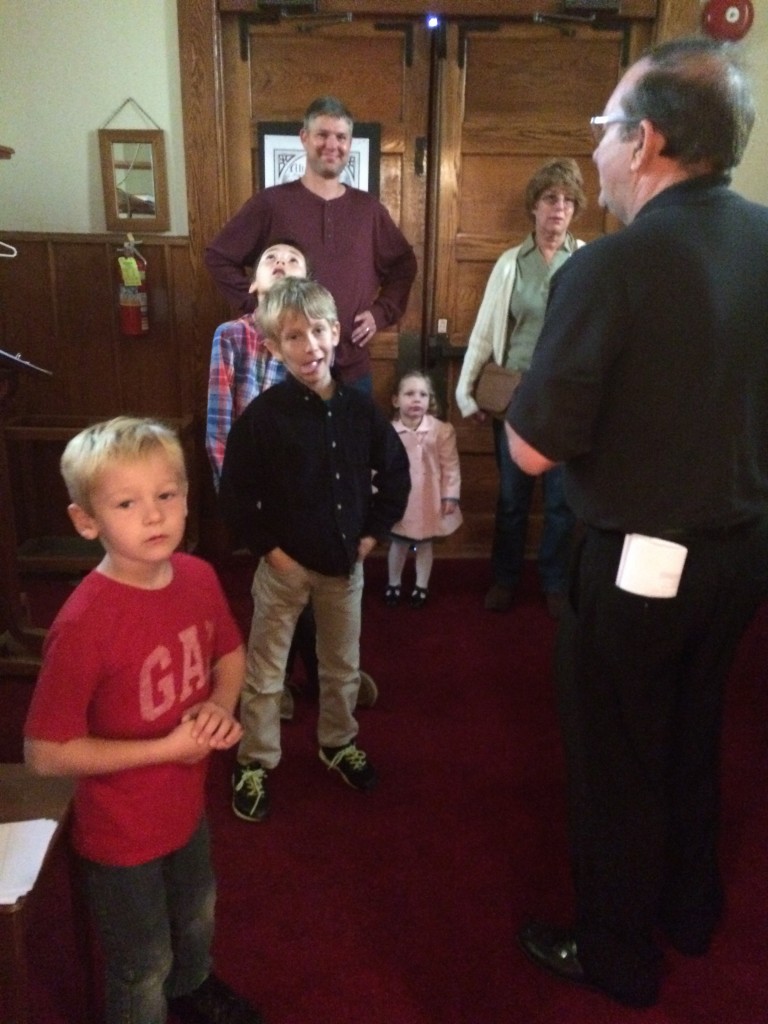
Michael Stitt FVGEC
VERGER, St. Andrew’s Episcopal Church
Shippensburg, PA